 Add to Chrome
 Add to Firefox
 Add to Edge
LBR: Towards Mitigating Length Bias in Large Language Models for Recommendation
Jul 05, 2026
Large language models (LLMs) have recently emerged as powerful backbones for recommender systems by reformulating recommendation as a token-level generation task. Despite their promise, we identify a pervasive yet underexplored issue: $\textit{Length Bias}$. Because items are represented by textual descriptions of varying lengths, LLM-based recommenders can be systematically biased in two ways. On the input side, longer item descriptions occupy more tokens in the context and thus receive disproportionately large aggregate attention mass during user preference modeling. On the output side, decoding based on summed autoregressive log-likelihood score inherently disfavors long items. Worse still, conventional length normalization can introduce an additional bias and even degrade recommendation performance. To address this problem, we propose $\textbf{LBR}$ ($\textbf{L}$ength $\textbf{B}$ias $\textbf{R}$eduction), a lightweight and model-agnostic framework for mitigating length bias in LLM-based recommendation. LBR mitigates input-side bias via Length-Aware Attention Calibration, which incorporates a length-dependent offset into attention logits to neutralize attention skew. For the output side, LBR introduces Effective Information Length Normalization, replacing naive token count with an information-theoretic length surrogate derived from the branching structure of the prefix tree. Extensive experiments on three real-world Amazon datasets and two representative LLM-based recommenders demonstrate that LBR substantially alleviates length bias while consistently improving recommendation accuracy and fairness, with negligible additional training and inference overhead (with an average NDCG@5 gain of 16.82%). The code is available at https://github.com/Void-JackLee/LBR.

Conditioning Matters: Stabilizing Inversion and Attention in Diffusion Image Editing
Jun 12, 2026Inversion-based image editing offers flexible and training-free control but still struggles with inversion accuracy and the trade-off between editing fidelity and background preservation. While recent methods improve inversion formulations or attention interactions, the role of textual conditioning in shaping diffusion dynamics and editing behavior remains underexplored. We show both empirically and theoretically that the precision of textual conditioning influences inversion stability by modulating the geometry of the diffusion velocity field, while also affecting the consistency of cross-branch attention during editing. These effects directly impact background preservation and semantic fidelity. Building on this analysis, we propose SimEdit, a conditioning-aware framework with two complementary components: (a) conditioning refinement, which constructs conditioning signals with improved semantic precision and structural alignment to facilitate stable inversion and consistent attention manipulation, and (b) token-wise cross-branch attention control, which separates edit-relevant and structure-preserving components and modulates them asymmetrically during attention manipulation. Extensive experiments on PIE-Bench demonstrate that SimEdit consistently improves both inversion reconstruction quality and editing performance over previous attention-manipulation approaches. Our code is available at https://github.com/zju-pi/SimEdit.
PlannerRFT: Reinforcing Diffusion Planners through Closed-Loop and Sample-Efficient Fine-Tuning
Jan 19, 2026Diffusion-based planners have emerged as a promising approach for human-like trajectory generation in autonomous driving. Recent works incorporate reinforcement fine-tuning to enhance the robustness of diffusion planners through reward-oriented optimization in a generation-evaluation loop. However, they struggle to generate multi-modal, scenario-adaptive trajectories, hindering the exploitation efficiency of informative rewards during fine-tuning. To resolve this, we propose PlannerRFT, a sample-efficient reinforcement fine-tuning framework for diffusion-based planners. PlannerRFT adopts a dual-branch optimization that simultaneously refines the trajectory distribution and adaptively guides the denoising process toward more promising exploration, without altering the original inference pipeline. To support parallel learning at scale, we develop nuMax, an optimized simulator that achieves 10 times faster rollout compared to native nuPlan. Extensive experiments shows that PlannerRFT yields state-of-the-art performance with distinct behaviors emerging during the learning process.
Risk Map As Middleware: Towards Interpretable Cooperative End-to-end Autonomous Driving for Risk-Aware Planning
Aug 11, 2025End-to-end paradigm has emerged as a promising approach to autonomous driving. However, existing single-agent end-to-end pipelines are often constrained by occlusion and limited perception range, resulting in hazardous driving. Furthermore, their black-box nature prevents the interpretability of the driving behavior, leading to an untrustworthiness system. To address these limitations, we introduce Risk Map as Middleware (RiskMM) and propose an interpretable cooperative end-to-end driving framework. The risk map learns directly from the driving data and provides an interpretable spatiotemporal representation of the scenario from the upstream perception and the interactions between the ego vehicle and the surrounding environment for downstream planning. RiskMM first constructs a multi-agent spatiotemporal representation with unified Transformer-based architecture, then derives risk-aware representations by modeling interactions among surrounding environments with attention. These representations are subsequently fed into a learning-based Model Predictive Control (MPC) module. The MPC planner inherently accommodates physical constraints and different vehicle types and can provide interpretation by aligning learned parameters with explicit MPC elements. Evaluations conducted on the real-world V2XPnP-Seq dataset confirm that RiskMM achieves superior and robust performance in risk-aware trajectory planning, significantly enhancing the interpretability of the cooperative end-to-end driving framework. The codebase will be released to facilitate future research in this field.
Reinforced Refinement with Self-Aware Expansion for End-to-End Autonomous Driving
Jun 11, 2025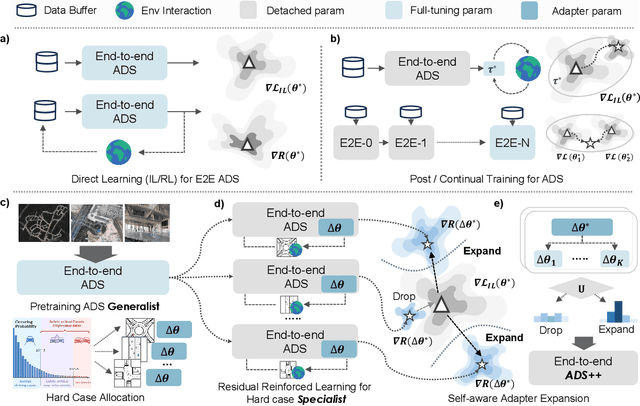
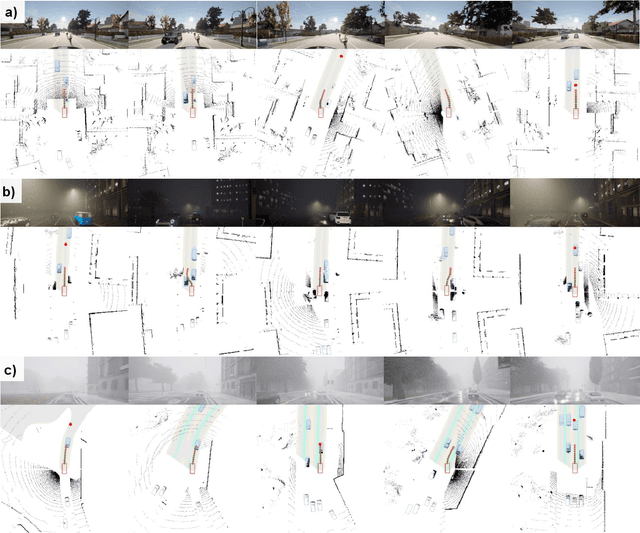
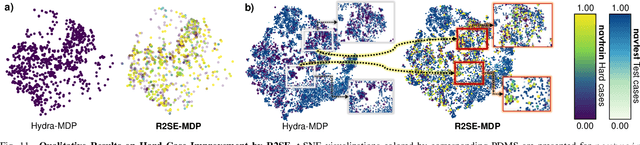
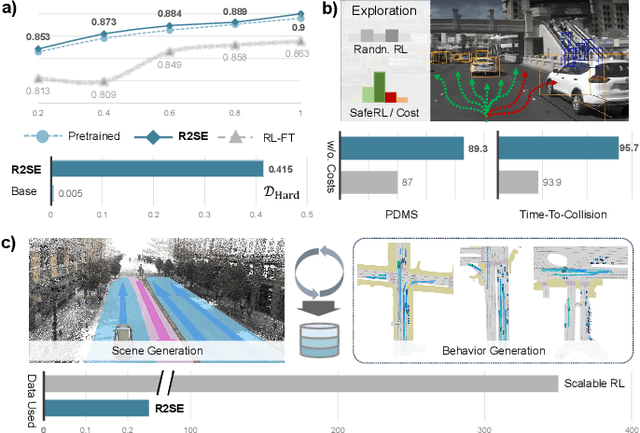
End-to-end autonomous driving has emerged as a promising paradigm for directly mapping sensor inputs to planning maneuvers using learning-based modular integrations. However, existing imitation learning (IL)-based models suffer from generalization to hard cases, and a lack of corrective feedback loop under post-deployment. While reinforcement learning (RL) offers a potential solution to tackle hard cases with optimality, it is often hindered by overfitting to specific driving cases, resulting in catastrophic forgetting of generalizable knowledge and sample inefficiency. To overcome these challenges, we propose Reinforced Refinement with Self-aware Expansion (R2SE), a novel learning pipeline that constantly refines hard domain while keeping generalizable driving policy for model-agnostic end-to-end driving systems. Through reinforcement fine-tuning and policy expansion that facilitates continuous improvement, R2SE features three key components: 1) Generalist Pretraining with hard-case allocation trains a generalist imitation learning (IL) driving system while dynamically identifying failure-prone cases for targeted refinement; 2) Residual Reinforced Specialist Fine-tuning optimizes residual corrections using reinforcement learning (RL) to improve performance in hard case domain while preserving global driving knowledge; 3) Self-aware Adapter Expansion dynamically integrates specialist policies back into the generalist model, enhancing continuous performance improvement. Experimental results in closed-loop simulation and real-world datasets demonstrate improvements in generalization, safety, and long-horizon policy robustness over state-of-the-art E2E systems, highlighting the effectiveness of reinforce refinement for scalable autonomous driving.