 Add to Chrome
 Add to Firefox
 Add to Edge
Red-Teaming Vision-Language-Action Models via Quality Diversity Prompt Generation for Robust Robot Policies
Mar 12, 2026
Vision-Language-Action (VLA) models have significant potential to enable general-purpose robotic systems for a range of vision-language tasks. However, the performance of VLA-based robots is highly sensitive to the precise wording of language instructions, and it remains difficult to predict when such robots will fail. To improve the robustness of VLAs to different wordings, we present Q-DIG (Quality Diversity for Diverse Instruction Generation), which performs red-teaming by scalably identifying diverse natural language task descriptions that induce failures while remaining task-relevant. Q-DIG integrates Quality Diversity (QD) techniques with Vision-Language Models (VLMs) to generate a broad spectrum of adversarial instructions that expose meaningful vulnerabilities in VLA behavior. Our results across multiple simulation benchmarks show that Q-DIG finds more diverse and meaningful failure modes compared to baseline methods, and that fine-tuning VLAs on the generated instructions improves task success rates. Furthermore, results from a user study highlight that Q-DIG generates prompts judged to be more natural and human-like than those from baselines. Finally, real-world evaluations of Q-DIG prompts show results consistent with simulation, and fine-tuning VLAs on the generated prompts further success rates on unseen instructions. Together, these findings suggest that Q-DIG is a promising approach for identifying vulnerabilities and improving the robustness of VLA-based robots. Our anonymous project website is at qdigvla.github.io.

Discount Model Search for Quality Diversity Optimization in High-Dimensional Measure Spaces
Jan 03, 2026Quality diversity (QD) optimization searches for a collection of solutions that optimize an objective while attaining diverse outputs of a user-specified, vector-valued measure function. Contemporary QD algorithms focus on low-dimensional measures because high-dimensional measures are prone to distortion, where many solutions found by the QD algorithm map to similar measures. For example, the CMA-MAE algorithm guides measure space exploration with a histogram in measure space that records so-called discount values. However, CMA-MAE stagnates in domains with high-dimensional measure spaces because solutions with similar measures fall into the same histogram cell and thus receive identical discount values. To address these limitations, we propose Discount Model Search (DMS), which guides exploration with a model that provides a smooth, continuous representation of discount values. In high-dimensional measure spaces, this model enables DMS to distinguish between solutions with similar measures and thus continue exploration. We show that DMS facilitates new QD applications by introducing two domains where the measure space is the high-dimensional space of images, which enables users to specify their desired measures by providing a dataset of images rather than hand-designing the measure function. Results in these domains and on high-dimensional benchmarks show that DMS outperforms CMA-MAE and other black-box QD algorithms.
Autonomous Vehicle Visual Signals for Pedestrians: Experiments and Design Recommendations
Oct 10, 2020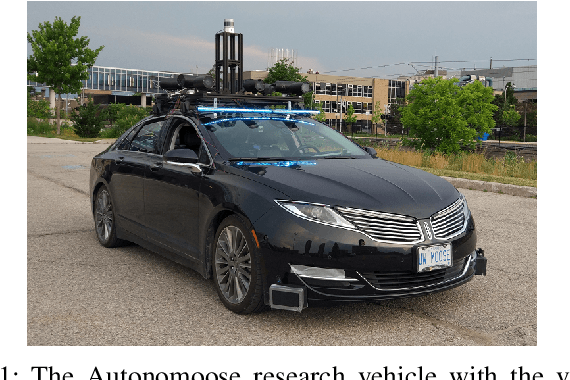
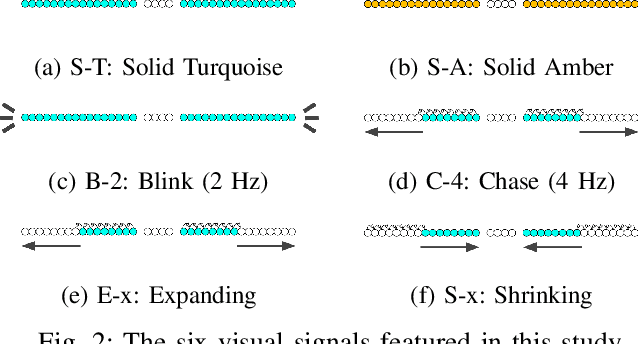
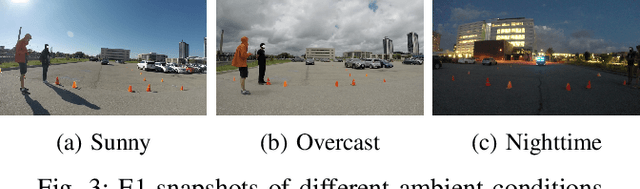
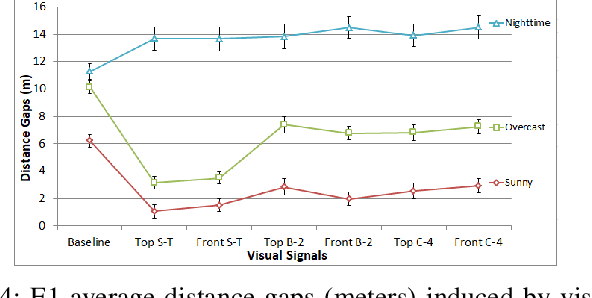
Autonomous Vehicles (AV) will transform transportation, but also the interaction between vehicles and pedestrians. In the absence of a driver, it is not clear how an AV can communicate its intention to pedestrians. One option is to use visual signals. To advance their design, we conduct four human-participant experiments and evaluate six representative AV visual signals for visibility, intuitiveness, persuasiveness, and usability at pedestrian crossings. Based on the results, we distill twelve practical design recommendations for AV visual signals, with focus on signal pattern design and placement. Moreover, the paper advances the methodology for experimental evaluation of visual signals, including lab, closed-course, and public road tests using an autonomous vehicle. In addition, the paper also reports insights on pedestrian crosswalk behaviours and the impacts of pedestrian trust towards AVs on the behaviors. We hope that this work will constitute valuable input to the ongoing development of international standards for AV lamps, and thus help mature automated driving in general.