 Add to Chrome
 Add to Firefox
 Add to Edge
Red-Teaming Vision-Language-Action Models via Quality Diversity Prompt Generation for Robust Robot Policies
Mar 12, 2026
Vision-Language-Action (VLA) models have significant potential to enable general-purpose robotic systems for a range of vision-language tasks. However, the performance of VLA-based robots is highly sensitive to the precise wording of language instructions, and it remains difficult to predict when such robots will fail. To improve the robustness of VLAs to different wordings, we present Q-DIG (Quality Diversity for Diverse Instruction Generation), which performs red-teaming by scalably identifying diverse natural language task descriptions that induce failures while remaining task-relevant. Q-DIG integrates Quality Diversity (QD) techniques with Vision-Language Models (VLMs) to generate a broad spectrum of adversarial instructions that expose meaningful vulnerabilities in VLA behavior. Our results across multiple simulation benchmarks show that Q-DIG finds more diverse and meaningful failure modes compared to baseline methods, and that fine-tuning VLAs on the generated instructions improves task success rates. Furthermore, results from a user study highlight that Q-DIG generates prompts judged to be more natural and human-like than those from baselines. Finally, real-world evaluations of Q-DIG prompts show results consistent with simulation, and fine-tuning VLAs on the generated prompts further success rates on unseen instructions. Together, these findings suggest that Q-DIG is a promising approach for identifying vulnerabilities and improving the robustness of VLA-based robots. Our anonymous project website is at qdigvla.github.io.

Algorithmic Prompt Generation for Diverse Human-like Teaming and Communication with Large Language Models
Apr 04, 2025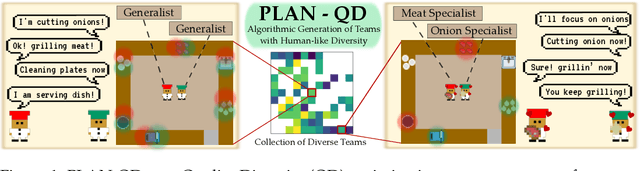
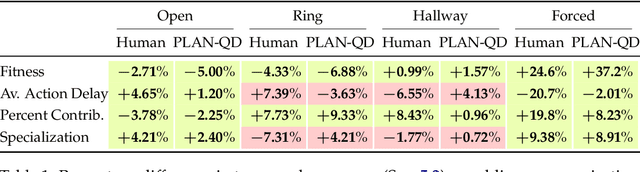
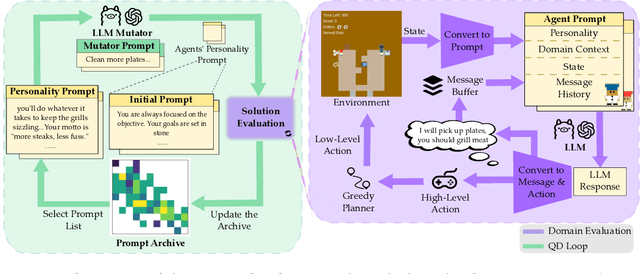

Understanding how humans collaborate and communicate in teams is essential for improving human-agent teaming and AI-assisted decision-making. However, relying solely on data from large-scale user studies is impractical due to logistical, ethical, and practical constraints, necessitating synthetic models of multiple diverse human behaviors. Recently, agents powered by Large Language Models (LLMs) have been shown to emulate human-like behavior in social settings. But, obtaining a large set of diverse behaviors requires manual effort in the form of designing prompts. On the other hand, Quality Diversity (QD) optimization has been shown to be capable of generating diverse Reinforcement Learning (RL) agent behavior. In this work, we combine QD optimization with LLM-powered agents to iteratively search for prompts that generate diverse team behavior in a long-horizon, multi-step collaborative environment. We first show, through a human-subjects experiment (n=54 participants), that humans exhibit diverse coordination and communication behavior in this domain. We then show that our approach can effectively replicate trends from human teaming data and also capture behaviors that are not easily observed without collecting large amounts of data. Our findings highlight the combination of QD and LLM-powered agents as an effective tool for studying teaming and communication strategies in multi-agent collaboration.