 Add to Chrome
 Add to Firefox
 Add to Edge
Autoregression-Free Neural Operators for Time-Dependent PDEs
May 28, 2026
Neural operators learn mappings from function-dependent inputs to solutions, providing an effective framework for solving partial differential equations (PDEs). For time-dependent PDEs, existing methods typically perform long-horizon prediction through autoregressive rollout directly in high-dimensional physical field spaces, where each predicted state is recursively fed back as the input for the next step. Although effective for short-term prediction, this autoregressive rollout and the lack of continuous-time modeling lead to progressive error accumulation over long-horizon rollouts. In this work, we propose Autoregression-Free Neural Operators (AFNO), which map the time evolution of PDEs into a latent space and model continuous-time vector fields within it. AFNO uses flow matching to learn the latent vector field, thereby enabling continuous evolution over extended horizons, avoiding autoregressive rollout and capturing dynamics under varying parameter configurations through explicit conditioning on physical parameters. Theoretical analysis and extensive experiments on six PDEs demonstrate that AFNO improves long-horizon prediction stability and consistently reduces rollout errors compared with the baselines.

Understanding Chain-of-Thought in Large Language Models via Topological Data Analysis
Dec 22, 2025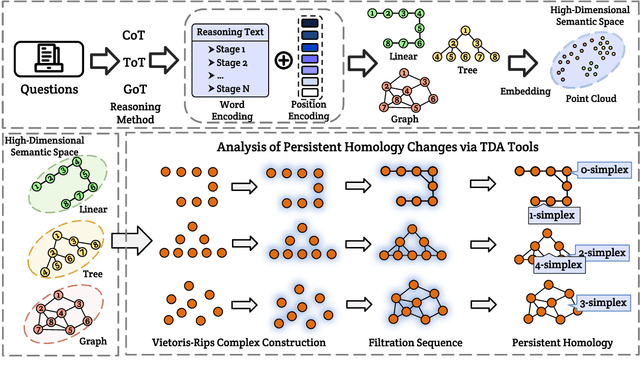
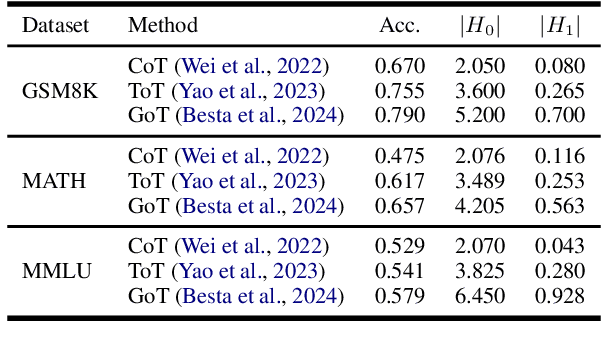
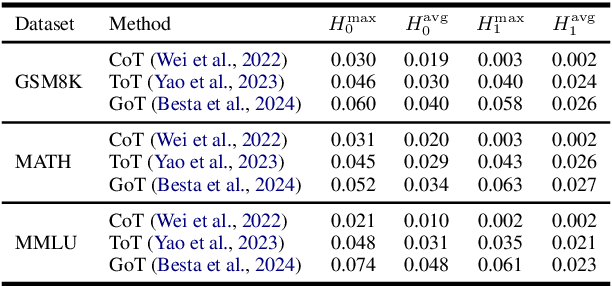
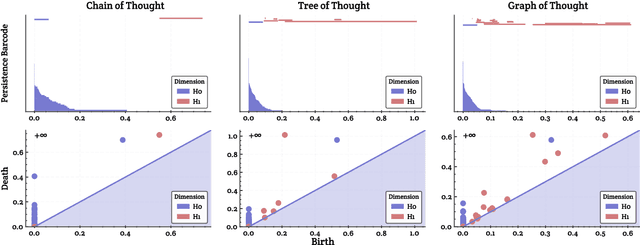
With the development of large language models (LLMs), particularly with the introduction of the long reasoning chain technique, the reasoning ability of LLMs in complex problem-solving has been significantly enhanced. While acknowledging the power of long reasoning chains, we cannot help but wonder: Why do different reasoning chains perform differently in reasoning? What components of the reasoning chains play a key role? Existing studies mainly focus on evaluating reasoning chains from a functional perspective, with little attention paid to their structural mechanisms. To address this gap, this work is the first to analyze and evaluate the quality of the reasoning chain from a structural perspective. We apply persistent homology from Topological Data Analysis (TDA) to map reasoning steps into semantic space, extract topological features, and analyze structural changes. These changes reveal semantic coherence, logical redundancy, and identify logical breaks and gaps. By calculating homology groups, we assess connectivity and redundancy at various scales, using barcode and persistence diagrams to quantify stability and consistency. Our results show that the topological structural complexity of reasoning chains correlates positively with accuracy. More complex chains identify correct answers sooner, while successful reasoning exhibits simpler topologies, reducing redundancy and cycles, enhancing efficiency and interpretability. This work provides a new perspective on reasoning chain quality assessment and offers guidance for future optimization.