 Add to Chrome
 Add to Firefox
 Add to Edge
Sample-efficient Transfer Reinforcement Learning via Adaptive Reward Shaping and Policy-Ratio Reweighting Strategy
Jun 25, 2026
Transfer learning improves policy learning efficiency by reusing knowledge from source tasks, providing a feasible paradigm for safe and efficient autonomous highway lane changing decision-making. Existing methods frequently encounter transfer mismatch induced by distribution shifts between source and target domains, leading to training oscillation and performance decline. Besides, target domain adaptation depends on exploratory interactions, which struggles to guarantee training safety in safety-critical lane changing cases. To tackle these limitations, this paper proposes a safe transfer reinforcement learning framework for autonomous highway lane changing. First, we design an adaptive teacher intervention mechanism based on instantaneous safety cost to restrain risky exploration and fade intervention strength progressively, with theoretical analysis on return bounds for mixed behavior policy. This intervention also produces dual-source samples for joint training. Second, a teacher-guided safe transfer module embeds action evaluation information of teacher policy into student learning via reward shaping to boost training safety and efficiency, with teacher guidance decaying as policy safety rises. Third, a teacher-guided weighted optimization mechanism adjusts sample weights in policy optimization using a likelihood ratio factor to stabilize transfer performance. Experiments under varied traffic densities and validations on real-world NGSIM dataset reveal that our method surpasses baseline approaches by over 52.2% in safety and 5.0% in learning efficiency. Results verify the efficacy and robustness of our safety-aware transfer strategy for autonomous highway lane changing under various traffic conditions.

AccidentGPT: Accident Analysis and Prevention from V2X Environmental Perception with Multi-modal Large Model
Dec 29, 2023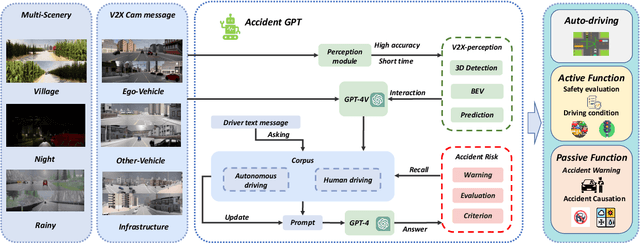
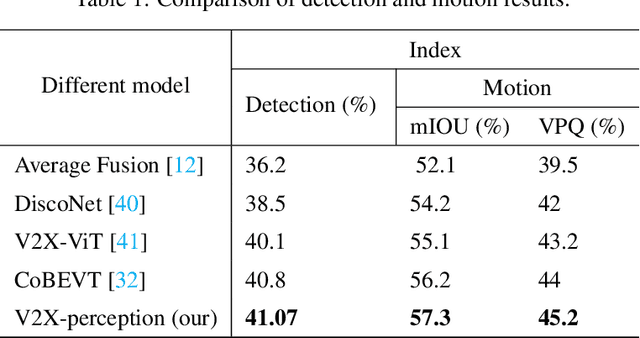
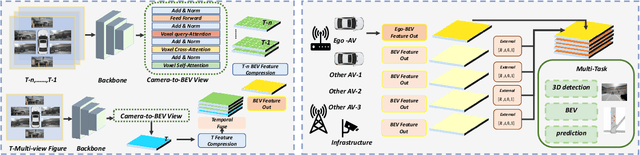
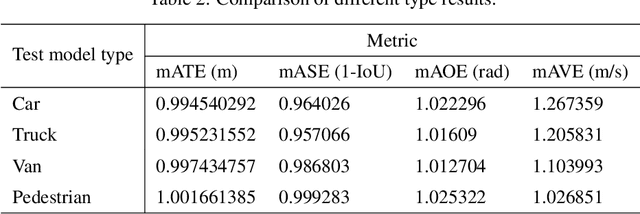
Traffic accidents, being a significant contributor to both human casualties and property damage, have long been a focal point of research for many scholars in the field of traffic safety. However, previous studies, whether focusing on static environmental assessments or dynamic driving analyses, as well as pre-accident predictions or post-accident rule analyses, have typically been conducted in isolation. There has been a lack of an effective framework for developing a comprehensive understanding and application of traffic safety. To address this gap, this paper introduces AccidentGPT, a comprehensive accident analysis and prevention multi-modal large model. AccidentGPT establishes a multi-modal information interaction framework grounded in multi-sensor perception, thereby enabling a holistic approach to accident analysis and prevention in the field of traffic safety. Specifically, our capabilities can be categorized as follows: for autonomous driving vehicles, we provide comprehensive environmental perception and understanding to control the vehicle and avoid collisions. For human-driven vehicles, we offer proactive long-range safety warnings and blind-spot alerts while also providing safety driving recommendations and behavioral norms through human-machine dialogue and interaction. Additionally, for traffic police and management agencies, our framework supports intelligent and real-time analysis of traffic safety, encompassing pedestrian, vehicles, roads, and the environment through collaborative perception from multiple vehicles and road testing devices. The system is also capable of providing a thorough analysis of accident causes and liability after vehicle collisions. Our framework stands as the first large model to integrate comprehensive scene understanding into traffic safety studies. Project page: https://accidentgpt.github.io