 Add to Chrome
 Add to Firefox
 Add to Edge
Sample-efficient Transfer Reinforcement Learning via Adaptive Reward Shaping and Policy-Ratio Reweighting Strategy
Jun 25, 2026
Transfer learning improves policy learning efficiency by reusing knowledge from source tasks, providing a feasible paradigm for safe and efficient autonomous highway lane changing decision-making. Existing methods frequently encounter transfer mismatch induced by distribution shifts between source and target domains, leading to training oscillation and performance decline. Besides, target domain adaptation depends on exploratory interactions, which struggles to guarantee training safety in safety-critical lane changing cases. To tackle these limitations, this paper proposes a safe transfer reinforcement learning framework for autonomous highway lane changing. First, we design an adaptive teacher intervention mechanism based on instantaneous safety cost to restrain risky exploration and fade intervention strength progressively, with theoretical analysis on return bounds for mixed behavior policy. This intervention also produces dual-source samples for joint training. Second, a teacher-guided safe transfer module embeds action evaluation information of teacher policy into student learning via reward shaping to boost training safety and efficiency, with teacher guidance decaying as policy safety rises. Third, a teacher-guided weighted optimization mechanism adjusts sample weights in policy optimization using a likelihood ratio factor to stabilize transfer performance. Experiments under varied traffic densities and validations on real-world NGSIM dataset reveal that our method surpasses baseline approaches by over 52.2% in safety and 5.0% in learning efficiency. Results verify the efficacy and robustness of our safety-aware transfer strategy for autonomous highway lane changing under various traffic conditions.

Efficient Reservoir Computing using Field Programmable Gate Array and Electro-optic Modulation
Feb 11, 2021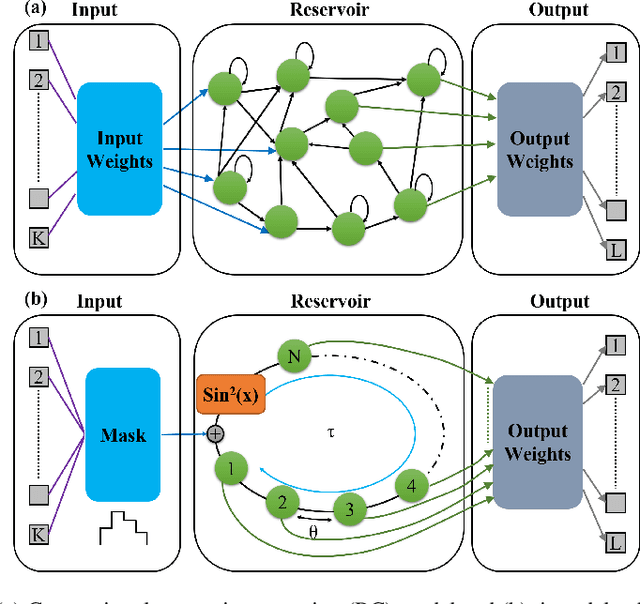
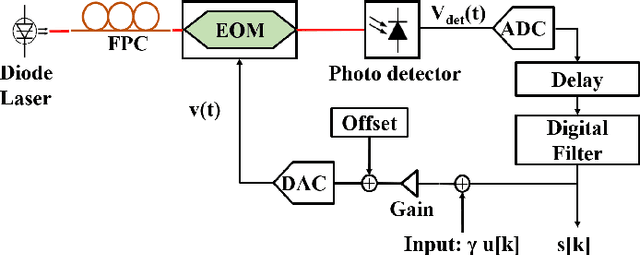
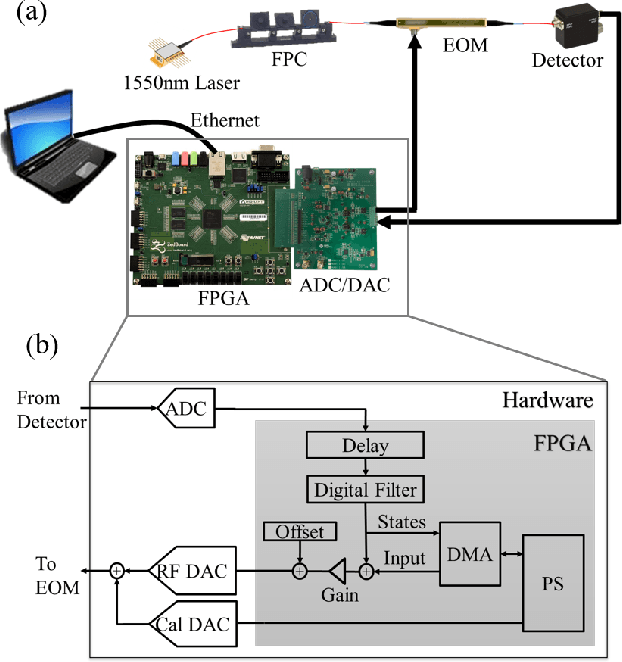
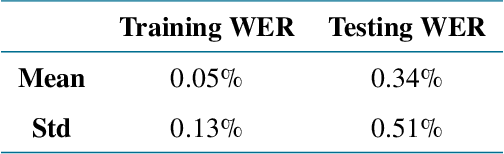
We experimentally demonstrate a hybrid reservoir computing system consisting of an electro-optic modulator and field programmable gate array (FPGA). It implements delay lines and filters digitally for flexible dynamics and high connectivity, while supporting a large number of reservoir nodes. To evaluate the system's performance and versatility, three benchmark tests are performed. The first is the 10th order Nonlinear Auto-Regressive Moving Average test (NARMA-10), where the predictions of 1000 and 25,000 steps yield impressively low normalized root mean square errors (NRMSE's) of 0.142 and 0.148, respectively. Such accurate predictions over into the far future speak to its capability of large sample size processing, as enabled by the present hybrid design. The second is the Santa Fe laser data prediction, where a normalized mean square error (NMSE) of 6.73x10⁻³ is demonstrated. The third is the isolate spoken digit recognition, with a word error rate close to 0.34%. Accurate, versatile, flexibly reconfigurable, and capable of long-term prediction, this reservoir computing system could find a wealth of impactful applications in real-time information processing, weather forecasting, and financial analysis.