 Add to Chrome
 Add to Firefox
 Add to Edge
MuEvo: LLM-Driven Evolution of Multi-Heuristic Ensemble
Aug 04, 2026
Large language model-based automated heuristic design (LLM-AHD) has shown strong potential in discovering effective heuristics for combinatorial optimization problems. However, existing methods primarily optimize a single heuristic, whereas practical optimization frameworks often rely on multiple interacting components. Directly extending single-heuristic methods is challenging because early component selection can overlook components with late potential, while independent evolution ignores inter-component dependencies. We propose MuEvo, an LLM-driven framework for evolving heuristic ensembles under ensemble-level feedback. MuEvo combines Dynamic Component Management, which uses short-budget probing and a reversible lifecycle to revise component priorities throughout the search, with LLM-Driven Co-Evolution, which coordinates component populations through Multi-Ensemble Evaluation, Cross-Component Information Sharing, Relation-Guided Pair Evolution, and Adaptive Budget Allocation. We evaluate MuEvo on selection hyper-heuristics and componentized ant colony optimization across four combinatorial optimization domains. Results show that MuEvo consistently improves human-designed frameworks and outperforms representative multi-component extensions of state-of-the-art LLM-AHD methods, demonstrating its effectiveness across both controller-mediated heuristic pools and functionally differentiated algorithmic components.

Cooperative Coevolution for Resource-Constrained Agentic LLM Post-Training
Aug 03, 2026Tool-using large language model (LLM) agents produce long, multi-turn trajectories, making gradient-based post-training memory-intensive. Evolution strategies (ES) enable memory-efficient full-parameter post-training without backpropagation and can eventually match the performance of gradient-based reinforcement learning (RL). However, resource-constrained settings typically offer only a few GPUs, so the high GPU-hour requirements of ES translate into prohibitively long training times. To address this, we introduce Cooperative Parameter-subspace Evolution Strategy (CoPES), a cooperative coevolutionary method that decomposes the full parameter space into lower-dimensional subspaces and searches over them cooperatively to improve optimization efficiency. We post-train a Qwen3.5-4B tool-using agent for the math task and evaluate it on five benchmarks of varying difficulty. Under the GPU-hour budget of full-parameter GRPO's best validation checkpoint, CoPES recovers 92% of GRPO's validation-accuracy gain, versus 67% for standard ES, while its theoretical GPU memory requirement is less than one-eighth that of full-parameter GRPO. It consistently outperforms standard ES and LoRA-based GRPO on all evaluated pass@k metrics across the five benchmarks. Additional experiments further show the advantage of CoPES on the question-answering task. These results demonstrate an improved trade-off between memory requirements and training time for agentic LLM post-training under resource constraints. The code is open-sourced in https://github.com/MetaronWang/CoPES
Large Language Model-Driven Cooperative Operator Ensemble Evolution for Permutation Flow Shop Scheduling
Jun 16, 2026The permutation flow shop scheduling problem (PFSP) is a classical NP-hard combinatorial optimization problem in intelligent manufacturing. In practice, PFSP is commonly addressed using metaheuristic algorithms, among which the iterated greedy (IG) algorithm is widely adopted due to its simplicity and strong empirical performance. However, classical IG relies on a single fixed destruction operator, which often limits exploration and leads to search stagnation on large and complex problem instances. To address this issue, this work proposes a multi-operator IG algorithm, termed IG-DOE, which enhances exploration by switching among heterogeneous destruction operators along a single search trajectory. The core mechanism, called stagnation-triggered sequential switching, activates the next destruction operator in an ordered destruction operator ensemble (DOE) when stagnation is detected, thereby enriching the perturbation behavior of classical IG. Moreover, to reduce reliance on expert-crafted operators, a large language model (LLM)-assisted framework, termed SCOE, is introduced to automatically construct a high-quality DOE through stagewise evolution, state-awareness, and cooperative evaluation. Experiments on the challenging VRF-hard-large benchmark show that the DOE evolved from smaller problem instances generalizes well to larger unseen instances. Under the same CPU-time limit, IG-DOE obtained much better average performance than QIG, a state-of-the-art IG algorithm. Additional experiments on real-world industrial-data-derived instances further show that the evolved DOE can generalize effectively to different data distributions without additional adaptation.
Policy and World Modeling Co-Training for Language Agents
Jun 01, 2026Reinforcement learning (RL) improves large language model (LLM) agents by teaching them which actions lead to high rewards, but provides little supervision on what those actions do to the environment. World modeling (WM) can fill this gap, yet existing approaches often require separate simulators, extra training stages, or additional inference-time computation. We observe that on-policy RL rollouts already contain the needed signal: each transition pairs an action with its resulting next observation. Based on this observation, we propose PaW, a Policy and World modeling co-training framework that adds auxiliary WM supervision to the same policy during RL, without changing the inference paradigm. To make auxiliary WM supervision informative and stable, PaW introduces three components: action-entropy-based WM data selection, noise-tolerant WM loss, and reward-adaptive loss balancing. Experiments on three agentic task benchmarks show consistent improvements over strong RL baselines across models and RL algorithms. These results suggest that standard RL rollouts are a practical source of WM supervision for language-agent training.
Cascaded Large-Scale TSP Solving with Unified Neural Guidance: Bridging Local and Population-based Search
Jan 24, 2025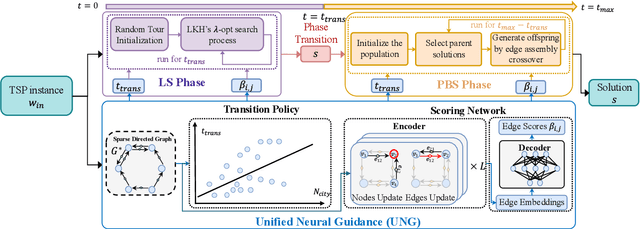
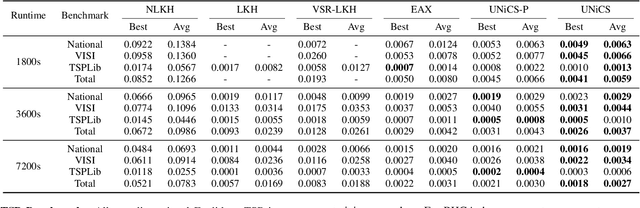
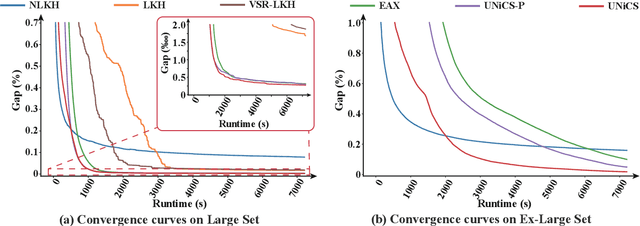
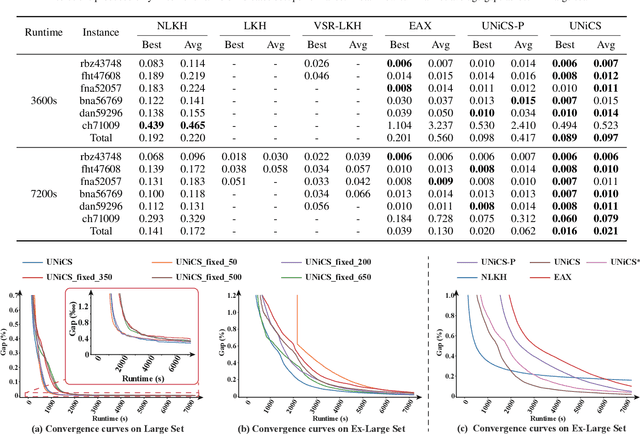
The traveling salesman problem (TSP) is a fundamental NP-hard optimization problem. This work presents UNiCS, a novel unified neural-guided cascaded solver for solving large-scale TSP instances. UNiCS comprises a local search (LS) phase and a population-based search (PBS) phase, both guided by a learning component called unified neural guidance (UNG). Specifically, UNG guides solution generation across both phases and determines appropriate phase transition timing to effectively combine the complementary strengths of LS and PBS. While trained only on simple distributions with relatively small-scale TSP instances, UNiCS generalizes effectively to challenging TSP benchmarks containing much larger instances (10,000-71,009 nodes) with diverse node distributions entirely unseen during training. Experimental results on the large-scale TSP instances demonstrate that UNiCS consistently outperforms state-of-the-art methods, with its advantage remaining consistent across various runtime budgets.