 Add to Chrome
 Add to Firefox
 Add to Edge
Large Language Model-Driven Cooperative Operator Ensemble Evolution for Permutation Flow Shop Scheduling
Jun 16, 2026
The permutation flow shop scheduling problem (PFSP) is a classical NP-hard combinatorial optimization problem in intelligent manufacturing. In practice, PFSP is commonly addressed using metaheuristic algorithms, among which the iterated greedy (IG) algorithm is widely adopted due to its simplicity and strong empirical performance. However, classical IG relies on a single fixed destruction operator, which often limits exploration and leads to search stagnation on large and complex problem instances. To address this issue, this work proposes a multi-operator IG algorithm, termed IG-DOE, which enhances exploration by switching among heterogeneous destruction operators along a single search trajectory. The core mechanism, called stagnation-triggered sequential switching, activates the next destruction operator in an ordered destruction operator ensemble (DOE) when stagnation is detected, thereby enriching the perturbation behavior of classical IG. Moreover, to reduce reliance on expert-crafted operators, a large language model (LLM)-assisted framework, termed SCOE, is introduced to automatically construct a high-quality DOE through stagewise evolution, state-awareness, and cooperative evaluation. Experiments on the challenging VRF-hard-large benchmark show that the DOE evolved from smaller problem instances generalizes well to larger unseen instances. Under the same CPU-time limit, IG-DOE obtained much better average performance than QIG, a state-of-the-art IG algorithm. Additional experiments on real-world industrial-data-derived instances further show that the evolved DOE can generalize effectively to different data distributions without additional adaptation.

Invariant Random Forest: Tree-Based Model Solution for OOD Generalization
Dec 20, 2023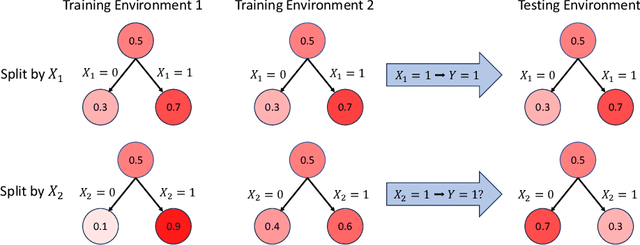



Out-Of-Distribution (OOD) generalization is an essential topic in machine learning. However, recent research is only focusing on the corresponding methods for neural networks. This paper introduces a novel and effective solution for OOD generalization of decision tree models, named Invariant Decision Tree (IDT). IDT enforces a penalty term with regard to the unstable/varying behavior of a split across different environments during the growth of the tree. Its ensemble version, the Invariant Random Forest (IRF), is constructed. Our proposed method is motivated by a theoretical result under mild conditions, and validated by numerical tests with both synthetic and real datasets. The superior performance compared to non-OOD tree models implies that considering OOD generalization for tree models is absolutely necessary and should be given more attention.
Decorr: Environment Partitioning for Invariant Learning and OOD Generalization
Nov 18, 2022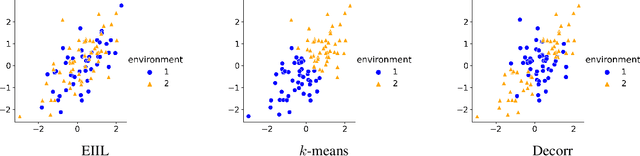
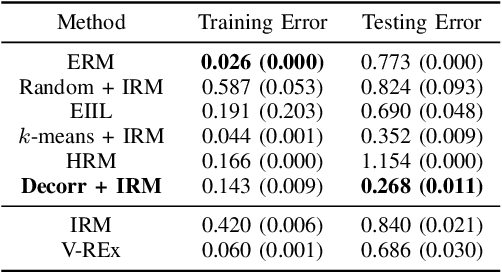
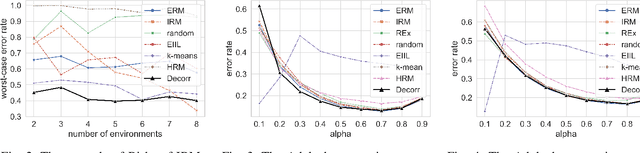
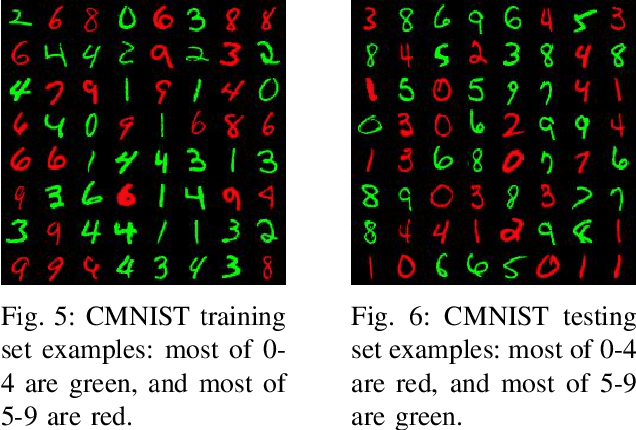
Invariant learning methods try to find an invariant predictor across several environments and have become popular in OOD generalization. However, in situations where environments do not naturally exist in the data, they have to be decided by practitioners manually. Environment partitioning, which splits the whole training dataset into environments by algorithms, will significantly influence the performance of invariant learning and has been left undiscussed. A good environment partitioning method can bring invariant learning to applications with more general settings and improve its performance. We propose to split the dataset into several environments by finding low-correlated data subsets. Theoretical interpretations and algorithm details are both introduced in the paper. Through experiments on both synthetic and real data, we show that our Decorr method can achieve outstanding performance, while some other partitioning methods may lead to bad, even below-ERM results using the same training scheme of IRM.
The Brain-Inspired Decoder for Natural Visual Image Reconstruction
Jul 18, 2022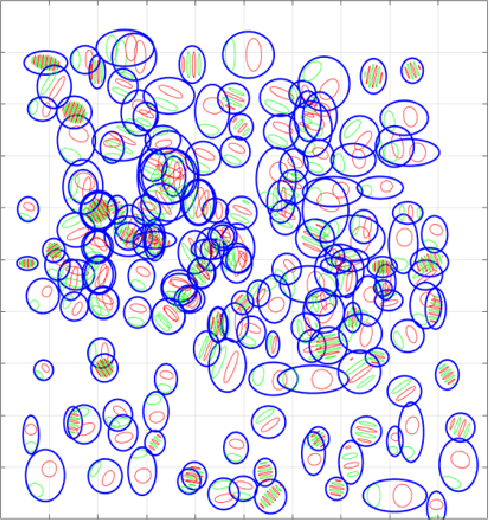
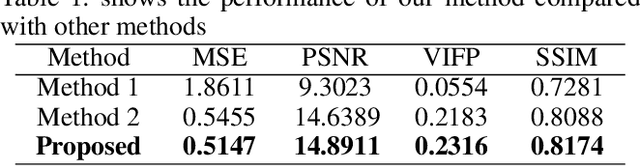
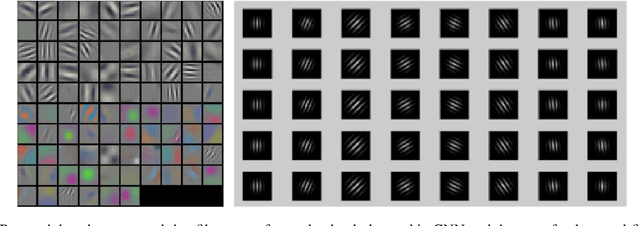
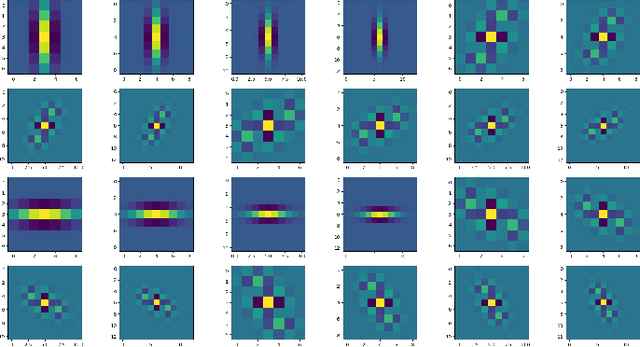
Decoding images from brain activity has been a challenge. Owing to the development of deep learning, there are available tools to solve this problem. The decoded image, which aims to map neural spike trains to low-level visual features and high-level semantic information space. Recently, there are a few studies of decoding from spike trains, however, these studies pay less attention to the foundations of neuroscience and there are few studies that merged receptive field into visual image reconstruction. In this paper, we propose a deep learning neural network architecture with biological properties to reconstruct visual image from spike trains. As far as we know, we implemented a method that integrated receptive field property matrix into loss function at the first time. Our model is an end-to-end decoder from neural spike trains to images. We not only merged Gabor filter into auto-encoder which used to generate images but also proposed a loss function with receptive field properties. We evaluated our decoder on two datasets which contain macaque primary visual cortex neural spikes and salamander retina ganglion cells (RGCs) spikes. Our results show that our method can effectively combine receptive field features to reconstruct images, providing a new approach to visual reconstruction based on neural information.