 Add to Chrome
 Add to Firefox
 Add to Edge
SMOPD: Multi-Reward Reinforcement Learning via Specialize-and-Merge Online Policy Distillation
Aug 04, 2026
We aim to improve model performance in multi-reward reinforcement learning training process. Existing Group reward-Decoupled Normalization Policy Optimization (GDPO) has mitigated the issue of reward signals masking one another during direct scalarization by normalizing each reward dimension separately before aggregation. However, our experiments show that GDPO still struggles to balance reward signals with different granularities. Specifically, in some particular training tasks, the model may receive a dense reward that assigns fine-grained scores ranging from 0.1 to 1.0, together with a sparse reward that provides only binary feedback of either 0 or 1. In such cases, we find that the sparse reward may provide an insufficient optimization signal, preventing its corresponding capability from being effectively reinforced. Therefore, how can we strengthen the optimization signal from the sparse reward without sacrificing the capability already learned from the fine-grained reward? To overcome this limitation, we propose Specialize-and-Merge Online Policy Distillation (SMOPD), a two-stage training method for multi-reward optimization. Stage1-Specialize: SMOPD first employs reward-priority configurations to train multiple reward-specialized teachers, allowing each reward to be learned under conditions where its signal can effectively drive optimization. Stage2-Merge: SMOPD then utilizes online policy distillation to combine the reward-specialized capabilities of these teachers into a single student policy, while maintaining balanced task-level optimization. To validate our method, we conduct experiments on two multi-reward settings: complementary rewards(tool-calling accuracy and format) and conflicting rewards (helpful and harmless rewards). Based on above settings, SMOPD outperforms GDPO across 1.5B, 3B and 7B backbones.

PixVL: Self-Supervised Training of Pixel-Level MLLMs via a Unified Mask--Text Consistency Cycle
Aug 02, 2026Recent studies develop pixel-level multimodal large language models (MLLMs) that support both Region Segmentation and Region Understanding, extending multimodal interaction from whole images to specific objects and regions. However, these methods face two fundamental challenges. First, the scarcity of high-quality mask--text pairs leaves abundant mask annotations without corresponding language supervision. Second, discrepancies in supervision formats and learning-signal densities induce optimization interference between Region Segmentation and Region Understanding. To address these challenges, we propose PixVL, a self-supervised post-training framework that introduces a unified Mask--Text Consistency Cycle, enabling pixel-level MLLMs to generate and self-verify regional descriptions and learn from unlabeled data. We found that direct cycle based solely on geometric reconstruction is unreliable because re-segmentation IoU does not faithfully reflect the semantic quality and referring sufficiency. PixVL therefore introduces confuser-aware semantic verification, which uses the model's confidence when it correctly chooses the target among highly similar candidate regions, and assigns zero reward to an incorrect choice. Meanwhile, PixVL performs cross-view verification using temporally separated video frames or geometrically transformed image views, preventing cyclic learning from collapsing to positional and shape shortcuts. Finally, a quality-coupled bidirectional learning strategy uses the highest-reward description to guide Text-to-Mask learning. This strategy transforms Region Understanding and Region Segmentation from competing tasks into mutual generators and verifiers. Experiments demonstrate that PixVL improves both region understanding task and segmentation task.
SoccerNet 2026 Challenges Results
Jul 08, 2026The SoccerNet 2026 Challenges constitute the sixth annual edition of the SoccerNet open benchmarking effort, dedicated to advancing computer vision research in sports video understanding. This year's challenges span five vision-based tasks: (1) Ball Action Anticipation, predicting the timing and class of ball-related actions within a short future window from a preceding observation window; (2) Player-Centric Ball Action Spotting, temporally localizing and classifying ball-related actions while assigning each action to the acting player through team affiliation and jersey number; (3) Novel View Synthesis, rendering images from unobserved camera poses in multi-view football scenes; (4) Spiideo SoccerNet Synloc, localizing athletes in real-world pitch coordinates from a single calibrated static-camera image; and (5) Visual Question Answering, answering multiple-choice questions about football broadcasts across text, image, and video inputs. For each task, participants were provided with annotated data, a unified evaluation protocol, and a public baseline. This edition saw broad participation, with 427 teams submitting 1,129 entries across the five tasks and 28 teams contributing reviewed technical reports. This paper describes each task and its evaluation protocol, presents the challenge leaderboards, and summarizes the leading submissions, with the aim of documenting the current state of each task as measured on held-out challenge data.
GPS-Enhanced Tourist Mobility Modeling with Seasonal Spatial Priors and LLM-Based Activity Chain Generation
May 28, 2026Tourist mobility poses a distinct challenge for urban transportation planning. Unlike resident commuting, tourist travel is largely non-routine, attraction driven, and highly sensitive to trip purpose, travel season, and trip member composition. Existing approaches either measure aggregate tourist spatial patterns without generating individual schedules, or synthesize mobility without tourist specific structure such as trip duration conditioning, month varying attraction demand, and household co-travel rules. To address these challenges, we propose a four stage simulation framework combining month conditioned spatial priors derived from GPS and survey data, trip extent prediction from tourist demographics, distance feasible ward sequence assignment, and LLM-based activity chain generation under household and spatial constraints. GPS data are used only in privacy preserving aggregated form as month conditioned spatial priors, with no individual traces retained or exposed. Experiments on tourism in Tokyo demonstrate that the GPS based tourist cohort extraction recovers spatial visitation signatures consistent with survey references, and our framework produces demographically aligned synthetic schedules whose ward-level visitation shares align closely with both survey distributions and staypoint derived monthly visitation patterns. The results demonstrate the framework's effectiveness as a geographically grounded, demographically aware approach to tourist mobility modeling.
Adversarial Orthogonal Disentanglement for LVLM Hallucination Mitigation
May 25, 2026Large Vision-Language Models (LVLMs) have advanced multimodal understanding, yet their reliability is limited by hallucination, where generated content conflicts with visual facts. Existing mitigation methods either rely on costly external interventions, such as instruction tuning and retrieval, or use internal mechanisms that remain limited by flawed attention weights and entangled hidden representations. We propose Adversarial Orthogonal Disentanglement (AOD), a latent geometric framework for mitigating LVLM hallucinations. AOD learns a hallucination-related direction through a minimax objective: a classifier concentrates hallucination signals into the projected component, while an adversary removes them from the orthogonal residual space via a Gradient Reversal Layer. The learned direction enables a training-free dual-forward-pass contrastive decoding strategy that suppresses hallucinations while preserving general capabilities. Experiments on three LVLMs across four hallucination and four utility benchmarks show that AOD consistently outperforms strong baselines. It improves POPE accuracy by over 6\% on average, boosts AMBER by 6\%, and maintains strong performance on utility tasks such as MMMU. Further analysis shows robust transfer across datasets, suggesting that AOD captures general hallucination-related biases rather than dataset-specific artifacts. Our source code and datasets are available at https://github.com/Hunter-Wrynn/AOD.
MMR-Bench: A Comprehensive Benchmark for Multimodal LLM Routing
Jan 25, 2026Multimodal large language models (MLLMs) have advanced rapidly, yet heterogeneity in architecture, alignment strategies, and efficiency means that no single model is uniformly superior across tasks. In practical deployments, workloads span lightweight OCR to complex multimodal reasoning; using one MLLM for all queries either over-provisions compute on easy instances or sacrifices accuracy on hard ones. Query-level model selection (routing) addresses this tension, but extending routing from text-only LLMs to MLLMs is nontrivial due to modality fusion, wide variation in computational cost across models, and the absence of a standardized, budget-aware evaluation. We present MMR-Bench, a unified benchmark that isolates the multimodal routing problem and enables comparison under fixed candidate sets and cost models. MMR-Bench provides (i) a controlled environment with modality-aware inputs and variable compute budgets, (ii) a broad suite of vision-language tasks covering OCR, general VQA, and multimodal math reasoning, and (iii) strong single-model reference, oracle upper bounds, and representative routing policies. Using MMR-Bench, we show that incorporating multimodal signals improves routing quality. Empirically, these cues improve the cost-accuracy frontier and enable the routed system to exceed the strongest single model's accuracy at roughly 33% of its cost. Furthermore, policies trained on a subset of models and tasks generalize zero-shot to new datasets and text-only benchmarks without retuning, establishing MMR-Bench as a foundation for studying adaptive multimodal model selection and efficient MLLM deployment. The code will be available at: https://github.com/Hunter-Wrynn/MMR-Bench.
EcoAlign: An Economically Rational Framework for Efficient LVLM Alignment
Nov 14, 2025Large Vision-Language Models (LVLMs) exhibit powerful reasoning capabilities but suffer sophisticated jailbreak vulnerabilities. Fundamentally, aligning LVLMs is not just a safety challenge but a problem of economic efficiency. Current alignment methods struggle with the trade-off between safety, utility, and operational costs. Critically, a focus solely on final outputs (process-blindness) wastes significant computational budget on unsafe deliberation. This flaw allows harmful reasoning to be disguised with benign justifications, thereby circumventing simple additive safety scores. To address this, we propose EcoAlign, an inference-time framework that reframes alignment as an economically rational search by treating the LVLM as a boundedly rational agent. EcoAlign incrementally expands a thought graph and scores actions using a forward-looking function (analogous to net present value) that dynamically weighs expected safety, utility, and cost against the remaining budget. To prevent deception, path safety is enforced via the weakest-link principle. Extensive experiments across 3 closed-source and 2 open-source models on 6 datasets show that EcoAlign matches or surpasses state-of-the-art safety and utility at a lower computational cost, thereby offering a principled, economical pathway to robust LVLM alignment.
PixCLIP: Achieving Fine-grained Visual Language Understanding via Any-granularity Pixel-Text Alignment Learning
Nov 06, 2025While the Contrastive Language-Image Pretraining(CLIP) model has achieved remarkable success in a variety of downstream vison language understanding tasks, enhancing its capability for fine-grained image-text alignment remains an active research focus. To this end, most existing works adopt the strategy of explicitly increasing the granularity of visual information processing, e.g., incorporating visual prompts to guide the model focus on specific local regions within the image. Meanwhile, researches on Multimodal Large Language Models(MLLMs) have demonstrated that training with long and detailed textual descriptions can effectively improve the model's fine-grained vision-language alignment. However, the inherent token length limitation of CLIP's text encoder fundamentally limits CLIP to process more granular textual information embedded in long text sequences. To synergistically leverage the advantages of enhancing both visual and textual content processing granularity, we propose PixCLIP, a novel framework designed to concurrently accommodate visual prompt inputs and process lengthy textual descriptions. Specifically, we first establish an automated annotation pipeline capable of generating pixel-level localized, long-form textual descriptions for images. Utilizing this pipeline, we construct LongGRIT, a high-quality dataset comprising nearly 1.5 million samples. Secondly, we replace CLIP's original text encoder with the LLM and propose a three-branch pixel-text alignment learning framework, facilitating fine-grained alignment between image regions and corresponding textual descriptions at arbitrary granularity. Experiments demonstrate that PixCLIP showcases breakthroughs in pixel-level interaction and handling long-form texts, achieving state-of-the-art performance.
MobiFuse: Learning Universal Human Mobility Patterns through Cross-domain Data Fusion
Mar 20, 2025Human mobility modeling is critical for urban planning and transportation management, yet existing datasets often lack the resolution and semantic richness required for comprehensive analysis. To address this, we proposed a cross-domain data fusion framework that integrates multi-modal data of distinct nature and spatio-temporal resolution, including geographical, mobility, socio-demographic, and traffic information, to construct a privacy-preserving and semantically enriched human travel trajectory dataset. This framework is demonstrated through two case studies in Los Angeles (LA) and Egypt, where a domain adaptation algorithm ensures its transferability across diverse urban contexts. Quantitative evaluation shows that the generated synthetic dataset accurately reproduces mobility patterns observed in empirical data. Moreover, large-scale traffic simulations for LA County based on the generated synthetic demand align well with observed traffic. On California's I-405 corridor, the simulation yields a Mean Absolute Percentage Error of 5.85% for traffic volume and 4.36% for speed compared to Caltrans PeMS observations.
Driving with Regulation: Interpretable Decision-Making for Autonomous Vehicles with Retrieval-Augmented Reasoning via LLM
Oct 07, 2024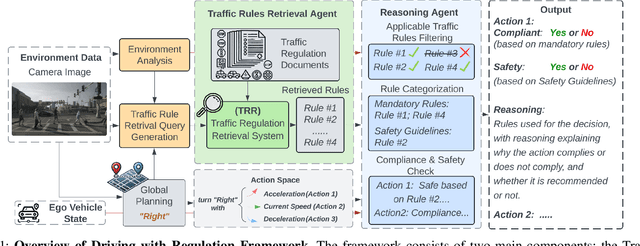
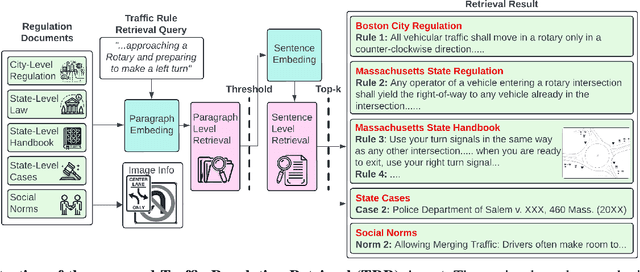
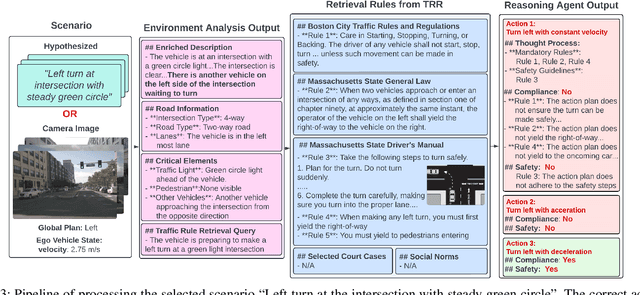
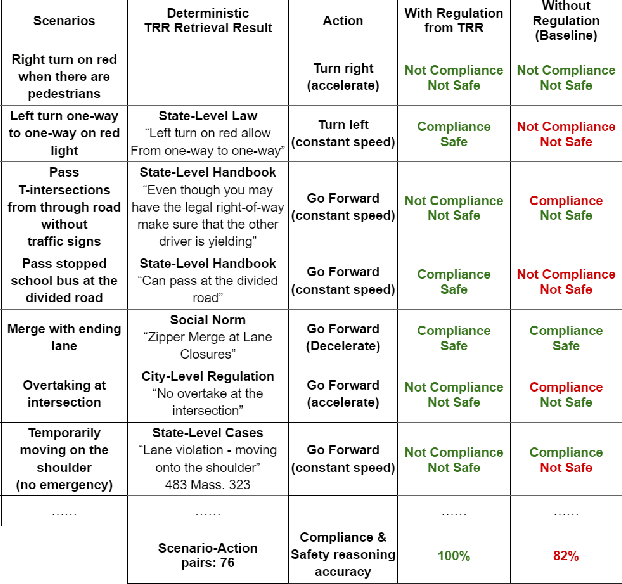
This work presents an interpretable decision-making framework for autonomous vehicles that integrates traffic regulations, norms, and safety guidelines comprehensively and enables seamless adaptation to different regions. While traditional rule-based methods struggle to incorporate the full scope of traffic rules, we develop a Traffic Regulation Retrieval (TRR) Agent based on Retrieval-Augmented Generation (RAG) to automatically retrieve relevant traffic rules and guidelines from extensive regulation documents and relevant records based on the ego vehicle's situation. Given the semantic complexity of the retrieved rules, we also design a reasoning module powered by a Large Language Model (LLM) to interpret these rules, differentiate between mandatory rules and safety guidelines, and assess actions on legal compliance and safety. Additionally, the reasoning is designed to be interpretable, enhancing both transparency and reliability. The framework demonstrates robust performance on both hypothesized and real-world cases across diverse scenarios, along with the ability to adapt to different regions with ease.