 Add to Chrome
 Add to Firefox
 Add to Edge
LLaDA2.1: Speeding Up Text Diffusion via Token Editing
Feb 09, 2026
While LLaDA2.0 showcased the scaling potential of 100B-level block-diffusion models and their inherent parallelization, the delicate equilibrium between decoding speed and generation quality has remained an elusive frontier. Today, we unveil LLaDA2.1, a paradigm shift designed to transcend this trade-off. By seamlessly weaving Token-to-Token (T2T) editing into the conventional Mask-to-Token (M2T) scheme, we introduce a joint, configurable threshold-decoding scheme. This structural innovation gives rise to two distinct personas: the Speedy Mode (S Mode), which audaciously lowers the M2T threshold to bypass traditional constraints while relying on T2T to refine the output; and the Quality Mode (Q Mode), which leans into conservative thresholds to secure superior benchmark performances with manageable efficiency degrade. Furthering this evolution, underpinned by an expansive context window, we implement the first large-scale Reinforcement Learning (RL) framework specifically tailored for dLLMs, anchored by specialized techniques for stable gradient estimation. This alignment not only sharpens reasoning precision but also elevates instruction-following fidelity, bridging the chasm between diffusion dynamics and complex human intent. We culminate this work by releasing LLaDA2.1-Mini (16B) and LLaDA2.1-Flash (100B). Across 33 rigorous benchmarks, LLaDA2.1 delivers strong task performance and lightning-fast decoding speed. Despite its 100B volume, on coding tasks it attains an astounding 892 TPS on HumanEval+, 801 TPS on BigCodeBench, and 663 TPS on LiveCodeBench.

Generative Psycho-Lexical Approach for Constructing Value Systems in Large Language Models
Feb 04, 2025


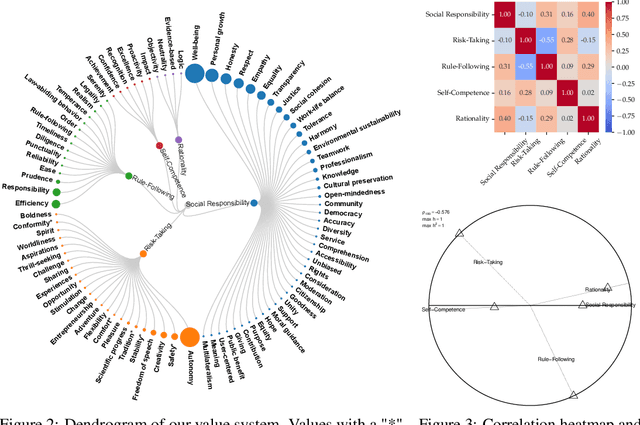
Values are core drivers of individual and collective perception, cognition, and behavior. Value systems, such as Schwartz's Theory of Basic Human Values, delineate the hierarchy and interplay among these values, enabling cross-disciplinary investigations into decision-making and societal dynamics. Recently, the rise of Large Language Models (LLMs) has raised concerns regarding their elusive intrinsic values. Despite growing efforts in evaluating, understanding, and aligning LLM values, a psychologically grounded LLM value system remains underexplored. This study addresses the gap by introducing the Generative Psycho-Lexical Approach (GPLA), a scalable, adaptable, and theoretically informed method for constructing value systems. Leveraging GPLA, we propose a psychologically grounded five-factor value system tailored for LLMs. For systematic validation, we present three benchmarking tasks that integrate psychological principles with cutting-edge AI priorities. Our results reveal that the proposed value system meets standard psychological criteria, better captures LLM values, improves LLM safety prediction, and enhances LLM alignment, when compared to the canonical Schwartz's values.