 Add to Chrome
 Add to Firefox
 Add to Edge
Toward Real-World Adoption of Portrait Relighting via Hybrid Domain Knowledge Fusion
Apr 25, 2026
The real-world adoption of portrait relighting is hindered by dataset domain gaps, camera sensitivity, and computational costs. We address these challenges with Hybrid Domain Knowledge Fusion, a paradigm that fuses the specialized strengths of synthetic, One-Light-at-A-Time (OLAT), and real-world datasets into a compact model. Our approach features specialized prior models hardened by domain-aware adaptation, followed by augmented knowledge distillation into a lightweight student model with multi-domain expertise. Our method demonstrates a 6x to 240x inference speedup while maintaining state-of-the-art (SOTA) visual quality in the experiments. Additionally, we construct a massive, high-fidelity synthetic dataset with diverse ground-truth intrinsics to support our training pipeline.

PAKAN: Pixel Adaptive Kolmogorov-Arnold Network Modules for Pansharpening
Mar 16, 2026Pansharpening aims to fuse high-resolution spatial details from panchromatic images with the rich spectral information of multispectral images. Existing deep neural networks for this task typically rely on static activation functions, which limit their ability to dynamically model the complex, non-linear mappings required for optimal spatial-spectral fusion. While the recently introduced Kolmogorov-Arnold Network (KAN) utilizes learnable activation functions, traditional KANs lack dynamic adaptability during inference. To address this limitation, we propose a Pixel Adaptive Kolmogorov-Arnold Network framework. Starting from KAN, we design two adaptive variants: a 2D Adaptive KAN that generates spline summation weights across spatial dimensions and a 1D Adaptive KAN that generates them across spectral channels. These two components are then assembled into PAKAN 2to1 for feature fusion and PAKAN 1to1 for feature refinement. Extensive experiments demonstrate that our proposed modules significantly enhance network performance, proving the effectiveness and superiority of pixel-adaptive activation in pansharpening tasks.
Separate, Dynamic and Differentiable (SMART) Pruner for Block/Output Channel Pruning on Computer Vision Tasks
Mar 29, 2024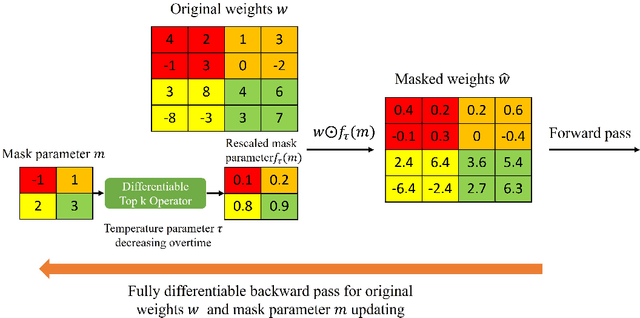
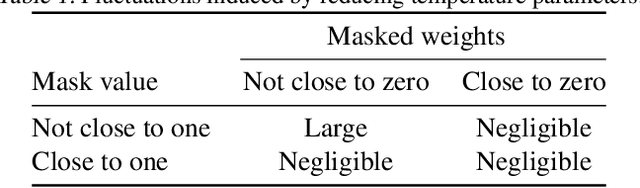
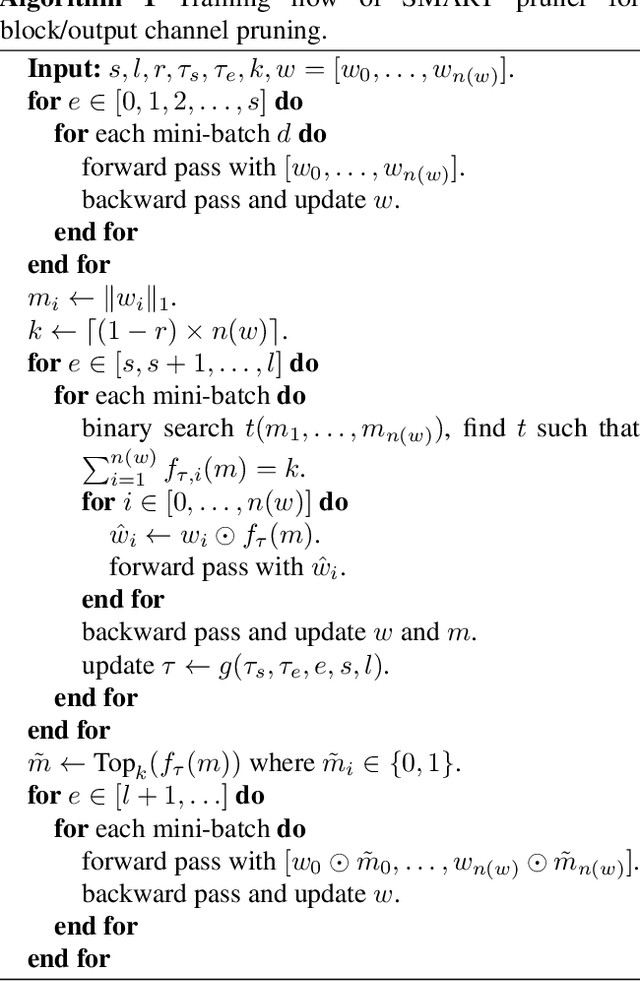
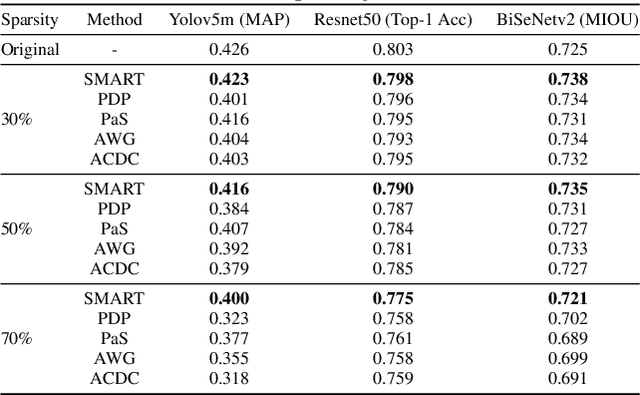
Deep Neural Network (DNN) pruning has emerged as a key strategy to reduce model size, improve inference latency, and lower power consumption on DNN accelerators. Among various pruning techniques, block and output channel pruning have shown significant potential in accelerating hardware performance. However, their accuracy often requires further improvement. In response to this challenge, we introduce a separate, dynamic and differentiable (SMART) pruner. This pruner stands out by utilizing a separate, learnable probability mask for weight importance ranking, employing a differentiable Top k operator to achieve target sparsity, and leveraging a dynamic temperature parameter trick to escape from non-sparse local minima. In our experiments, the SMART pruner consistently demonstrated its superiority over existing pruning methods across a wide range of tasks and models on block and output channel pruning. Additionally, we extend our testing to Transformer-based models in N:M pruning scenarios, where SMART pruner also yields state-of-the-art results, demonstrating its adaptability and robustness across various neural network architectures, and pruning types.