 Add to Chrome
 Add to Firefox
 Add to Edge
Towards Generalizable and Evidential Nuclear Magnetic Resonance-Based Molecular Structure Elucidation via Large Language Model Agent
Jun 29, 2026
Nuclear Magnetic Resonance (NMR) spectroscopy is the gold standard for molecular structure elucidation, yet interpreting complex spectra for unknown molecules remains a bottleneck reliant on human expertise. While artificial intelligence has advanced this field, current methods face a critical trade-off: database retrieval cannot identify novel scaffolds, while de novo molecular structure elucidation models operate as black boxes, lacking the atom-level interpretability required for rigorous scientific validation. Here, we present NMRAgent, an evidential reasoning agent powered by large language models (LLMs) that bridges this gap by integrating specialized spectral analysis tools with chemical knowledge graphs. Unlike previous approaches, NMRAgent mimics the deductive reasoning of human experts: it takes experimental NMR spectra and molecular formula as input, plans the elucidation process, proposes candidate structures, verifies peak-atom consistency, and refines misaligned substructure through formula-aware fragment optimization. Enabled by its evidential reasoning, NMRAgent outperforms state-of-the-art methods, improving top-1 accuracy by 46.5% and Tanimoto similarity by 0.502 on a scaffold-split benchmark with novel scaffolds in the test set. Besides, we demonstrate the agent's practical utility by elucidating the structures of two previously unknown natural products isolated from Hydrangea davidii and Vitex trifolia, and by correcting structural misassignments in established literature. By combining high-accuracy prediction with transparent and evidence-based reasoning, NMRAgent establishes a new paradigm for interpretable AI in analytical chemistry.

A large-scale foundation model enables simulation-to-real adaptation for nuclear magnetic resonance-based molecular structure analysis
Jun 18, 2026Nuclear Magnetic Resonance (NMR) spectroscopy is a powerful tool for molecular structure analysis, and spectral artificial intelligence offers great potential for its rapid and automated interpretation. However, the scarcity of experimental NMR datasets has constrained deep learning in this domain to narrow, task-specific applications that lack broad generalization. Here, we introduce UltraNMR, a large-scale foundation model for NMR that leverages the intrinsic properties of NMR spectra to learn generalizable spectral representations. We collected 158 million paired simulated $^{1}$H and $^{13}$C NMR spectra to train UltraNMR, employing multiple domain-specific pre-training objectives. UltraNMR captures both intra-spectral and inter-spectral dependencies, enabling seamless simulation-to-real adaptation. We demonstrate that adapting UltraNMR to a range of molecular structure analysis tasks on experimental NMR spectra consistently yields state-of-the-art performance and clearly outperforms UltraNMR variants trained directly on downstream data without simulation pre-training. We also construct a large-scale NMR spectral vector library by encoding simulated NMR spectra using UltraNMR, covering 94 million unique molecules and enabling effective structure-aware retrieval. In real-world applications, UltraNMR facilitates the structural elucidation of two previously unknown natural products from Chinese herbal medicines recorded in the Chinese Pharmacopoeia. These results suggest that large-scale simulation pre-training can effectively bridge the simulation-to-real gap, enabling robust and generalizable molecular structure analysis of real-world NMR spectra.
SeLIP: Similarity Enhanced Contrastive Language Image Pretraining for Multi-modal Head MRI
Mar 25, 2025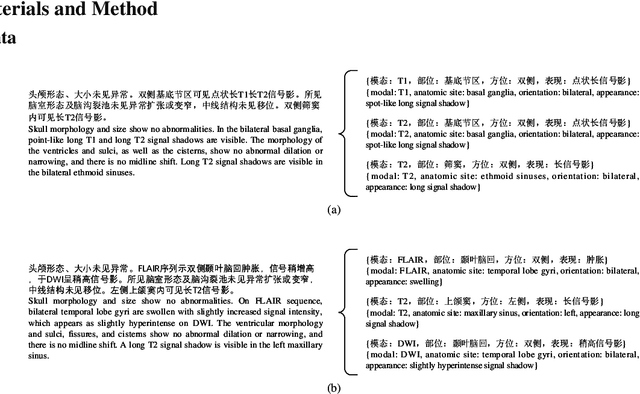
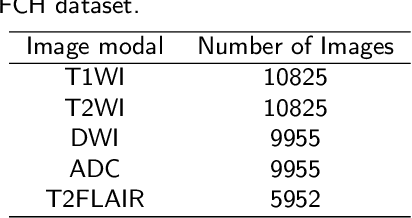
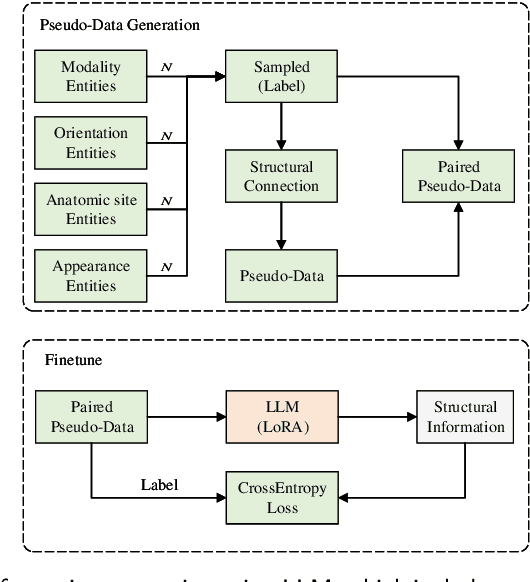
Despite that deep learning (DL) methods have presented tremendous potential in many medical image analysis tasks, the practical applications of medical DL models are limited due to the lack of enough data samples with manual annotations. By noting that the clinical radiology examinations are associated with radiology reports that describe the images, we propose to develop a foundation model for multi-model head MRI by using contrastive learning on the images and the corresponding radiology findings. In particular, a contrastive learning framework is proposed, where a mixed syntax and semantic similarity matching metric is integrated to reduce the thirst of extreme large dataset in conventional contrastive learning framework. Our proposed similarity enhanced contrastive language image pretraining (SeLIP) is able to effectively extract more useful features. Experiments revealed that our proposed SeLIP performs well in many downstream tasks including image-text retrieval task, classification task, and image segmentation, which highlights the importance of considering the similarities among texts describing different images in developing medical image foundation models.
Beyond Prediction: On-street Parking Recommendation using Heterogeneous Graph-based List-wise Ranking
Apr 29, 2023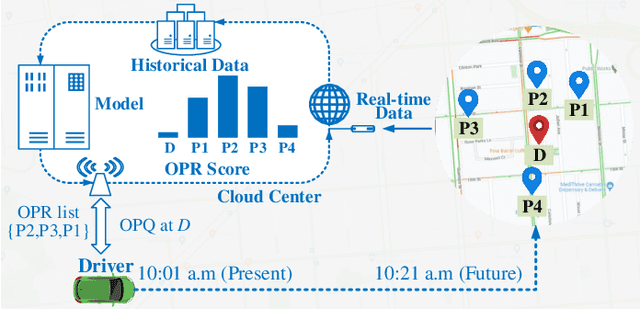
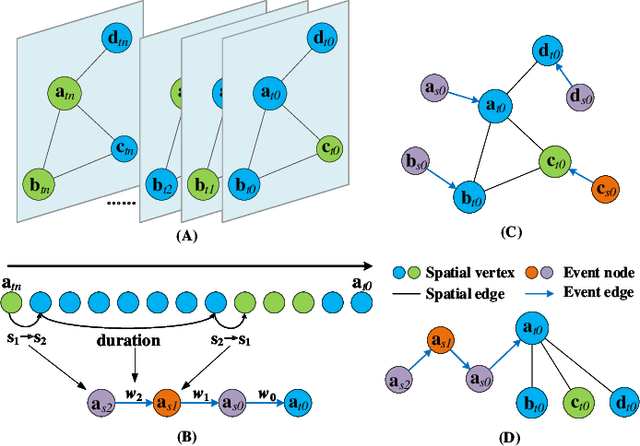
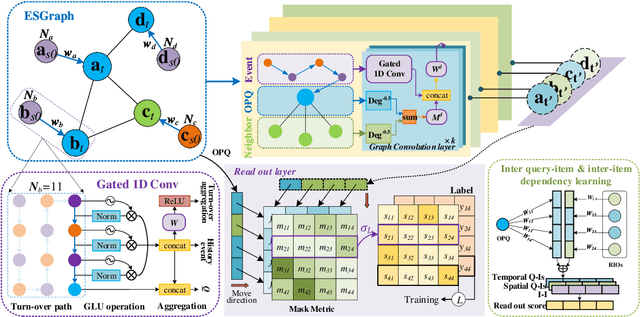
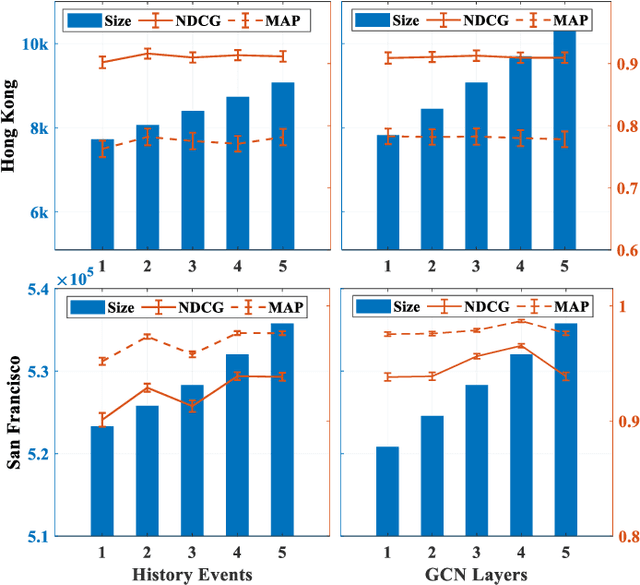
To provide real-time parking information, existing studies focus on predicting parking availability, which seems an indirect approach to saving drivers' cruising time. In this paper, we first time propose an on-street parking recommendation (OPR) task to directly recommend a parking space for a driver. To this end, a learn-to-rank (LTR) based OPR model called OPR-LTR is built. Specifically, parking recommendation is closely related to the "turnover events" (state switching between occupied and vacant) of each parking space, and hence we design a highly efficient heterogeneous graph called ESGraph to represent historical and real-time meters' turnover events as well as geographical relations; afterward, a convolution-based event-then-graph network is used to aggregate and update representations of the heterogeneous graph. A ranking model is further utilized to learn a score function that helps recommend a list of ranked parking spots for a specific on-street parking query. The method is verified using the on-street parking meter data in Hong Kong and San Francisco. By comparing with the other two types of methods: prediction-only and prediction-then-recommendation, the proposed direct-recommendation method achieves satisfactory performance in different metrics. Extensive experiments also demonstrate that the proposed ESGraph and the recommendation model are more efficient in terms of computational efficiency as well as saving drivers' on-street parking time.