 Add to Chrome
 Add to Firefox
 Add to Edge
WQ-Fusion: Dynamic Gated Attention for Cross-Domain Audio Representation
Jun 25, 2026
While pre-trained models excel in specialized tasks, learning universal representations across diverse acoustic domains remains challenging. To address this, we propose WQ-Fusion, a robust dual-encoder framework for cross-domain audio representation learning. Overcoming the limitations of static concatenation, WQ-Fusion integrates whisper and qwen via an Adaptive Feature Modulation module and a novel element-wise gated attention mechanism. This design enables dynamic feature selection, allowing the model to selectively emphasize relevant acoustic and semantic dimensions. Extensive experiments on the Interspeech 2026 Audio Encoder Capability Challenge (Track A) benchmark demonstrate that by effectively routing heterogeneous information, WQ-Fusion achieves a superior overall score of 0.836, significantly outperforming the strongest single-encoder baseline.

Joint Learning of Covariance Estimation and White Noise Gain for Robust MVDR Beamforming
Jun 23, 2026The minimum variance distortionless response (MVDR) beamformer is widely used for multichannel speech enhancement due to strong noise suppression while preserving target signals. In practice, its performance is sensitive to microphone self-noise and array mismatches. Existing approaches typically rely on fixed, manually tuned WNG thresholds or diagonal loading, leading to suboptimal performance under unknown or time-varying acoustic conditions. This paper proposes a data-driven MVDR framework that adaptively estimates the WNG constraint using a deep neural network. The network jointly predicts a time-frequency noise mask for covariance estimation and a frequency-dependent WNG threshold, enabling dynamic robustness-directivity control. A differentiable robust MVDR layer is integrated into the framework, allowing end-to-end optimization. Experiments demonstrate consistent improvements in speech quality and intelligibility over conventional fixed-WNG MVDR methods.
A Unified Neural Codec Language Model for Selective Editable Text to Speech Generation
Jan 18, 2026Neural codec language models achieve impressive zero-shot Text-to-Speech (TTS) by fully imitating the acoustic characteristics of a short speech prompt, including timbre, prosody, and paralinguistic information. However, such holistic imitation limits their ability to isolate and control individual attributes. In this paper, we present a unified codec language model SpeechEdit that extends zero-shot TTS with a selective control mechanism. By default, SpeechEdit reproduces the complete acoustic profile inferred from the speech prompt, but it selectively overrides only the attributes specified by explicit control instructions. To enable controllable modeling, SpeechEdit is trained on our newly constructed LibriEdit dataset, which provides delta (difference-aware) training pairs derived from LibriHeavy. Experimental results show that our approach maintains naturalness and robustness while offering flexible and localized control over desired attributes. Audio samples are available at https://speech-editing.github.io/speech-editing/.
Spatial-Filter-Bank-Based Neural Method for Multichannel Speech Enhancement
Apr 02, 2025The performance of deep learning-based multi-channel speech enhancement methods often deteriorates when the geometric parameters of the microphone array change. Traditional approaches to mitigate this issue typically involve training on multiple microphone arrays, which can be costly. To address this challenge, we focus on uniform circular arrays and propose the use of a spatial filter bank to extract features that are approximately invariant to geometric parameters. These features are then processed by a two-stage conformer-based model (TSCBM) to enhance speech quality. Experimental results demonstrate that our proposed method can be trained on a fixed microphone array while maintaining effective performance across uniform circular arrays with unseen geometric configurations during applications.
LMFCA-Net: A Lightweight Model for Multi-Channel Speech Enhancement with Efficient Narrow-Band and Cross-Band Attention
Feb 17, 2025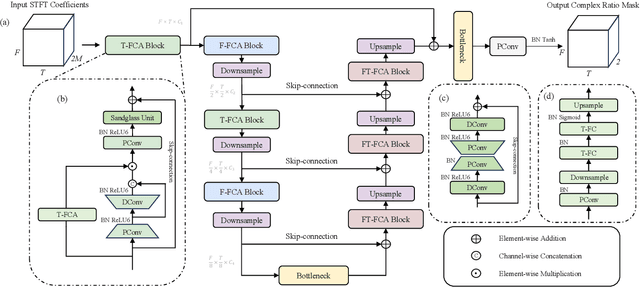
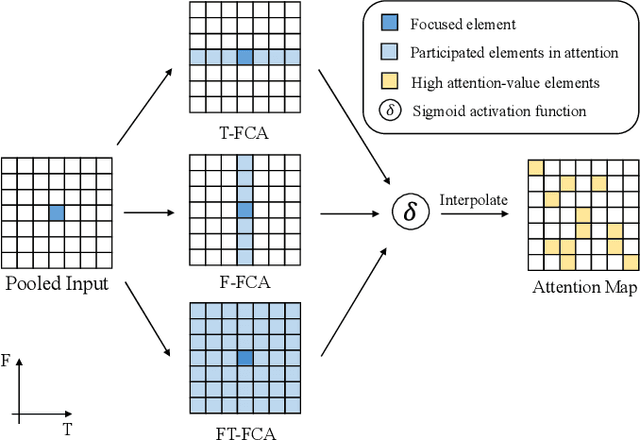
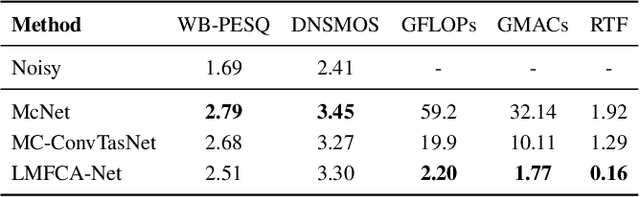
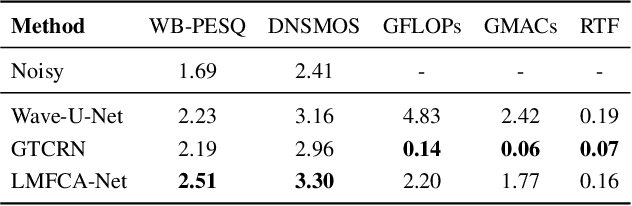
Deep learning based end-to-end multi-channel speech enhancement methods have achieved impressive performance by leveraging sub-band, cross-band, and spatial information. However, these methods often demand substantial computational resources, limiting their practicality on terminal devices. This paper presents a lightweight multi-channel speech enhancement network with decoupled fully connected attention (LMFCA-Net). The proposed LMFCA-Net introduces time-axis decoupled fully-connected attention (T-FCA) and frequency-axis decoupled fully-connected attention (F-FCA) mechanisms to effectively capture long-range narrow-band and cross-band information without recurrent units. Experimental results show that LMFCA-Net performs comparably to state-of-the-art methods while significantly reducing computational complexity and latency, making it a promising solution for practical applications.