 Add to Chrome
 Add to Firefox
 Add to Edge
Joint Learning of Covariance Estimation and White Noise Gain for Robust MVDR Beamforming
Jun 23, 2026
The minimum variance distortionless response (MVDR) beamformer is widely used for multichannel speech enhancement due to strong noise suppression while preserving target signals. In practice, its performance is sensitive to microphone self-noise and array mismatches. Existing approaches typically rely on fixed, manually tuned WNG thresholds or diagonal loading, leading to suboptimal performance under unknown or time-varying acoustic conditions. This paper proposes a data-driven MVDR framework that adaptively estimates the WNG constraint using a deep neural network. The network jointly predicts a time-frequency noise mask for covariance estimation and a frequency-dependent WNG threshold, enabling dynamic robustness-directivity control. A differentiable robust MVDR layer is integrated into the framework, allowing end-to-end optimization. Experiments demonstrate consistent improvements in speech quality and intelligibility over conventional fixed-WNG MVDR methods.

A Fusion-Aware Two-Stage Framework for Mispronunciation Detection and Diagnosis in Low-Resource Modern Standard Arabic
Jun 23, 2026Accurate phoneme recognition is pivotal for mispronunciation detection and diagnosis (MDD) in modern standard Arabic (MSA), yet remains constrained by data scarcity and the synthetic-real domain gap. This work proposes a two-stage end-to-end framework. It integrates a pre-trained encoder with causal dilated temporal convolutional networks to preserve fine-grained phonetic variations. A hierarchical two-stage strategy first learns general mappings from native/synthetic corpora, then adapts to scarce real learner data to mitigate domain shift without over-correction. Prediction stability is further enhanced via multi-checkpoint ensemble inference with N-gram rescoring. Evaluated on the QuranMB.v2 test set, our system achieves an F1-score of $0.7201$, a $63.1$\% relative improvement over baseline ($0.4414$). This performance ranks at the top of the IqraEval.2 Challenge, establishing a new state-of-the-art for low-resource MSA in MDD.
A Directional-Derivative-Constrained Method for Continuously Steerable Differential Beamformers with Uniform Circular Arrays
Feb 26, 2026Differential microphone arrays offer a promising solution for far-field acoustic signal acquisition due to their high spatial directivity and compact array structure. A key challenge lies in designing differential beamformers that are continuously steerable and capable of enhancing target signals arriving from arbitrary directions. This paper studies the design of differential beamformers for circular arrays and proposes a novel framework that incorporates directional derivative constraints. By constraining the first-order derivatives of the beampattern at the desired steering direction to zero and assigning suitable values to higher-order derivatives, the beamformer is ensured to achieve its maximum response in the target direction and provide sufficient beam steering. This approach not only improves steering flexibility but also enables a more intuitive and robust beampattern design. Simulation results demonstrate that the proposed method produces continuously steerable beampatterns.
Multi-modal Document Presentation Attack Detection With Forensics Trace Disentanglement
Apr 10, 2024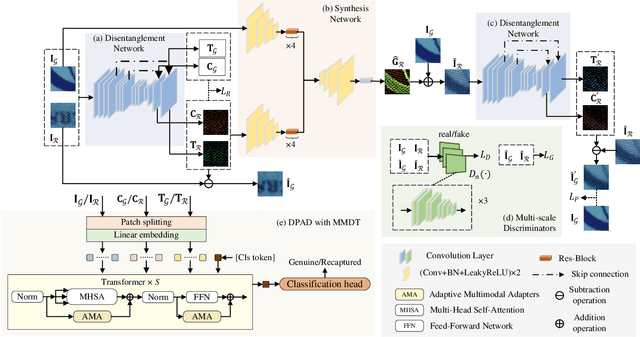
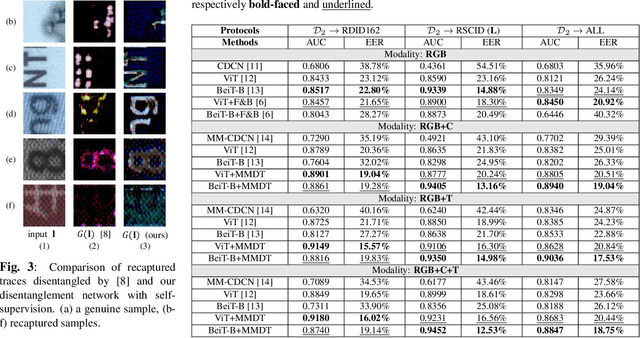
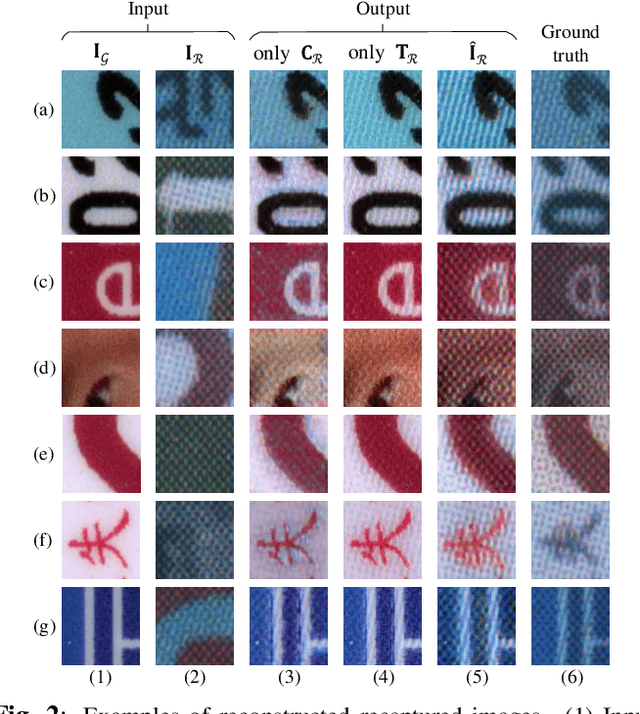
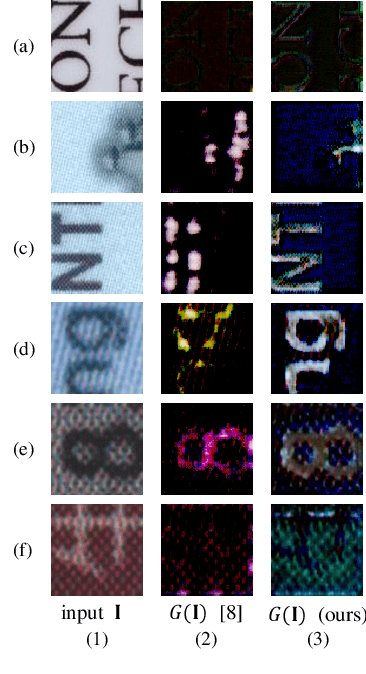
Document Presentation Attack Detection (DPAD) is an important measure in protecting the authenticity of a document image. However, recent DPAD methods demand additional resources, such as manual effort in collecting additional data or knowing the parameters of acquisition devices. This work proposes a DPAD method based on multi-modal disentangled traces (MMDT) without the above drawbacks. We first disentangle the recaptured traces by a self-supervised disentanglement and synthesis network to enhance the generalization capacity in document images with different contents and layouts. Then, unlike the existing DPAD approaches that rely only on data in the RGB domain, we propose to explicitly employ the disentangled recaptured traces as new modalities in the transformer backbone through adaptive multi-modal adapters to fuse RGB/trace features efficiently. Visualization of the disentangled traces confirms the effectiveness of the proposed method in different document contents. Extensive experiments on three benchmark datasets demonstrate the superiority of our MMDT method on representing forensic traces of recapturing distortion.