 Add to Chrome
 Add to Firefox
 Add to Edge
CapProbe: Evaluating Detailed Image Captions via Full-Scene Dense Question Answering
Aug 11, 2026
Evaluating detailed image captions from Vision-Language Models (VLMs) requires going beyond surface-level semantic similarity. Reference-based metrics (e.g., CIDEr and SPICE) and LLM-as-scorer protocols struggle to verify dense factual claims, while existing QA-based alternatives generally offer lower probe density, narrower domain coverage, or no explicit alignment between individual questions and segmented image regions. We introduce CapProbe, a full-scene dense QA benchmark that turns detailed caption evaluation into region-aligned factual checking. Each image is decomposed into coarse semantic regions covering both foreground and background elements; for every retained region, we generate multiple-choice questions spanning 10 semantic categories, forming a dense checklist of probed visual facts. Guided by a two-tier taxonomy of 37 L1 domains and 219 L2 sub-domains, CapProbe comprises 346 images, 1,868 regions, and 25,650 questions, averaging 74 QA pairs per image. A language judge answers from the caption alone; an Uncertain option and Effective Accuracy provide a judge-dependent proxy for distinguishing unanswered probes from incorrectly resolved ones, while density-based metrics penalize verbose yet uninformative captions. The protocol is cost-effective: by converting unconstrained scalar scoring into structured MCQ reading, it reduces open-ended scoring bias while remaining judge-conditioned and yields relatively stable model rankings under a fixed reader. Experiments on 13 VLMs show large Coverage gaps across models, a clear competency-efficiency trade-off, and failure modes that sparse or overlap-based evaluation often misses. The benchmark data, annotations, and evaluation code will be released soon.

SlimVLM: Sensitivity-aware Dynamic Structured Pruning with Adaptive Visual Token Selection for Efficient Vision-Language Models
Aug 04, 2026While Vision-Language Models (VLMs) have demonstrated remarkable performance in processing and understanding both text and images, their large parameter sizes lead to significant computational overhead, limiting their deployment on resource-constrained devices. While pruning has been effective for compressing Large Language Models (LLMs), directly applying it to VLMs leads to significant performance drops, largely due to redundant visual tokens interfering with importance estimation. To this end, we propose SlimVLM, a structured pruning framework designed to compress VLMs while preserving their task performance. We introduce an adaptive visual token selection strategy for VLMs that leverages average text-to-visual attention scores to assess the importance of visual tokens, removing redundant ones during pruning based on a set threshold, thereby optimizing the importance calculation. Recognizing the varying tolerance to sparsity across different modules, we also propose a Sensitivity-aware dynamic pruning mechanism that determines the appropriate pruning ratio for each module by calculating the linear reconstruction error between the outputs of the pruned and unpruned modules, ensuring overall performance stability. Experimental results show that SlimVLM outperforms existing methods across multiple multimodal benchmarks, achieving state-of-the-art performance.
Thinking-while-speaking: A Controlled, Interleaved Reasoning Method for Real-Time Speech Generation
May 20, 2026The thinking-while-speaking paradigm aims to make AI communication more human. A key challenge is maintaining fluent speech while performing deep reasoning. Our method, InterRS, tackles this by inserting reasoning steps only during natural speech generation. This requires high-quality data where reasoning and speech are precisely aligned, and the length ratio are under controlled. We introduce a novel pipeline to generate such seamlessly interleaved audio data. To train our model, we combine interleaved SFT with refined data and reinforcement learning with two new rewards: a TA-Balance Reward to manage timing and thinking-answer ratio, and a Linguistic Quality Reward to refine expression. Experiments show our approach achieves 13% better performance on mathmatical and logic benchmarks while generating instant response like a spoken-language instruct model which outputs fast CoT response. Furthermore, our method generates more natural and fluent answers than prior methods.
SJD-PAC: Accelerating Speculative Jacobi Decoding via Proactive Drafting and Adaptive Continuation
Mar 19, 2026Speculative Jacobi Decoding (SJD) offers a draft-model-free approach to accelerate autoregressive text-to-image synthesis. However, the high-entropy nature of visual generation yields low draft-token acceptance rates in complex regions, creating a bottleneck that severely limits overall throughput. To overcome this, we introduce SJD-PAC, an enhanced SJD framework. First, SJD-PAC employs a proactive drafting strategy to improve local acceptance rates in these challenging high-entropy regions. Second, we introduce an adaptive continuation mechanism that sustains sequence validation after an initial rejection, bypassing the need for full resampling. Working in tandem, these optimizations significantly increase the average acceptance length per step, boosting inference speed while strictly preserving the target distribution. Experiments on standard text-to-image benchmarks demonstrate that SJD-PAC achieves a $3.8\times$ speedup with lossless image quality.
ViSpec: Accelerating Vision-Language Models with Vision-Aware Speculative Decoding
Sep 17, 2025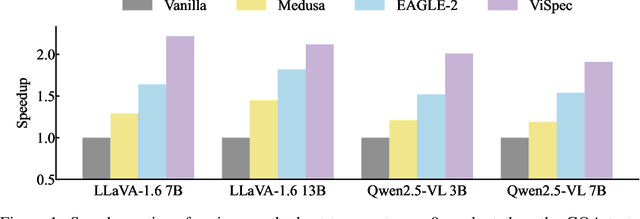
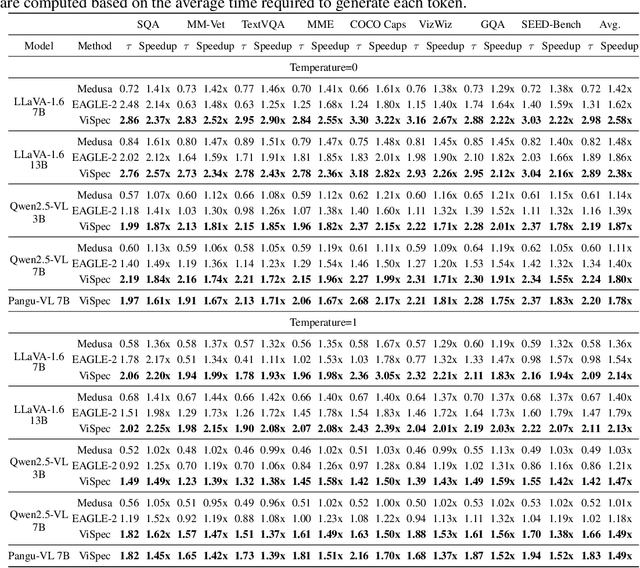
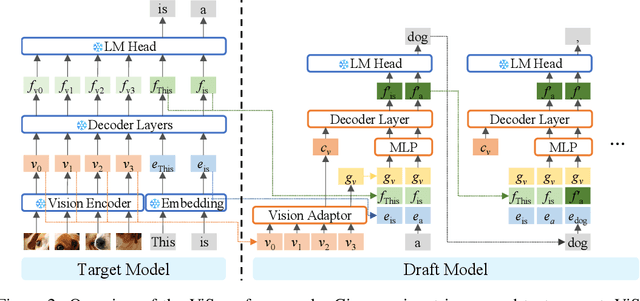
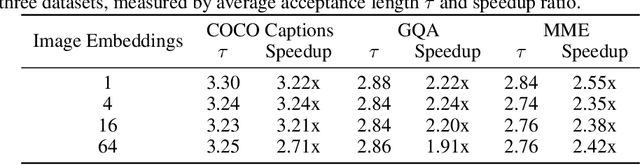
Speculative decoding is a widely adopted technique for accelerating inference in large language models (LLMs), yet its application to vision-language models (VLMs) remains underexplored, with existing methods achieving only modest speedups (<1.5x). This gap is increasingly significant as multimodal capabilities become central to large-scale models. We hypothesize that large VLMs can effectively filter redundant image information layer by layer without compromising textual comprehension, whereas smaller draft models struggle to do so. To address this, we introduce Vision-Aware Speculative Decoding (ViSpec), a novel framework tailored for VLMs. ViSpec employs a lightweight vision adaptor module to compress image tokens into a compact representation, which is seamlessly integrated into the draft model's attention mechanism while preserving original image positional information. Additionally, we extract a global feature vector for each input image and augment all subsequent text tokens with this feature to enhance multimodal coherence. To overcome the scarcity of multimodal datasets with long assistant responses, we curate a specialized training dataset by repurposing existing datasets and generating extended outputs using the target VLM with modified prompts. Our training strategy mitigates the risk of the draft model exploiting direct access to the target model's hidden states, which could otherwise lead to shortcut learning when training solely on target model outputs. Extensive experiments validate ViSpec, achieving, to our knowledge, the first substantial speedup in VLM speculative decoding.
Federated Koopman-Reservoir Learning for Large-Scale Multivariate Time-Series Anomaly Detection
Mar 14, 2025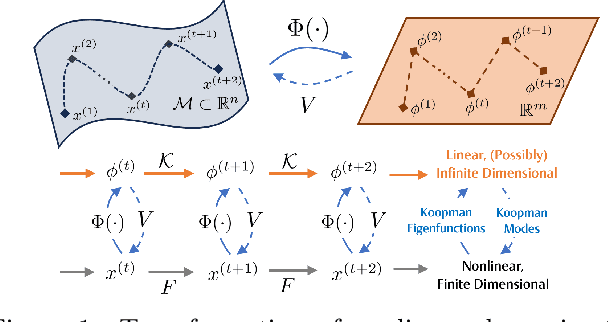
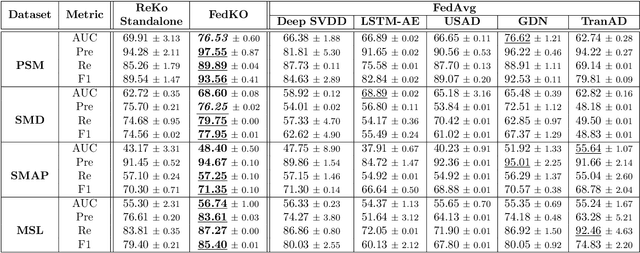
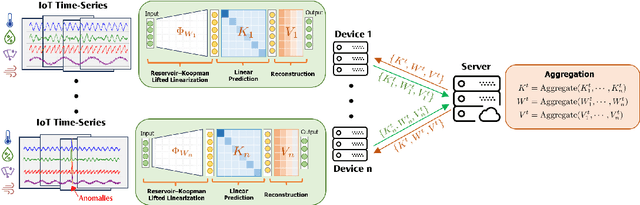
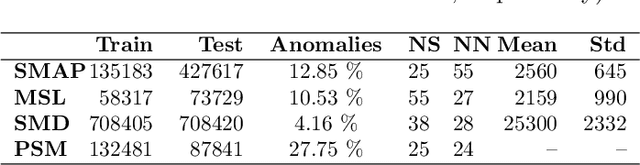
The proliferation of edge devices has dramatically increased the generation of multivariate time-series (MVTS) data, essential for applications from healthcare to smart cities. Such data streams, however, are vulnerable to anomalies that signal crucial problems like system failures or security incidents. Traditional MVTS anomaly detection methods, encompassing statistical and centralized machine learning approaches, struggle with the heterogeneity, variability, and privacy concerns of large-scale, distributed environments. In response, we introduce FedKO, a novel unsupervised Federated Learning framework that leverages the linear predictive capabilities of Koopman operator theory along with the dynamic adaptability of Reservoir Computing. This enables effective spatiotemporal processing and privacy preservation for MVTS data. FedKO is formulated as a bi-level optimization problem, utilizing a specific federated algorithm to explore a shared Reservoir-Koopman model across diverse datasets. Such a model is then deployable on edge devices for efficient detection of anomalies in local MVTS streams. Experimental results across various datasets showcase FedKO's superior performance against state-of-the-art methods in MVTS anomaly detection. Moreover, FedKO reduces up to 8x communication size and 2x memory usage, making it highly suitable for large-scale systems.
ExCP: Extreme LLM Checkpoint Compression via Weight-Momentum Joint Shrinking
Jun 17, 2024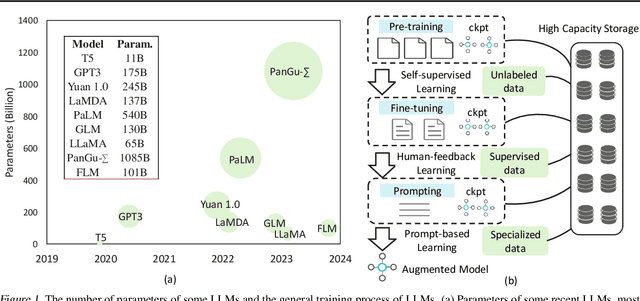
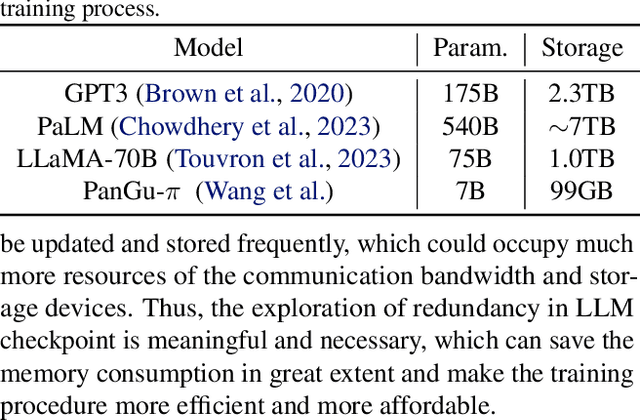
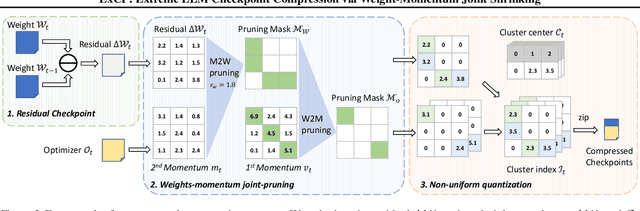
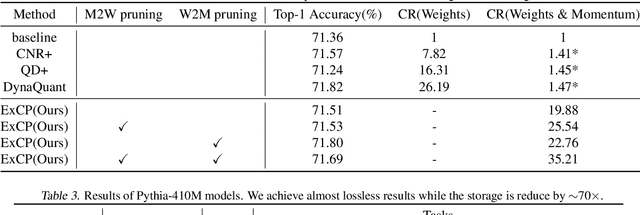
Large language models (LLM) have recently attracted significant attention in the field of artificial intelligence. However, the training process of these models poses significant challenges in terms of computational and storage capacities, thus compressing checkpoints has become an urgent problem. In this paper, we propose a novel Extreme Checkpoint Compression (ExCP) framework, which significantly reduces the required storage of training checkpoints while achieving nearly lossless performance. We first calculate the residuals of adjacent checkpoints to obtain the essential but sparse information for higher compression ratio. To further excavate the redundancy parameters in checkpoints, we then propose a weight-momentum joint shrinking method to utilize another important information during the model optimization, i.e., momentum. In particular, we exploit the information of both model and optimizer to discard as many parameters as possible while preserving critical information to ensure optimal performance. Furthermore, we utilize non-uniform quantization to further compress the storage of checkpoints. We extensively evaluate our proposed ExCP framework on several models ranging from 410M to 7B parameters and demonstrate significant storage reduction while maintaining strong performance. For instance, we achieve approximately $70\times$ compression for the Pythia-410M model, with the final performance being as accurate as the original model on various downstream tasks. Codes will be available at https://github.com/Gaffey/ExCP.
$i$REPO: $i$mplicit Reward Pairwise Difference based Empirical Preference Optimization
May 24, 2024


While astonishingly capable, large Language Models (LLM) can sometimes produce outputs that deviate from human expectations. Such deviations necessitate an alignment phase to prevent disseminating untruthful, toxic, or biased information. Traditional alignment methods based on reinforcement learning often struggle with the identified instability, whereas preference optimization methods are limited by their overfitting to pre-collected hard-label datasets. In this paper, we propose a novel LLM alignment framework named $i$REPO, which utilizes implicit Reward pairwise difference regression for Empirical Preference Optimization. Particularly, $i$REPO employs self-generated datasets labelled by empirical human (or AI annotator) preference to iteratively refine the aligned policy through a novel regression-based loss function. Furthermore, we introduce an innovative algorithm backed by theoretical guarantees for achieving optimal results under ideal assumptions and providing a practical performance-gap result without such assumptions. Experimental results with Phi-2 and Mistral-7B demonstrate that $i$REPO effectively achieves self-alignment using soft-label, self-generated responses and the logit of empirical AI annotators. Furthermore, our approach surpasses preference optimization baselines in evaluations using the Language Model Evaluation Harness and Multi-turn benchmarks.
TinySAM: Pushing the Envelope for Efficient Segment Anything Model
Dec 21, 2023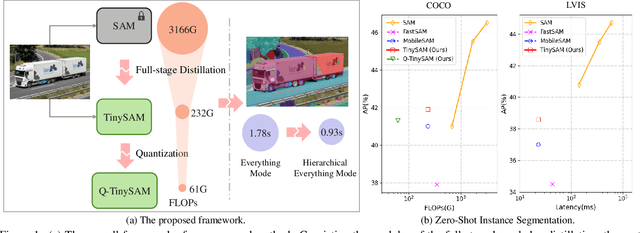
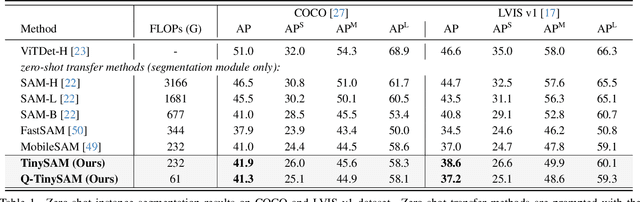
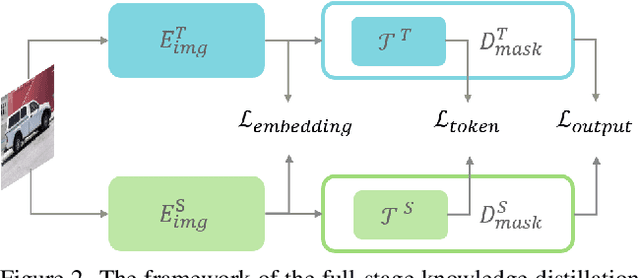
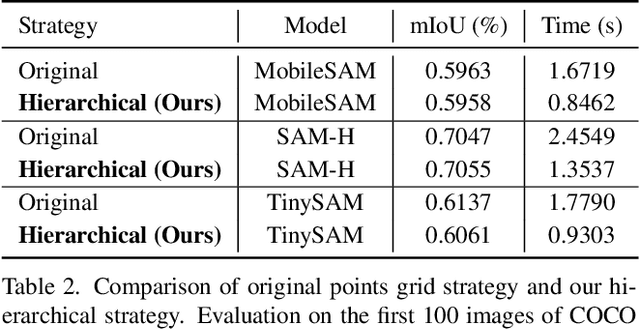
Recently segment anything model (SAM) has shown powerful segmentation capability and has drawn great attention in computer vision fields. Massive following works have developed various applications based on the pretrained SAM and achieved impressive performance on downstream vision tasks. However, SAM consists of heavy architectures and requires massive computational capacity, which hinders the further application of SAM on computation constrained edge devices. To this end, in this paper we propose a framework to obtain a tiny segment anything model (TinySAM) while maintaining the strong zero-shot performance. We first propose a full-stage knowledge distillation method with online hard prompt sampling strategy to distill a lightweight student model. We also adapt the post-training quantization to the promptable segmentation task and further reduce the computational cost. Moreover, a hierarchical segmenting everything strategy is proposed to accelerate the everything inference by $2\times$ with almost no performance degradation. With all these proposed methods, our TinySAM leads to orders of magnitude computational reduction and pushes the envelope for efficient segment anything task. Extensive experiments on various zero-shot transfer tasks demonstrate the significantly advantageous performance of our TinySAM against counterpart methods. Pre-trained models and codes will be available at https://github.com/xinghaochen/TinySAM and https://gitee.com/mindspore/models/tree/master/research/cv/TinySAM.
Coarse-to-Fine Searching for Efficient Generative Adversarial Networks
Apr 19, 2021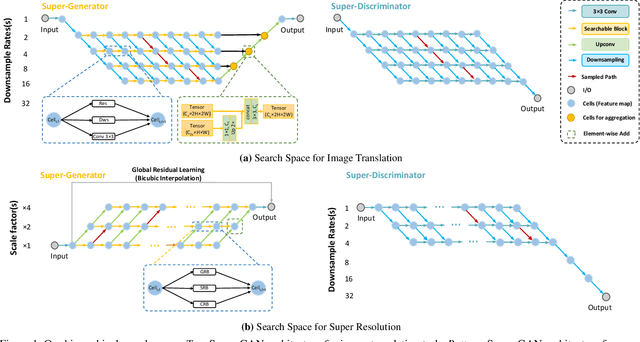
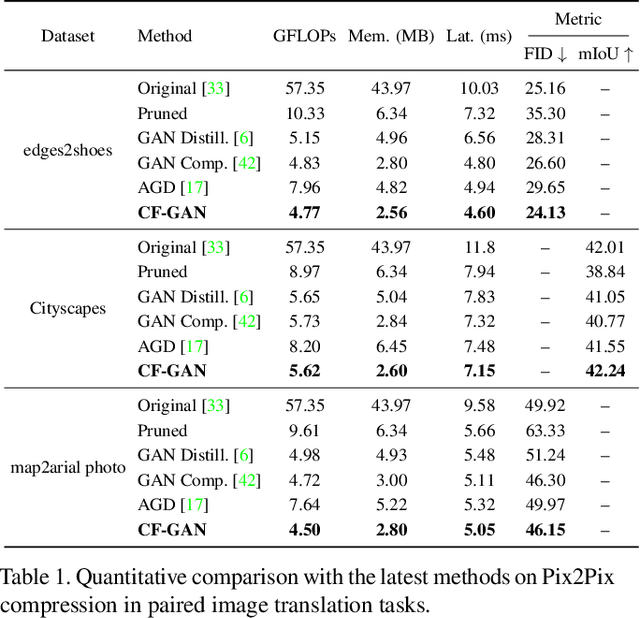
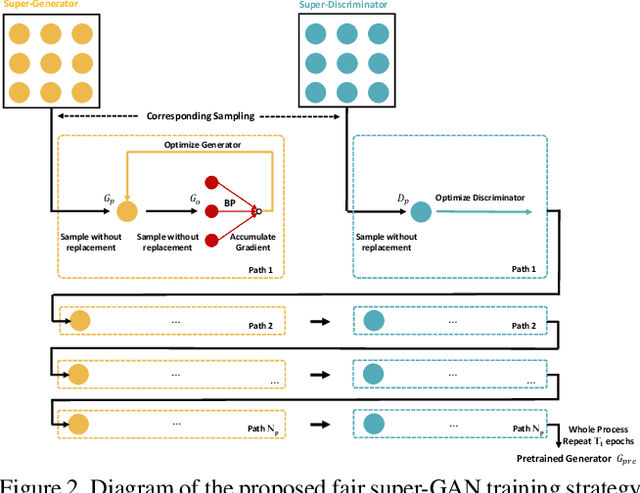
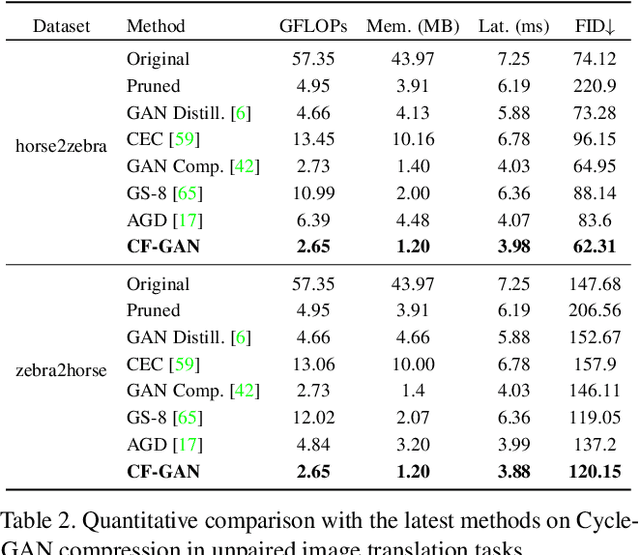
This paper studies the neural architecture search (NAS) problem for developing efficient generator networks. Compared with deep models for visual recognition tasks, generative adversarial network (GAN) are usually designed to conduct various complex image generation. We first discover an intact search space of generator networks including three dimensionalities, i.e., path, operator, channel for fully excavating the network performance. To reduce the huge search cost, we explore a coarse-to-fine search strategy which divides the overall search process into three sub-optimization problems accordingly. In addition, a fair supernet training approach is utilized to ensure that all sub-networks can be updated fairly and stably. Experiments results on benchmarks show that we can provide generator networks with better image quality and lower computational costs over the state-of-the-art methods. For example, with our method, it takes only about 8 GPU hours on the entire edges-to-shoes dataset to get a 2.56 MB model with a 24.13 FID score and 10 GPU hours on the entire Urban100 dataset to get a 1.49 MB model with a 24.94 PSNR score.