 Add to Chrome
 Add to Firefox
 Add to Edge
A Reasoning-Enabled Vision-Language Foundation Model for Chest X-ray Interpretation
Apr 01, 2026
Chest X-rays (CXRs) are among the most frequently performed imaging examinations worldwide, yet rising imaging volumes increase radiologist workload and the risk of diagnostic errors. Although artificial intelligence (AI) systems have shown promise for CXR interpretation, most generate only final predictions, without making explicit how visual evidence is translated into radiographic findings and diagnostic predictions. We present CheXOne, a reasoning-enabled vision-language model for CXR interpretation. CheXOne jointly generates diagnostic predictions and explicit, clinically grounded reasoning traces that connect visual evidence, radiographic findings, and these predictions. The model is trained on 14.7 million instruction and reasoning samples curated from 30 public datasets spanning 36 CXR interpretation tasks, using a two-stage framework that combines instruction tuning with reinforcement learning to improve reasoning quality. We evaluate CheXOne in zero-shot settings across visual question answering, report generation, visual grounding and reasoning assessment, covering 17 evaluation settings. CheXOne outperforms existing medical and general-domain foundation models and achieves strong performance on independent public benchmarks. A clinical reader study demonstrates that CheXOne-drafted reports are comparable to or better than resident-written reports in 55% of cases, while effectively addressing clinical indications and enhancing both report writing and CXR interpretation efficiency. Further analyses involving radiologists reveal that the generated reasoning traces show high clinical factuality and provide causal support for the final predictions, offering a plausible explanation for the performance gains. These results suggest that explicit reasoning can improve model performance, interpretability and clinical utility in AI-assisted CXR interpretation.

Exploring the Versatility of Zero-Shot CLIP for Interstitial Lung Disease Classification
Jun 01, 2023
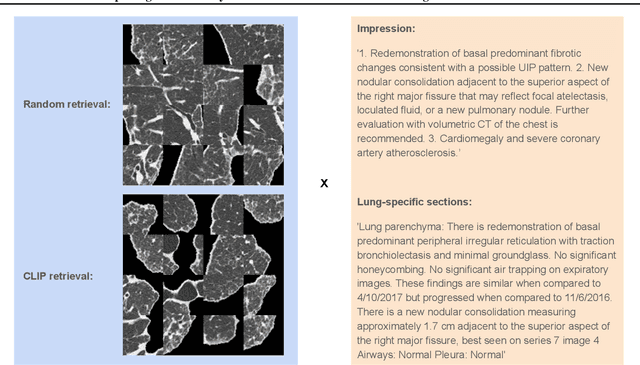


Interstitial lung diseases (ILD) present diagnostic challenges due to their varied manifestations and overlapping imaging features. To address this, we propose a machine learning approach that utilizes CLIP, a multimodal (image and text) self-supervised model, for ILD classification. We extensively integrate zero-shot CLIP throughout our workflow, starting from the initial extraction of image patches from volumetric CT scans and proceeding to ILD classification using "patch montages". Furthermore, we investigate how domain adaptive pretraining (DAPT) CLIP with task-specific images (CT "patch montages" extracted with ILD-specific prompts for CLIP) and/or text (lung-specific sections of radiology reports) affects downstream ILD classification performance. By leveraging CLIP-extracted "patch montages" and DAPT, we achieve strong zero-shot ILD classification results, including an AUROC of 0.893, without the need for any labeled training data. This work highlights the versatility and potential of multimodal models like CLIP for medical image classification tasks where labeled data is scarce.