 Add to Chrome
 Add to Firefox
 Add to Edge
Decoupling Reconnaissance and Exploitation: Measuring the Capability Boundaries of LLM-Based Web Penetration Testing
Jun 24, 2026
Large Language Models (LLMs) have shown promise for automated penetration testing, yet existing end-to-end black-box evaluations are highly susceptible to error cascading: failures in early reconnaissance can mask an agent's actual ability to exploit vulnerabilities. To more accurately characterize these capabilities, we propose a two-stage decoupled evaluation framework that separates exploit execution from reconnaissance. Using ground-truth injection and knowledge-driven ablation across 70 high-fidelity web vulnerability testbeds, our framework isolates exploitation performance from reconnaissance noise. We empirically evaluate five open-source penetration-testing agents, covering multiagent, monolithic, and graph-driven architectures, on a strictly aligned subset of 50 representative vulnerabilities. The results reveal a substantial capability gap. With accurate vulnerability context, agents achieve a functional success rate of up to 90.0%, whereas autonomous reconnaissance, measured by targeted vulnerability recall, plateaus at approximately 50.0%, primarily due to failures in parsing unstructured telemetry. Cross-architectural analysis further reveals distinct capability niches: multi-agent isolation is more effective for long-sequence interactions such as de-serialization, while monolithic and graph-driven designs perform better on short-chain injections and cross-session access-control vulnerabilities, respectively. This decoupled evaluation work provides a fine-grained benchmarking protocol and an empirical basis for designing next-generation automated offensive security agents.

Highly Scalable Deep Learning Training System with Mixed-Precision: Training ImageNet in Four Minutes
Jul 30, 2018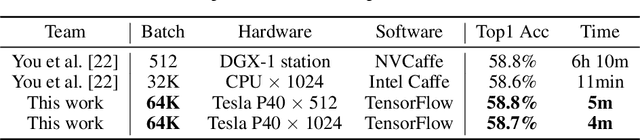
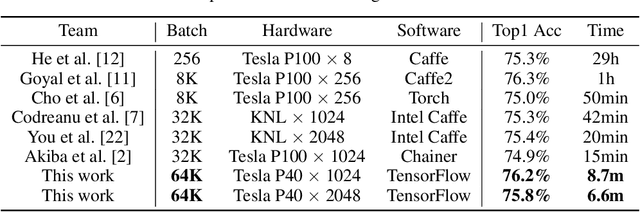
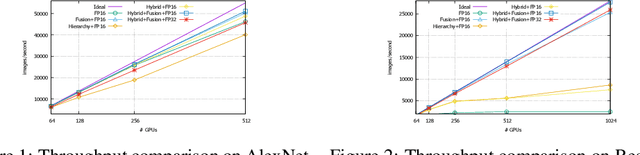
Synchronized stochastic gradient descent (SGD) optimizers with data parallelism are widely used in training large-scale deep neural networks. Although using larger mini-batch sizes can improve the system scalability by reducing the communication-to-computation ratio, it may hurt the generalization ability of the models. To this end, we build a highly scalable deep learning training system for dense GPU clusters with three main contributions: (1) We propose a mixed-precision training method that significantly improves the training throughput of a single GPU without losing accuracy. (2) We propose an optimization approach for extremely large mini-batch size (up to 64k) that can train CNN models on the ImageNet dataset without losing accuracy. (3) We propose highly optimized all-reduce algorithms that achieve up to 3x and 11x speedup on AlexNet and ResNet-50 respectively than NCCL-based training on a cluster with 1024 Tesla P40 GPUs. On training ResNet-50 with 90 epochs, the state-of-the-art GPU-based system with 1024 Tesla P100 GPUs spent 15 minutes and achieved 74.9\% top-1 test accuracy, and another KNL-based system with 2048 Intel KNLs spent 20 minutes and achieved 75.4\% accuracy. Our training system can achieve 75.8\% top-1 test accuracy in only 6.6 minutes using 2048 Tesla P40 GPUs. When training AlexNet with 95 epochs, our system can achieve 58.7\% top-1 test accuracy within 4 minutes, which also outperforms all other existing systems.