 Add to Chrome
 Add to Firefox
 Add to Edge
From Video to Control: A Survey of Learning Manipulation Interfaces from Temporal Visual Data
Apr 04, 2026
Video is a scalable observation of physical dynamics: it captures how objects move, how contact unfolds, and how scenes evolve under interaction -- all without requiring robot action labels. Yet translating this temporal structure into reliable robotic control remains an open challenge, because video lacks action supervision and differs from robot experience in embodiment, viewpoint, and physical constraints. This survey reviews methods that exploit non-action-annotated temporal video to learn control interfaces for robotic manipulation. We introduce an \emph{interface-centric taxonomy} organized by where the video-to-control interface is constructed and what control properties it enables, identifying three families: direct video--action policies, which keep the interface implicit; latent-action methods, which route temporal structure through a compact learned intermediate; and explicit visual interfaces, which predict interpretable targets for downstream control. For each family, we analyze control-integration properties -- how the loop is closed, what can be verified before execution, and where failures enter. A cross-family synthesis reveals that the most pressing open challenges center on the \emph{robotics integration layer} -- the mechanisms that connect video-derived predictions to dependable robot behavior -- and we outline research directions toward closing this gap.

Coordinated Defense Allocation in Reach-Avoid Scenarios with Efficient Online Optimization
Apr 01, 2023


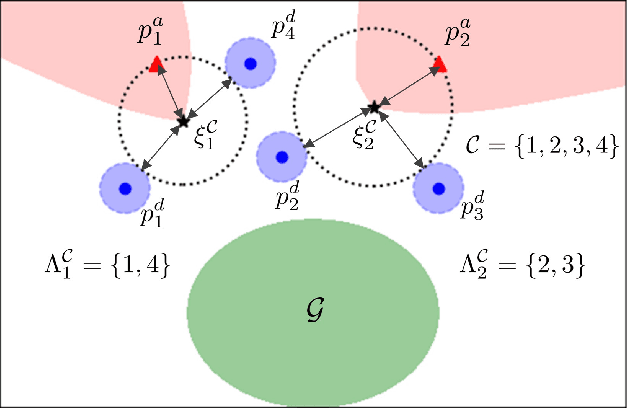
Deriving strategies for multiple agents under adversarial scenarios poses a significant challenge in attaining both optimality and efficiency. In this paper, we propose an efficient defense strategy for cooperative defense against a group of attackers in a convex environment. The defenders aim to minimize the total number of attackers that successfully enter the target set without prior knowledge of the attacker's strategy. Our approach involves a two-scale method that decomposes the problem into coordination against a single attacker and assigning defenders to attackers. We first develop a coordination strategy for multiple defenders against a single attacker, implementing online convex programming. This results in the maximum defense-winning region of initial joint states from which the defender can successfully defend against a single attacker. We then propose an allocation algorithm that significantly reduces computational effort required to solve the induced integer linear programming problem. The allocation guarantees defense performance enhancement as the game progresses. We perform various simulations to verify the efficiency of our algorithm compared to the state-of-the-art approaches, including the one using the Gazabo platform with Robot Operating System.