 Add to Chrome
 Add to Firefox
 Add to Edge
A Mixed-Reality Testbed for Autonomous Vehicles
Jun 17, 2026
We propose a mixed-reality, hardware-in-the-loop (HIL) testbed for autonomous vehicles that seamlessly integrates a physical testbed of mobile robots with a high-fidelity simulation environment. The virtual simulation enables the creation of diverse, safety-critical driving scenarios to validate state-of-the-art perception, planning, and control algorithms, while augmenting simulations with physical robots equipped with multimodal sensors in photorealistic virtual environments further facilitating rigorous validation. Our testbed also features vehicular connectivity using wireless communication and can accommodate a large number of agents through the combination of physical robots and virtual simulated agents, supporting research on multi-agent systems including Connected and Autonomous Vehicles (CAVs). Finally, we present a safety-guaranteed framework combining perception, planning and a novel online learning-based controller using Control Barrier Functions (CBFs) for CAVs. Experiments using the proposed framework are used to validate and demonstrate the key functionalities and the overall utility of the testbed to bridge the gap between simulation and real-world hardware deployment.

SpecRLBench: A Benchmark for Generalization in Specification-Guided Reinforcement Learning
Apr 27, 2026Specification-guided reinforcement learning (RL) provides a principled framework for encoding complex, temporally extended tasks using formal specifications such as linear temporal logic (LTL). While recent methods have shown promising results, their ability to generalize across unseen specifications and diverse environments remains insufficiently understood. In this work, we introduce SpecRLBench, a benchmark designed to evaluate the generalization capabilities of LTL-based specification-guided RL methods. The benchmark spans multiple difficulty levels across navigation and manipulation domains, incorporating both static and dynamic environments, diverse robot dynamics, and varied observation modalities. Through extensive empirical evaluation, we characterize the strengths and limitations of existing approaches and reveal the challenges that emerge as specification and environment complexity increase. SpecRLBench provides a structured platform for systematic comparison and supports the development of more generalizable specification-guided RL methods. Code is available at https://github.com/BU-DEPEND-Lab/SpecRLBench.
Multi-Robot Multi-Queue Control via Exhaustive Assignment Actor-Critic Learning
Apr 04, 2026We study online task allocation for multi-robot, multi-queue systems with asymmetric stochastic arrivals and switching delays. We formulate the problem in discrete time: each location can host at most one robot per slot, servicing a task consumes one slot, switching between locations incurs a one-slot travel delay, and arrivals at locations are independent Bernoulli processes with heterogeneous rates. Building on our previous structural result that optimal policies are of exhaustive type, we formulate a discounted-cost Markov decision process and develop an exhaustive-assignment actor-critic policy architecture that enforces exhaustive service by construction and learns only the next-queue allocation for idle robots. Unlike the exhaustive-serve-longest (ESL) queue rule, whose optimality is known only under symmetry, the proposed policy adapts to asymmetry in arrival rates. Across different server-location ratios, loads, and asymmetric arrival profiles, the proposed policy consistently achieves lower discounted holding cost and smaller mean queue length than the ESL baseline, while remaining near-optimal on instances where an optimal benchmark is available. These results show that structure-aware actor-critic methods provide an effective approach for real-time multi-robot scheduling.
VLM-UQBench: A Benchmark for Modality-Specific and Cross-Modality Uncertainties in Vision Language Models
Feb 09, 2026Uncertainty quantification (UQ) is vital for ensuring that vision-language models (VLMs) behave safely and reliably. A central challenge is to localize uncertainty to its source, determining whether it arises from the image, the text, or misalignment between the two. We introduce VLM-UQBench, a benchmark for modality-specific and cross-modal data uncertainty in VLMs, It consists of 600 real-world samples drawn from the VizWiz dataset, curated into clean, image-, text-, and cross-modal uncertainty subsets, and a scalable perturbation pipeline with 8 visual, 5 textual, and 3 cross-modal perturbations. We further propose two simple metrics that quantify the sensitivity of UQ scores to these perturbations and their correlation with hallucinations, and use them to evaluate a range of UQ methods across four VLMs and three datasets. Empirically, we find that: (i) existing UQ methods exhibit strong modality-specific specialization and substantial dependence on the underlying VLM, (ii) modality-specific uncertainty frequently co-occurs with hallucinations while current UQ scores provide only weak and inconsistent risk signals, and (iii) although UQ methods can rival reasoning-based chain-of-thought baselines on overt, group-level ambiguity, they largely fail to detect the subtle, instance-level ambiguity introduced by our perturbation pipeline. These results highlight a significant gap between current UQ practices and the fine-grained, modality-aware uncertainty required for reliable VLM deployment.
ReFORM: Reflected Flows for On-support Offline RL via Noise Manipulation
Feb 04, 2026Offline reinforcement learning (RL) aims to learn the optimal policy from a fixed dataset generated by behavior policies without additional environment interactions. One common challenge that arises in this setting is the out-of-distribution (OOD) error, which occurs when the policy leaves the training distribution. Prior methods penalize a statistical distance term to keep the policy close to the behavior policy, but this constrains policy improvement and may not completely prevent OOD actions. Another challenge is that the optimal policy distribution can be multimodal and difficult to represent. Recent works apply diffusion or flow policies to address this problem, but it is unclear how to avoid OOD errors while retaining policy expressiveness. We propose ReFORM, an offline RL method based on flow policies that enforces the less restrictive support constraint by construction. ReFORM learns a behavior cloning (BC) flow policy with a bounded source distribution to capture the support of the action distribution, then optimizes a reflected flow that generates bounded noise for the BC flow while keeping the support, to maximize the performance. Across 40 challenging tasks from the OGBench benchmark with datasets of varying quality and using a constant set of hyperparameters for all tasks, ReFORM dominates all baselines with hand-tuned hyperparameters on the performance profile curves.
Reinforcement Learning-based Receding Horizon Control using Adaptive Control Barrier Functions for Safety-Critical Systems
Mar 26, 2024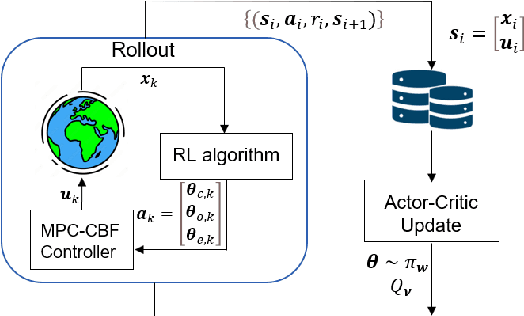
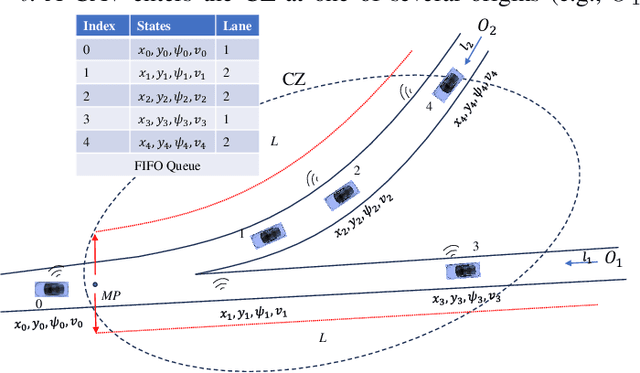
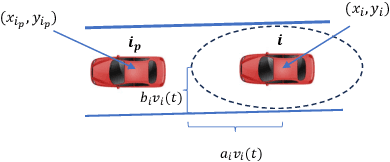
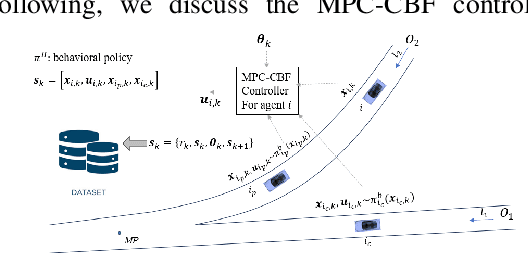
Optimal control methods provide solutions to safety-critical problems but easily become intractable. Control Barrier Functions (CBFs) have emerged as a popular technique that facilitates their solution by provably guaranteeing safety, through their forward invariance property, at the expense of some performance loss. This approach involves defining a performance objective alongside CBF-based safety constraints that must always be enforced. Unfortunately, both performance and solution feasibility can be significantly impacted by two key factors: (i) the selection of the cost function and associated parameters, and (ii) the calibration of parameters within the CBF-based constraints, which capture the trade-off between performance and conservativeness. %as well as infeasibility. To address these challenges, we propose a Reinforcement Learning (RL)-based Receding Horizon Control (RHC) approach leveraging Model Predictive Control (MPC) with CBFs (MPC-CBF). In particular, we parameterize our controller and use bilevel optimization, where RL is used to learn the optimal parameters while MPC computes the optimal control input. We validate our method by applying it to the challenging automated merging control problem for Connected and Automated Vehicles (CAVs) at conflicting roadways. Results demonstrate improved performance and a significant reduction in the number of infeasible cases compared to traditional heuristic approaches used for tuning CBF-based controllers, showcasing the effectiveness of the proposed method.
Optimal Control of Connected Automated Vehicles with Event-Triggered Control Barrier Functions: a Test Bed for Safe Optimal Merging
Jun 02, 2023

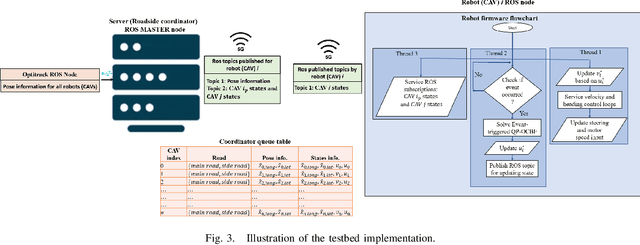

We address the problem of controlling Connected and Automated Vehicles (CAVs) in conflict areas of a traffic network subject to hard safety constraints. It has been shown that such problems can be solved through a combination of tractable optimal control problems and Control Barrier Functions (CBFs) that guarantee the satisfaction of all constraints. These solutions can be reduced to a sequence of Quadratic Programs (QPs) which are efficiently solved on line over discrete time steps. However, guaranteeing the feasibility of the CBF-based QP method within each discretized time interval requires the careful selection of time steps which need to be sufficiently small. This creates computational requirements and communication rates between agents which may hinder the controller's application to real CAVs. In this paper, we overcome this limitation by adopting an event-triggered approach for CAVs in a conflict area such that the next QP is triggered by properly defined events with a safety guarantee. We present a laboratory-scale test bed we have developed to emulate merging roadways using mobile robots as CAVs which can be used to demonstrate how the event-triggered scheme is computationally efficient and can handle measurement uncertainties and noise compared to time-driven control while guaranteeing safety.