 Add to Chrome
 Add to Firefox
 Add to Edge
Stop Wandering: Efficient Vision-Language Navigation via Metacognitive Reasoning
Apr 02, 2026
Training-free Vision-Language Navigation (VLN) agents powered by foundation models can follow instructions and explore 3D environments. However, existing approaches rely on greedy frontier selection and passive spatial memory, leading to inefficient behaviors such as local oscillation and redundant revisiting. We argue that this stems from a lack of metacognitive capabilities: the agent cannot monitor its exploration progress, diagnose strategy failures, or adapt accordingly. To address this, we propose MetaNav, a metacognitive navigation agent integrating spatial memory, history-aware planning, and reflective correction. Spatial memory builds a persistent 3D semantic map. History-aware planning penalizes revisiting to improve efficiency. Reflective correction detects stagnation and uses an LLM to generate corrective rules that guide future frontier selection. Experiments on GOAT-Bench, HM3D-OVON, and A-EQA show that MetaNav achieves state-of-the-art performance while reducing VLM queries by 20.7%, demonstrating that metacognitive reasoning significantly improves robustness and efficiency.

Multi-Agent Reinforcement Learning with Shared Resources for Inventory Management
Dec 18, 2022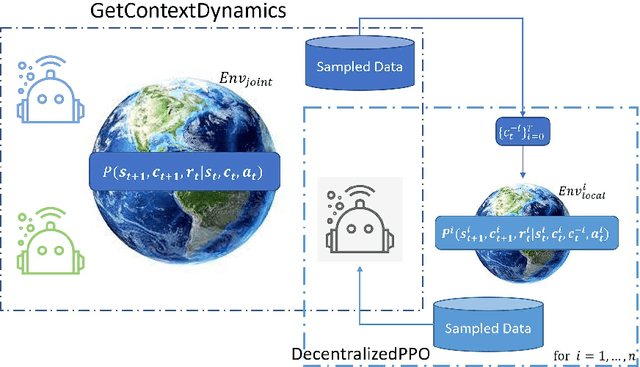


In this paper, we consider the inventory management (IM) problem where we need to make replenishment decisions for a large number of stock keeping units (SKUs) to balance their supply and demand. In our setting, the constraint on the shared resources (such as the inventory capacity) couples the otherwise independent control for each SKU. We formulate the problem with this structure as Shared-Resource Stochastic Game (SRSG)and propose an efficient algorithm called Context-aware Decentralized PPO (CD-PPO). Through extensive experiments, we demonstrate that CD-PPO can accelerate the learning procedure compared with standard MARL algorithms.