 Add to Chrome
 Add to Firefox
 Add to Edge
Stop Wandering: Efficient Vision-Language Navigation via Metacognitive Reasoning
Apr 02, 2026
Training-free Vision-Language Navigation (VLN) agents powered by foundation models can follow instructions and explore 3D environments. However, existing approaches rely on greedy frontier selection and passive spatial memory, leading to inefficient behaviors such as local oscillation and redundant revisiting. We argue that this stems from a lack of metacognitive capabilities: the agent cannot monitor its exploration progress, diagnose strategy failures, or adapt accordingly. To address this, we propose MetaNav, a metacognitive navigation agent integrating spatial memory, history-aware planning, and reflective correction. Spatial memory builds a persistent 3D semantic map. History-aware planning penalizes revisiting to improve efficiency. Reflective correction detects stagnation and uses an LLM to generate corrective rules that guide future frontier selection. Experiments on GOAT-Bench, HM3D-OVON, and A-EQA show that MetaNav achieves state-of-the-art performance while reducing VLM queries by 20.7%, demonstrating that metacognitive reasoning significantly improves robustness and efficiency.

Duration-adaptive Video Highlight Pre-caching for Vehicular Communication Network
Sep 05, 2023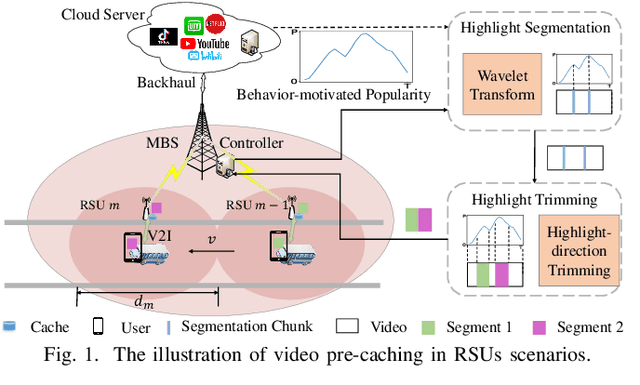
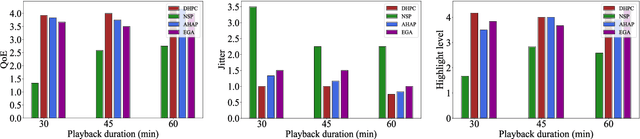
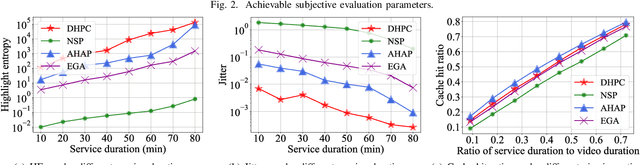
Video traffic in vehicular communication networks (VCNs) faces exponential growth. However, different segments of most videos reveal various attractiveness for viewers, and the pre-caching decision is greatly affected by the dynamic service duration that edge nodes can provide services for mobile vehicles driving along a road. In this paper, we propose an efficient video highlight pre-caching scheme in the vehicular communication network, adapting to the service duration. Specifically, a highlight entropy model is devised with the consideration of the segments' popularity and continuity between segments within a period of time, based on which, an optimization problem of video highlight pre-caching is formulated. As this problem is non-convex and lacks a closed-form expression of the objective function, we decouple multiple variables by deriving candidate highlight segmentations of videos through wavelet transform, which can significantly reduce the complexity of highlight pre-caching. Then the problem is solved iteratively by a highlight-direction trimming algorithm, which is proven to be locally optimal. Simulation results based on real-world video datasets demonstrate significant improvement in highlight entropy and jitter compared to benchmark schemes.