 Add to Chrome
 Add to Firefox
 Add to Edge
Stop Wandering: Efficient Vision-Language Navigation via Metacognitive Reasoning
Apr 02, 2026
Training-free Vision-Language Navigation (VLN) agents powered by foundation models can follow instructions and explore 3D environments. However, existing approaches rely on greedy frontier selection and passive spatial memory, leading to inefficient behaviors such as local oscillation and redundant revisiting. We argue that this stems from a lack of metacognitive capabilities: the agent cannot monitor its exploration progress, diagnose strategy failures, or adapt accordingly. To address this, we propose MetaNav, a metacognitive navigation agent integrating spatial memory, history-aware planning, and reflective correction. Spatial memory builds a persistent 3D semantic map. History-aware planning penalizes revisiting to improve efficiency. Reflective correction detects stagnation and uses an LLM to generate corrective rules that guide future frontier selection. Experiments on GOAT-Bench, HM3D-OVON, and A-EQA show that MetaNav achieves state-of-the-art performance while reducing VLM queries by 20.7%, demonstrating that metacognitive reasoning significantly improves robustness and efficiency.

pvCNN: Privacy-Preserving and Verifiable Convolutional Neural Network Testing
Jan 23, 2022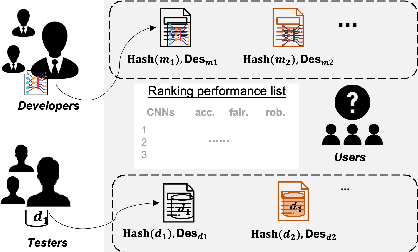
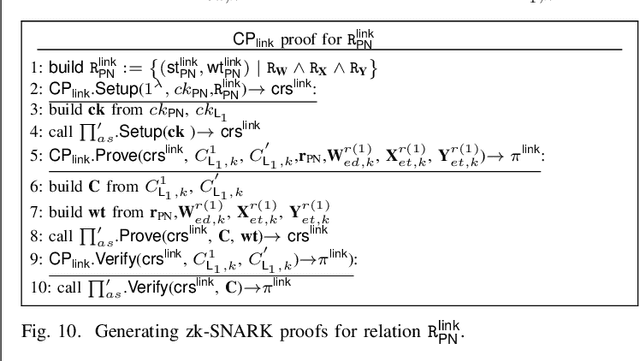
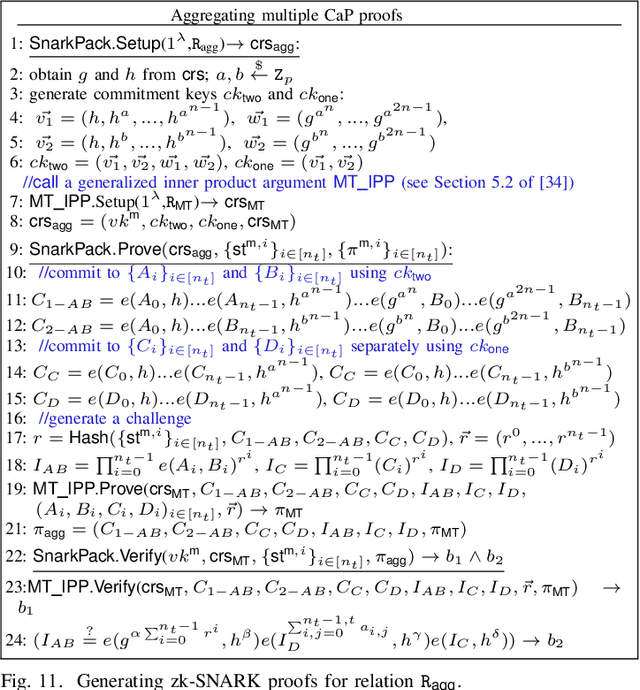
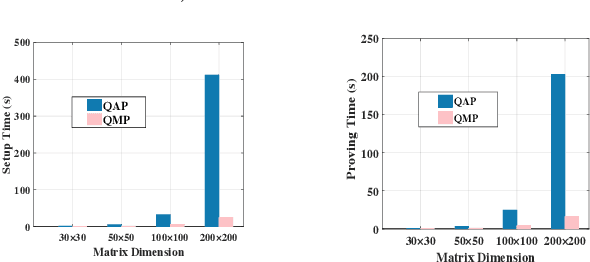
This paper proposes a new approach for privacy-preserving and verifiable convolutional neural network (CNN) testing, enabling a CNN model developer to convince a user of the truthful CNN performance over non-public data from multiple testers, while respecting model privacy. To balance the security and efficiency issues, three new efforts are done by appropriately integrating homomorphic encryption (HE) and zero-knowledge succinct non-interactive argument of knowledge (zk-SNARK) primitives with the CNN testing. First, a CNN model to be tested is strategically partitioned into a private part kept locally by the model developer, and a public part outsourced to an outside server. Then, the private part runs over HE-protected test data sent by a tester and transmits its outputs to the public part for accomplishing subsequent computations of the CNN testing. Second, the correctness of the above CNN testing is enforced by generating zk-SNARK based proofs, with an emphasis on optimizing proving overhead for two-dimensional (2-D) convolution operations, since the operations dominate the performance bottleneck during generating proofs. We specifically present a new quadratic matrix programs (QMPs)-based arithmetic circuit with a single multiplication gate for expressing 2-D convolution operations between multiple filters and inputs in a batch manner. Third, we aggregate multiple proofs with respect to a same CNN model but different testers' test data (i.e., different statements) into one proof, and ensure that the validity of the aggregated proof implies the validity of the original multiple proofs. Lastly, our experimental results demonstrate that our QMPs-based zk-SNARK performs nearly 13.9$\times$faster than the existing QAPs-based zk-SNARK in proving time, and 17.6$\times$faster in Setup time, for high-dimension matrix multiplication.