 Add to Chrome
 Add to Firefox
 Add to Edge
Leveraging Image Generators to Address Training Data Scarcity: The Gen4Regen Dataset for Forest Regeneration Mapping
May 07, 2026
Sustainable forest management relies on precise species composition mapping, yet traditional ground surveys are labour-intensive and geographically constrained. While Uncrewed Aerial Vehicles (UAVs) offer scalable data collection, the transition to deep learning-based interpretation is bottlenecked by the severe scarcity of expert-annotated imagery, particularly in complex, visually heterogeneous regeneration zones. This paper addresses the dual challenges of data scarcity and extreme class imbalance in the semantic segmentation of fine-grained forest regeneration species by providing a scalable framework that reduces reliance on manual photo-interpretation for high-resolution, millimetre-level aerial imagery. Importantly, we leverage the large-scale vision-language Nano Banana Pro model to simultaneously generate high-fidelity images and their corresponding pixel-aligned semantic masks from prompts. We introduce WilDReF-Q-V2, an expansion of a natural forest dataset with 13 977 new unlabelled and 50 labelled real images, as well as the Gen4Regen dataset, featuring 2101 pairs of synthetic images and semantic masks. Our methodology integrates real-world data with AI-generated images, highlighting that AI-generated data is highly complementary to real-world data, with unified training yielding an F1 score improvement of over 15 %pt compared to purely supervised baselines. Furthermore, we demonstrate that even small quantities of prompt-generated data significantly improve performance for underrepresented species, some of which saw per-species F1 score gains of up to 30 %pt. We conclude that vision-language models can serve as agile data generators, effectively bootstrapping perception tasks for niche AI domains where expert labels are scarce or unavailable. Our datasets, source code, and models will be available at https://norlab-ulaval.github.io/gen4regen.

FoMo: A Multi-Season Dataset for Robot Navigation in Forêt Montmorency
Mar 09, 2026The Forêt Montmorency (FoMo) dataset is a comprehensive multi-season data collection, recorded over the span of one year in a boreal forest. Featuring a unique combination of on- and off-pavement environments with significant environmental changes, the dataset challenges established odometry and SLAM pipelines. Some highlights of the data include the accumulation of snow exceeding 1 m, significant vegetation growth in front of sensors, and operations at the traction limits of the platform. In total, the FoMo dataset includes over 64 km of six diverse trajectories, repeated during 12 deployments throughout the year. The dataset features data from one rotating and one hybrid solid-state lidar, a Frequency Modulated Continuous Wave (FMCW) radar, full-HD images from a stereo camera and a wide lens monocular camera, as well as data from two IMUs. Ground Truth is calculated by post-processing three GNSS receivers mounted on the Uncrewed Ground Vehicle (UGV) and a static GNSS base station. Additional metadata, such as one measurement per minute from an on-site weather station, camera calibration intrinsics, and vehicle power consumption, is available for all sequences. To highlight the relevance of the dataset, we performed a preliminary evaluation of the robustness of a lidar-inertial, radar-gyro, and a visual-inertial localization and mapping techniques to seasonal changes. We show that seasonal changes have serious effects on the re-localization capabilities of the state-of-the-art methods. The dataset and development kit are available at https://fomo.norlab.ulaval.ca.
SilvaScenes: Tree Segmentation and Species Classification from Under-Canopy Images in Natural Forests
Oct 10, 2025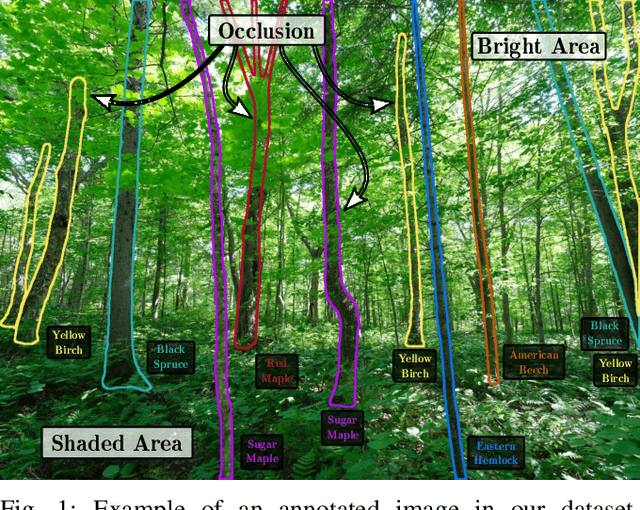
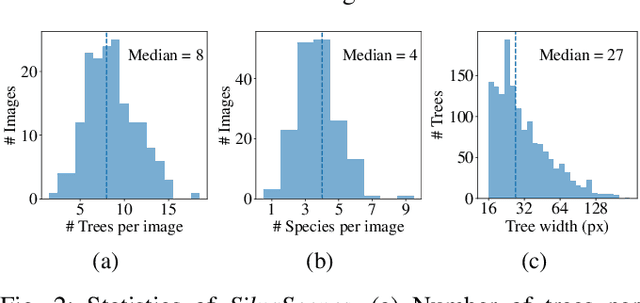
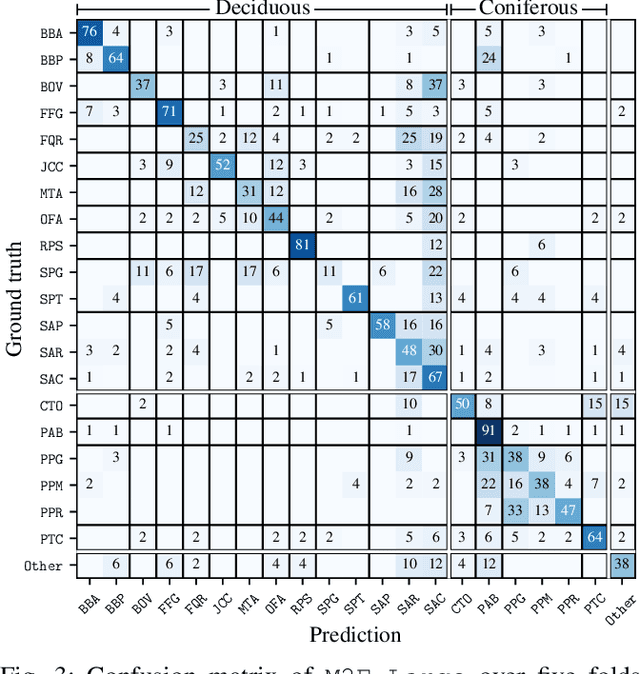
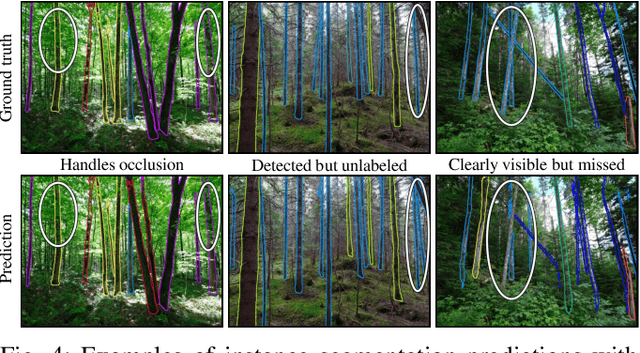
Interest in robotics for forest management is growing, but perception in complex, natural environments remains a significant hurdle. Conditions such as heavy occlusion, variable lighting, and dense vegetation pose challenges to automated systems, which are essential for precision forestry, biodiversity monitoring, and the automation of forestry equipment. These tasks rely on advanced perceptual capabilities, such as detection and fine-grained species classification of individual trees. Yet, existing datasets are inadequate to develop such perception systems, as they often focus on urban settings or a limited number of species. To address this, we present SilvaScenes, a new dataset for instance segmentation of tree species from under-canopy images. Collected across five bioclimatic domains in Quebec, Canada, SilvaScenes features 1476 trees from 24 species with annotations from forestry experts. We demonstrate the relevance and challenging nature of our dataset by benchmarking modern deep learning approaches for instance segmentation. Our results show that, while tree segmentation is easy, with a top mean average precision (mAP) of 67.65%, species classification remains a significant challenge with an mAP of only 35.69%. Our dataset and source code will be available at https://github.com/norlab-ulaval/SilvaScenes.