 Add to Chrome
 Add to Firefox
 Add to Edge
Leveraging Image Generators to Address Training Data Scarcity: The Gen4Regen Dataset for Forest Regeneration Mapping
May 07, 2026
Sustainable forest management relies on precise species composition mapping, yet traditional ground surveys are labour-intensive and geographically constrained. While Uncrewed Aerial Vehicles (UAVs) offer scalable data collection, the transition to deep learning-based interpretation is bottlenecked by the severe scarcity of expert-annotated imagery, particularly in complex, visually heterogeneous regeneration zones. This paper addresses the dual challenges of data scarcity and extreme class imbalance in the semantic segmentation of fine-grained forest regeneration species by providing a scalable framework that reduces reliance on manual photo-interpretation for high-resolution, millimetre-level aerial imagery. Importantly, we leverage the large-scale vision-language Nano Banana Pro model to simultaneously generate high-fidelity images and their corresponding pixel-aligned semantic masks from prompts. We introduce WilDReF-Q-V2, an expansion of a natural forest dataset with 13 977 new unlabelled and 50 labelled real images, as well as the Gen4Regen dataset, featuring 2101 pairs of synthetic images and semantic masks. Our methodology integrates real-world data with AI-generated images, highlighting that AI-generated data is highly complementary to real-world data, with unified training yielding an F1 score improvement of over 15 %pt compared to purely supervised baselines. Furthermore, we demonstrate that even small quantities of prompt-generated data significantly improve performance for underrepresented species, some of which saw per-species F1 score gains of up to 30 %pt. We conclude that vision-language models can serve as agile data generators, effectively bootstrapping perception tasks for niche AI domains where expert labels are scarce or unavailable. Our datasets, source code, and models will be available at https://norlab-ulaval.github.io/gen4regen.

Radar Odometry Subject to High Tilt Dynamics of Subarctic Environments
Apr 21, 2026Rotating FMCW radar odometry methods often assume flat ground conditions. While this assumption is sufficient in many scenarios, including urban environments or flat mining setups, the highly dynamic terrain of subarctic environments poses a challenge to standard feature extraction and state estimation techniques. This paper benchmarks three existing radar odometry methods under demanding conditions, exhibiting up to 13° in pitch and 4° in roll difference between consecutive scans, with absolute pitch and roll reaching 30° and 8°, respectively. Furthermore, we propose a novel radar-inertial odometry method utilizing tilt-proximity submap search and a hard threshold for vertical displacement between scan points and the estimated axis of rotation. Experimental results demonstrate a state-of-the-art performance of our method on an urban baseline and a 0.3% improvement over the second-best comparative method on a 2-kilometer-long dynamic trajectory. Finally, we analyze the performance of the four evaluated methods on a complex radar sequence characterized by high lateral slip and a steep ditch traversal.
FoMo: A Multi-Season Dataset for Robot Navigation in Forêt Montmorency
Mar 09, 2026The Forêt Montmorency (FoMo) dataset is a comprehensive multi-season data collection, recorded over the span of one year in a boreal forest. Featuring a unique combination of on- and off-pavement environments with significant environmental changes, the dataset challenges established odometry and SLAM pipelines. Some highlights of the data include the accumulation of snow exceeding 1 m, significant vegetation growth in front of sensors, and operations at the traction limits of the platform. In total, the FoMo dataset includes over 64 km of six diverse trajectories, repeated during 12 deployments throughout the year. The dataset features data from one rotating and one hybrid solid-state lidar, a Frequency Modulated Continuous Wave (FMCW) radar, full-HD images from a stereo camera and a wide lens monocular camera, as well as data from two IMUs. Ground Truth is calculated by post-processing three GNSS receivers mounted on the Uncrewed Ground Vehicle (UGV) and a static GNSS base station. Additional metadata, such as one measurement per minute from an on-site weather station, camera calibration intrinsics, and vehicle power consumption, is available for all sequences. To highlight the relevance of the dataset, we performed a preliminary evaluation of the robustness of a lidar-inertial, radar-gyro, and a visual-inertial localization and mapping techniques to seasonal changes. We show that seasonal changes have serious effects on the re-localization capabilities of the state-of-the-art methods. The dataset and development kit are available at https://fomo.norlab.ulaval.ca.
SilvaScenes: Tree Segmentation and Species Classification from Under-Canopy Images in Natural Forests
Oct 10, 2025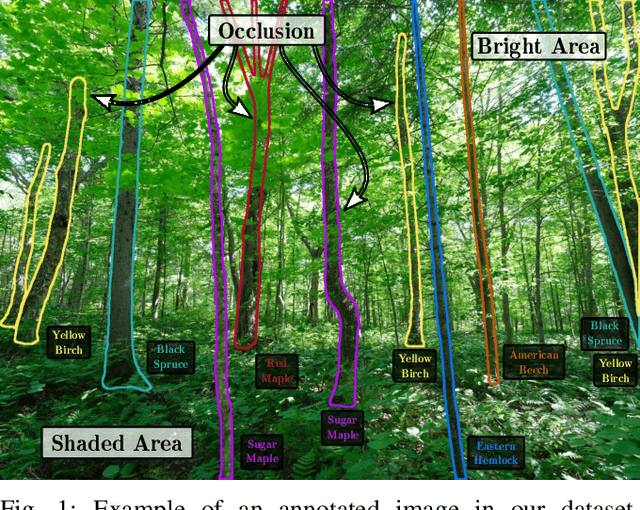
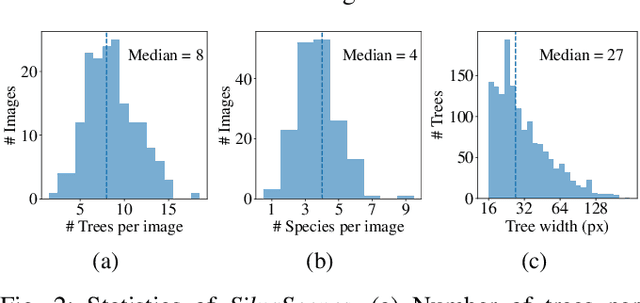
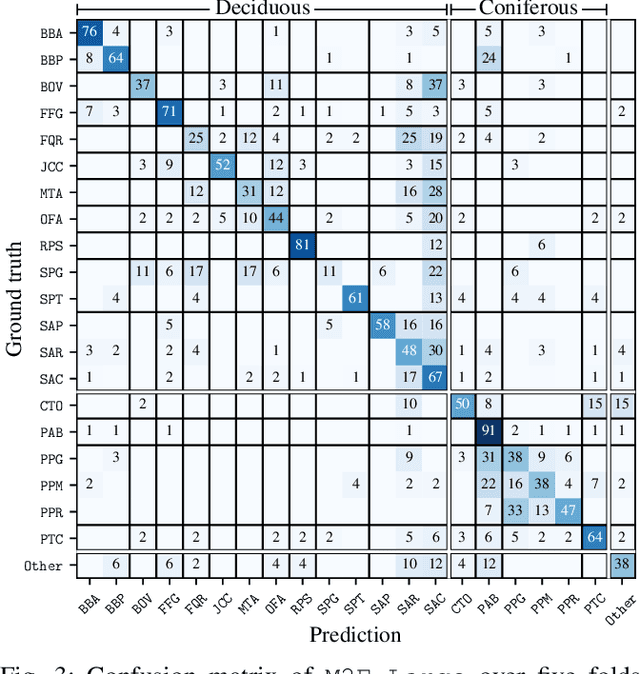
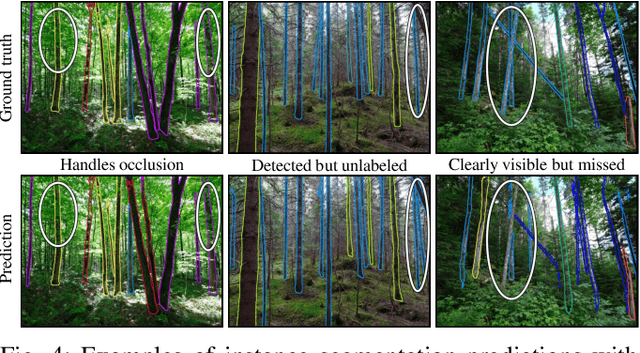
Interest in robotics for forest management is growing, but perception in complex, natural environments remains a significant hurdle. Conditions such as heavy occlusion, variable lighting, and dense vegetation pose challenges to automated systems, which are essential for precision forestry, biodiversity monitoring, and the automation of forestry equipment. These tasks rely on advanced perceptual capabilities, such as detection and fine-grained species classification of individual trees. Yet, existing datasets are inadequate to develop such perception systems, as they often focus on urban settings or a limited number of species. To address this, we present SilvaScenes, a new dataset for instance segmentation of tree species from under-canopy images. Collected across five bioclimatic domains in Quebec, Canada, SilvaScenes features 1476 trees from 24 species with annotations from forestry experts. We demonstrate the relevance and challenging nature of our dataset by benchmarking modern deep learning approaches for instance segmentation. Our results show that, while tree segmentation is easy, with a top mean average precision (mAP) of 67.65%, species classification remains a significant challenge with an mAP of only 35.69%. Our dataset and source code will be available at https://github.com/norlab-ulaval/SilvaScenes.
Toward Teach and Repeat Across Seasonal Deep Snow Accumulation
May 02, 2025Teach and repeat is a rapid way to achieve autonomy in challenging terrain and off-road environments. A human operator pilots the vehicles to create a network of paths that are mapped and associated with odometry. Immediately after teaching, the system can drive autonomously within its tracks. This precision lets operators remain confident that the robot will follow a traversable route. However, this operational paradigm has rarely been explored in off-road environments that change significantly through seasonal variation. This paper presents preliminary field trials using lidar and radar implementations of teach and repeat. Using a subset of the data from the upcoming FoMo dataset, we attempted to repeat routes that were 4 days, 44 days, and 113 days old. Lidar teach and repeat demonstrated a stronger ability to localize when the ground points were removed. FMCW radar was often able to localize on older maps, but only with small deviations from the taught path. Additionally, we highlight specific cases where radar localization failed with recent maps due to the high pitch or roll of the vehicle. We highlight lessons learned during the field deployment and highlight areas to improve to achieve reliable teach and repeat with seasonal changes in the environment. Please follow the dataset at https://norlab-ulaval.github.io/FoMo-website for updates and information on the data release.
ASAP-MO:Advanced Situational Awareness and Perception for Mission-critical Operations
May 02, 2025Deploying robotic missions can be challenging due to the complexity of controlling robots with multiple degrees of freedom, fusing diverse sensory inputs, and managing communication delays and interferences. In nuclear inspection, robots can be crucial in assessing environments where human presence is limited, requiring precise teleoperation and coordination. Teleoperation requires extensive training, as operators must process multiple outputs while ensuring safe interaction with critical assets. These challenges are amplified when operating a fleet of heterogeneous robots across multiple environments, as each robot may have distinct control interfaces, sensory systems, and operational constraints. Efficient coordination in such settings remains an open problem. This paper presents a field report on how we integrated robot fleet capabilities - including mapping, localization, and telecommunication - toward a joint mission. We simulated a nuclear inspection scenario for exposed areas, using lights to represent a radiation source. We deployed two Unmanned Ground Vehicles (UGVs) tasked with mapping indoor and outdoor environments while remotely controlled from a single base station. Despite having distinct operational goals, the robots produced a unified map output, demonstrating the feasibility of coordinated multi-robot missions. Our results highlight key operational challenges and provide insights into improving adaptability and situational awareness in remote robotic deployments.
Under Pressure: Altimeter-Aided ICP for 3D Maps Consistency
Oct 01, 2024We propose a novel method to enhance the accuracy of the Iterative Closest Point (ICP) algorithm by integrating altitude constraints from a barometric pressure sensor. While ICP is widely used in mobile robotics for Simultaneous Localization and Mapping ( SLAM ), it is susceptible to drift, especially in underconstrained environments such as vertical shafts. To address this issue, we propose to augment ICP with altimeter measurements, reliably constraining drifts along the gravity vector. To demonstrate the potential of altimetry in SLAM , we offer an analysis of calibration procedures and noise sensitivity of various pressure sensors, improving measurements to centimeter-level accuracy. Leveraging this accuracy, we propose a novel ICP formulation that integrates altitude measurements along the gravity vector, thus simplifying the optimization problem to 3-Degree Of Freedom (DOF). Experimental results from real-world deployments demonstrate that our method reduces vertical drift by 84% and improves overall localization accuracy compared to state-of-the-art methods in non-planar environments.
UAV-Assisted Self-Supervised Terrain Awareness for Off-Road Navigation
Sep 26, 2024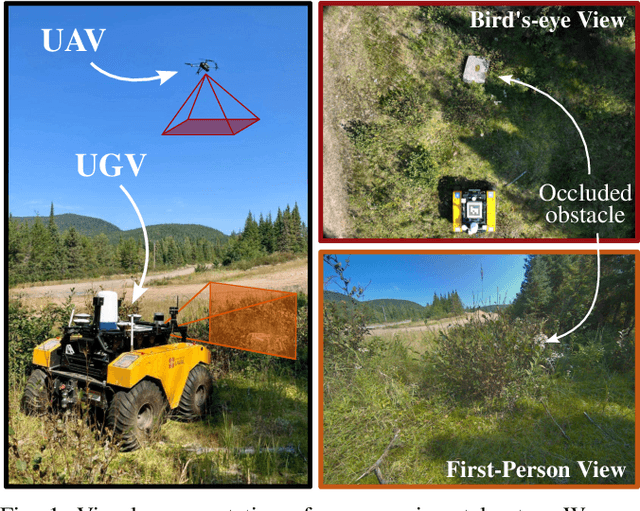
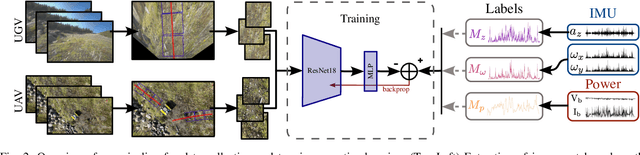
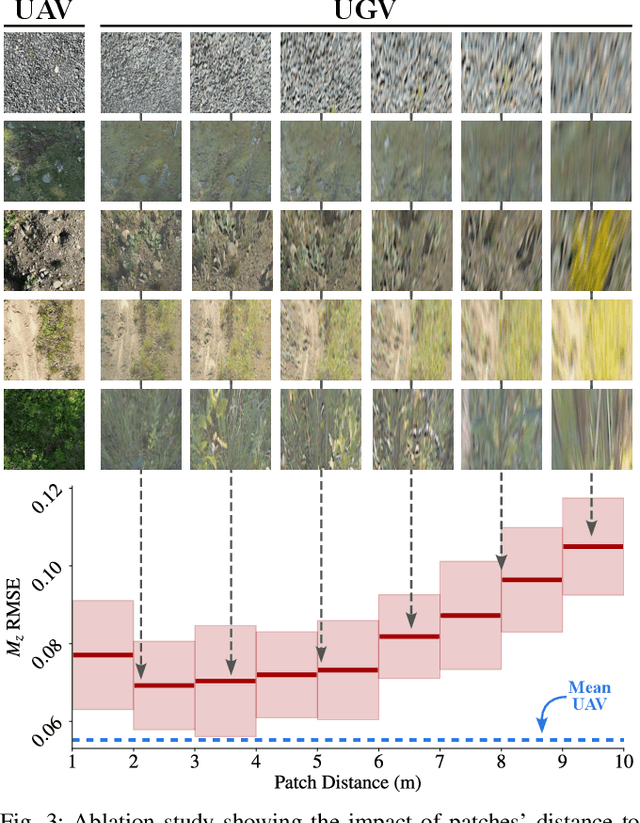
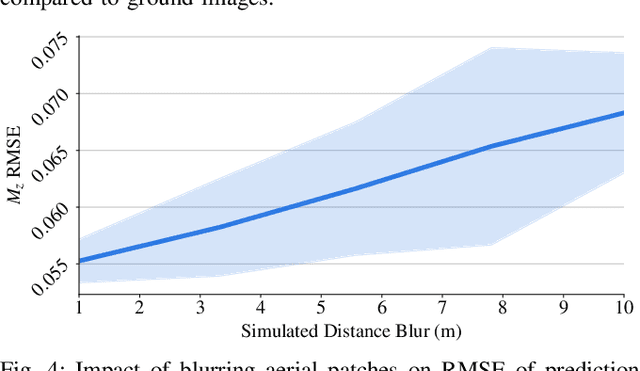
Terrain awareness is an essential milestone to enable truly autonomous off-road navigation. Accurately predicting terrain characteristics allows optimizing a vehicle's path against potential hazards. Recent methods use deep neural networks to predict traversability-related terrain properties in a self-supervised manner, relying on proprioception as a training signal. However, onboard cameras are inherently limited by their point-of-view relative to the ground, suffering from occlusions and vanishing pixel density with distance. This paper introduces a novel approach for self-supervised terrain characterization using an aerial perspective from a hovering drone. We capture terrain-aligned images while sampling the environment with a ground vehicle, effectively training a simple predictor for vibrations, bumpiness, and energy consumption. Our dataset includes 2.8 km of off-road data collected in forest environment, comprising 13 484 ground-based images and 12 935 aerial images. Our findings show that drone imagery improves terrain property prediction by 21.37 % on the whole dataset and 37.35 % in high vegetation, compared to ground robot images. We conduct ablation studies to identify the main causes of these performance improvements. We also demonstrate the real-world applicability of our approach by scouting an unseen area with a drone, planning and executing an optimized path on the ground.
Field Report on a Wearable and Versatile Solution for Field Acquisition and Exploration
Apr 30, 2024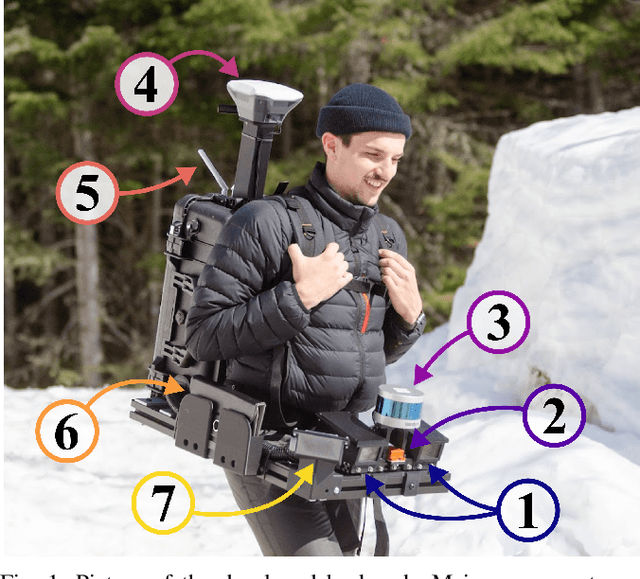
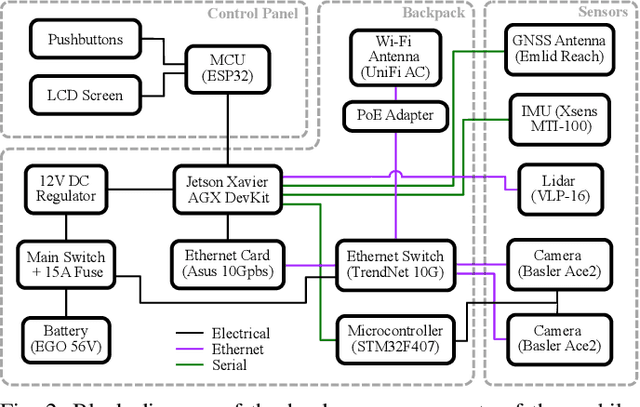
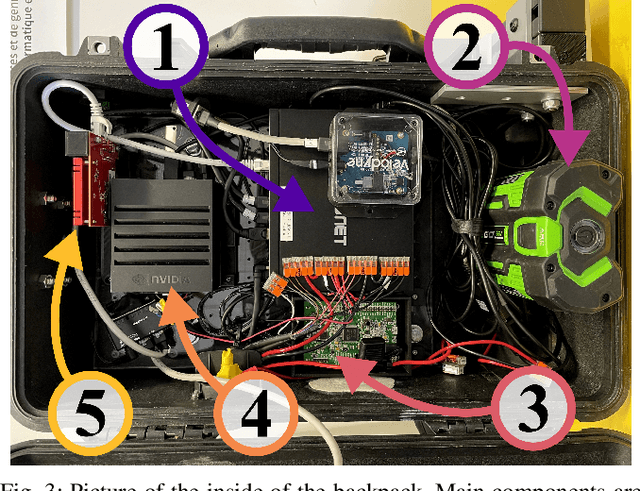
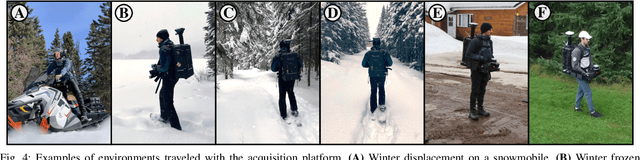
This report presents a wearable plug-and-play platform for data acquisition in the field. The platform, extending a waterproof Pelican Case into a 20 kg backpack offers 5.5 hours of power autonomy, while recording data with two cameras, a lidar, an Inertial Measurement Unit (IMU), and a Global Navigation Satellite System (GNSS) receiver. The system only requires a single operator and is readily controlled with a built-in screen and buttons. Due to its small footprint, it offers greater flexibility than large vehicles typically deployed in off-trail environments. We describe the platform's design, detailing the mechanical parts, electrical components, and software stack. We explain the system's limitations, drawing from its extensive deployment spanning over 20 kilometers of trajectories across various seasons, environments, and weather conditions. We derive valuable lessons learned from these deployments and present several possible applications for the system. The possible use cases consider not only academic research but also insights from consultations with our industrial partners. The mechanical design including all CAD files, as well as the software stack, are publicly available at https://github.com/norlab-ulaval/backpack_workspace.
Comparing Motion Distortion Between Vehicle Field Deployments
Apr 30, 2024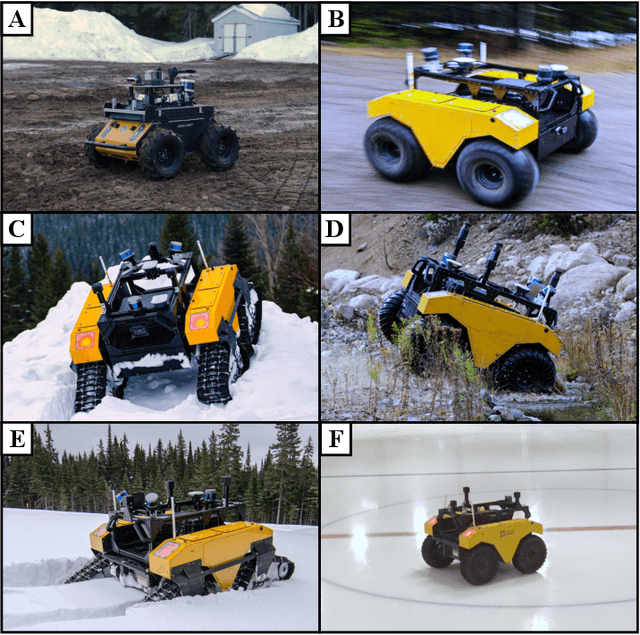
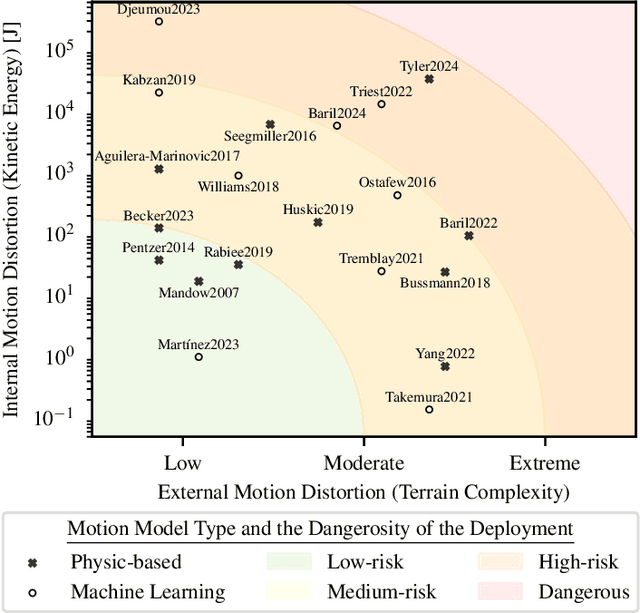
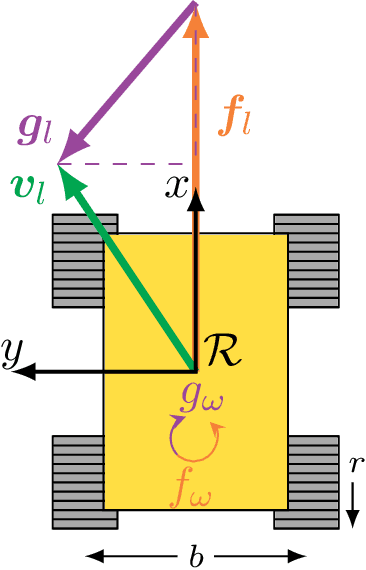
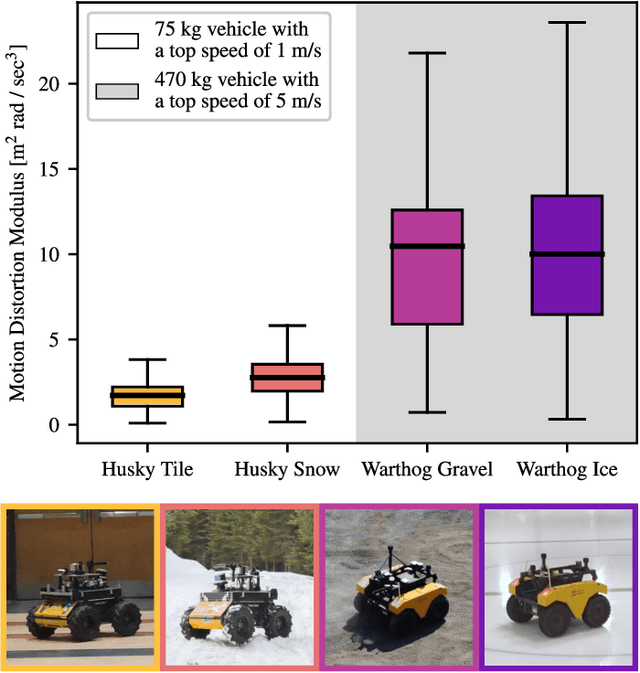
Recent advances in autonomous driving for uncrewed ground vehicles (UGVs) have spurred significant development, particularly in challenging terrains. This paper introduces a classification system assessing various UGV deployments reported in the literature. Our approach considers motion distortion features that include internal UGV features, such as mass and speed, and external features, such as terrain complexity, which all influence the efficiency of models and navigation systems. We present results that map UGV deployments relative to vehicle kinetic energy and terrain complexity, providing insights into the level of complexity and risk associated with different operational environments. Additionally, we propose a motion distortion metric to assess UGV navigation performance that does not require an explicit quantification of motion distortion features. Using this metric, we conduct a case study to illustrate the impact of motion distortion features on modeling accuracy. This research advocates for creating a comprehensive database containing many different motion distortion features, which would contribute to advancing the understanding of autonomous driving capabilities in rough conditions and provide a validation framework for future developments in UGV navigation systems.