 Add to Chrome
 Add to Firefox
 Add to Edge
Leveraging Image Generators to Address Training Data Scarcity: The Gen4Regen Dataset for Forest Regeneration Mapping
May 07, 2026
Sustainable forest management relies on precise species composition mapping, yet traditional ground surveys are labour-intensive and geographically constrained. While Uncrewed Aerial Vehicles (UAVs) offer scalable data collection, the transition to deep learning-based interpretation is bottlenecked by the severe scarcity of expert-annotated imagery, particularly in complex, visually heterogeneous regeneration zones. This paper addresses the dual challenges of data scarcity and extreme class imbalance in the semantic segmentation of fine-grained forest regeneration species by providing a scalable framework that reduces reliance on manual photo-interpretation for high-resolution, millimetre-level aerial imagery. Importantly, we leverage the large-scale vision-language Nano Banana Pro model to simultaneously generate high-fidelity images and their corresponding pixel-aligned semantic masks from prompts. We introduce WilDReF-Q-V2, an expansion of a natural forest dataset with 13 977 new unlabelled and 50 labelled real images, as well as the Gen4Regen dataset, featuring 2101 pairs of synthetic images and semantic masks. Our methodology integrates real-world data with AI-generated images, highlighting that AI-generated data is highly complementary to real-world data, with unified training yielding an F1 score improvement of over 15 %pt compared to purely supervised baselines. Furthermore, we demonstrate that even small quantities of prompt-generated data significantly improve performance for underrepresented species, some of which saw per-species F1 score gains of up to 30 %pt. We conclude that vision-language models can serve as agile data generators, effectively bootstrapping perception tasks for niche AI domains where expert labels are scarce or unavailable. Our datasets, source code, and models will be available at https://norlab-ulaval.github.io/gen4regen.

Toward Faithful Explanations in Acoustic Anomaly Detection
Jan 19, 2026Interpretability is essential for user trust in real-world anomaly detection applications. However, deep learning models, despite their strong performance, often lack transparency. In this work, we study the interpretability of autoencoder-based models for audio anomaly detection, by comparing a standard autoencoder (AE) with a mask autoencoder (MAE) in terms of detection performance and interpretability. We applied several attribution methods, including error maps, saliency maps, SmoothGrad, Integrated Gradients, GradSHAP, and Grad-CAM. Although MAE shows a slightly lower detection, it consistently provides more faithful and temporally precise explanations, suggesting a better alignment with true anomalies. To assess the relevance of the regions highlighted by the explanation method, we propose a perturbation-based faithfulness metric that replaces them with their reconstructions to simulate normal input. Our findings, based on experiments in a real industrial scenario, highlight the importance of incorporating interpretability into anomaly detection pipelines and show that masked training improves explanation quality without compromising performance.
Planing It by Ear: Convolutional Neural Networks for Acoustic Anomaly Detection in Industrial Wood Planers
Jan 08, 2025

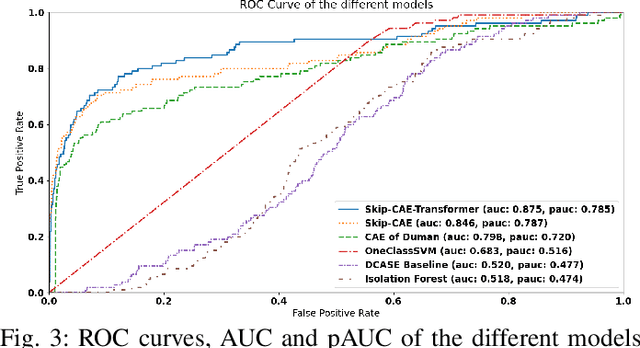

In recent years, the wood product industry has been facing a skilled labor shortage. The result is more frequent sudden failures, resulting in additional costs for these companies already operating in a very competitive market. Moreover, sawmills are challenging environments for machinery and sensors. Given that experienced machine operators may be able to diagnose defects or malfunctions, one possible way of assisting novice operators is through acoustic monitoring. As a step towards the automation of wood-processing equipment and decision support systems for machine operators, in this paper, we explore using a deep convolutional autoencoder for acoustic anomaly detection of wood planers on a new real-life dataset. Specifically, our convolutional autoencoder with skip connections (Skip-CAE) and our Skip-CAE transformer outperform the DCASE autoencoder baseline, one-class SVM, isolation forest and a published convolutional autoencoder architecture, respectively obtaining an area under the ROC curve of 0.846 and 0.875 on a dataset of real-factory planer sounds. Moreover, we show that adding skip connections and attention mechanism under the form of a transformer encoder-decoder helps to further improve the anomaly detection capabilities.