 Add to Chrome
 Add to Firefox
 Add to Edge
Managing AI Risks in an Era of Rapid Progress
Oct 26, 2023
In this short consensus paper, we outline risks from upcoming, advanced AI systems. We examine large-scale social harms and malicious uses, as well as an irreversible loss of human control over autonomous AI systems. In light of rapid and continuing AI progress, we propose priorities for AI R&D and governance.

Hard View Selection for Contrastive Learning
Oct 05, 2023Many Contrastive Learning (CL) methods train their models to be invariant to different "views" of an image input for which a good data augmentation pipeline is crucial. While considerable efforts were directed towards improving pre-text tasks, architectures, or robustness (e.g., Siamese networks or teacher-softmax centering), the majority of these methods remain strongly reliant on the random sampling of operations within the image augmentation pipeline, such as the random resized crop or color distortion operation. In this paper, we argue that the role of the view generation and its effect on performance has so far received insufficient attention. To address this, we propose an easy, learning-free, yet powerful Hard View Selection (HVS) strategy designed to extend the random view generation to expose the pretrained model to harder samples during CL training. It encompasses the following iterative steps: 1) randomly sample multiple views and create pairs of two views, 2) run forward passes for each view pair on the currently trained model, 3) adversarially select the pair yielding the worst loss, and 4) run the backward pass with the selected pair. In our empirical analysis we show that under the hood, HVS increases task difficulty by controlling the Intersection over Union of views during pretraining. With only 300-epoch pretraining, HVS is able to closely rival the 800-epoch DINO baseline which remains very favorable even when factoring in the slowdown induced by the additional forwards of HVS. Additionally, HVS consistently achieves accuracy improvements on ImageNet between 0.55% and 1.9% on linear evaluation and similar improvements on transfer tasks across multiple CL methods, such as DINO, SimSiam, and SimCLR.
Towards Automated Design of Riboswitches
Jul 17, 2023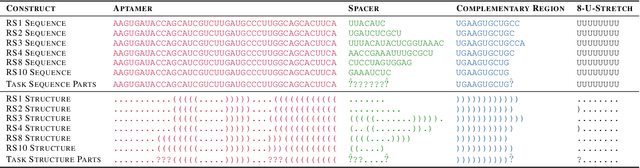
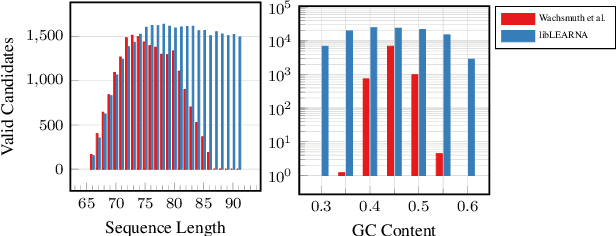

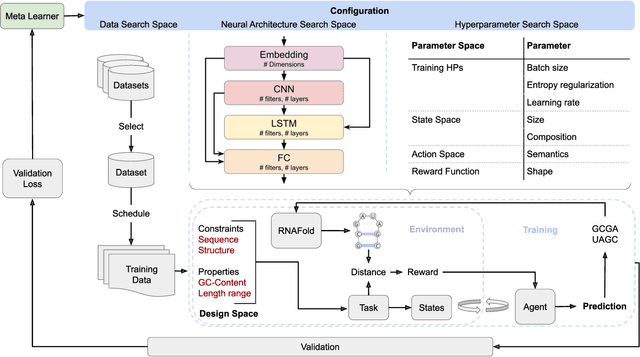
Experimental screening and selection pipelines for the discovery of novel riboswitches are expensive, time-consuming, and inefficient. Using computational methods to reduce the number of candidates for the screen could drastically decrease these costs. However, existing computational approaches do not fully satisfy all requirements for the design of such initial screening libraries. In this work, we present a new method, libLEARNA, capable of providing RNA focus libraries of diverse variable-length qualified candidates. Our novel structure-based design approach considers global properties as well as desired sequence and structure features. We demonstrate the benefits of our method by designing theophylline riboswitch libraries, following a previously published protocol, and yielding 30% more unique high-quality candidates.
Scalable Deep Learning for RNA Secondary Structure Prediction
Jul 14, 2023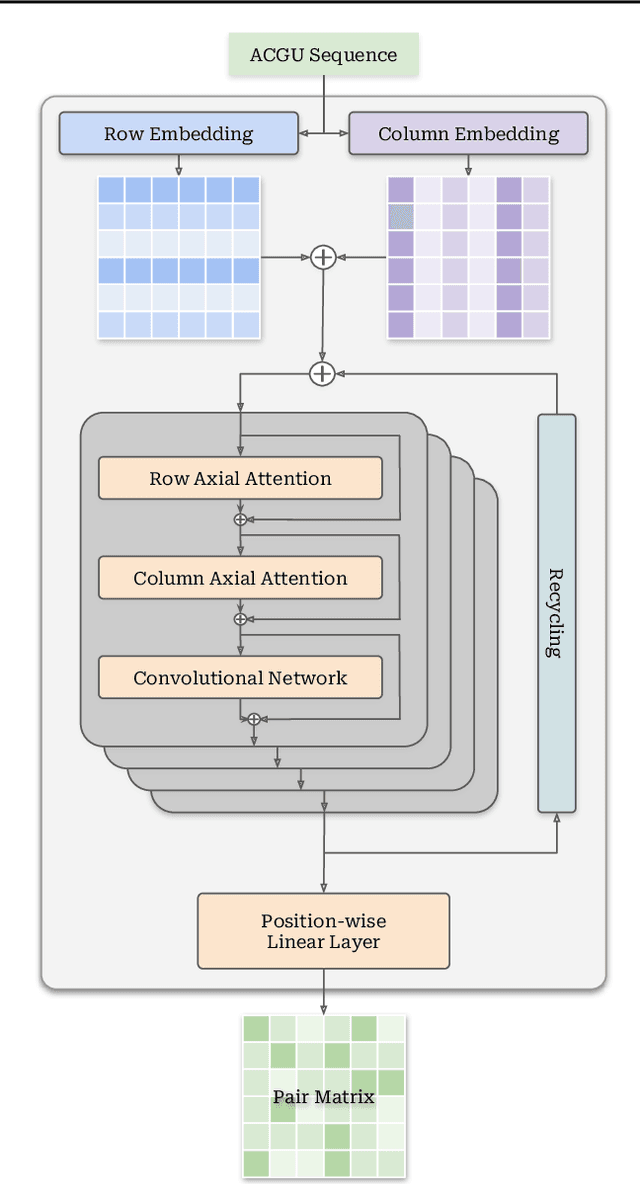
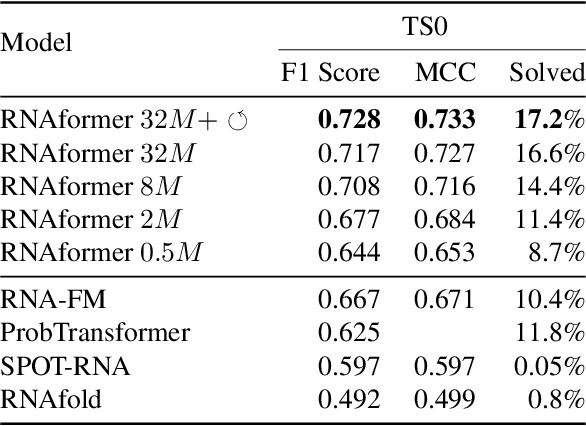

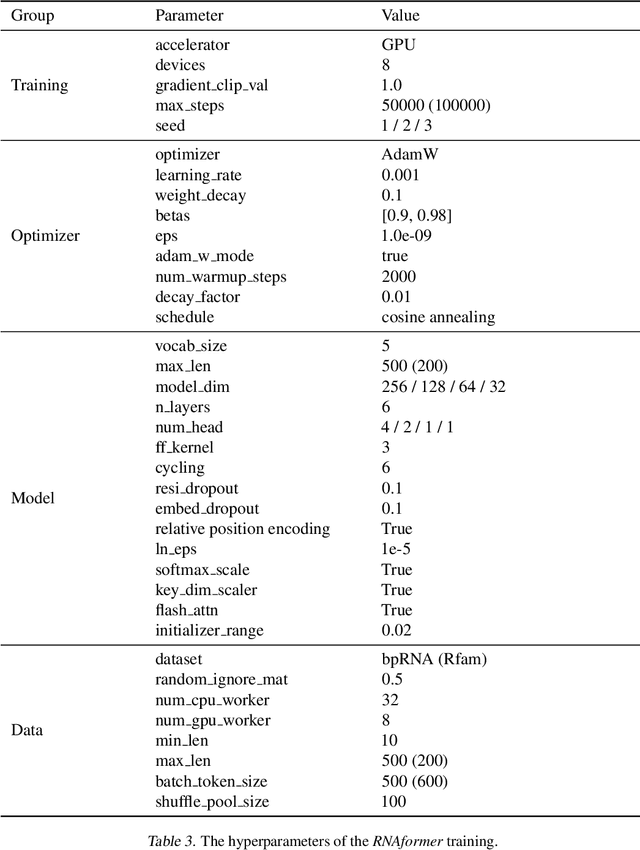
The field of RNA secondary structure prediction has made significant progress with the adoption of deep learning techniques. In this work, we present the RNAformer, a lean deep learning model using axial attention and recycling in the latent space. We gain performance improvements by designing the architecture for modeling the adjacency matrix directly in the latent space and by scaling the size of the model. Our approach achieves state-of-the-art performance on the popular TS0 benchmark dataset and even outperforms methods that use external information. Further, we show experimentally that the RNAformer can learn a biophysical model of the RNA folding process.
PriorBand: Practical Hyperparameter Optimization in the Age of Deep Learning
Jun 21, 2023


Hyperparameters of Deep Learning (DL) pipelines are crucial for their downstream performance. While a large number of methods for Hyperparameter Optimization (HPO) have been developed, their incurred costs are often untenable for modern DL. Consequently, manual experimentation is still the most prevalent approach to optimize hyperparameters, relying on the researcher's intuition, domain knowledge, and cheap preliminary explorations. To resolve this misalignment between HPO algorithms and DL researchers, we propose PriorBand, an HPO algorithm tailored to DL, able to utilize both expert beliefs and cheap proxy tasks. Empirically, we demonstrate PriorBand's efficiency across a range of DL benchmarks and show its gains under informative expert input and robustness against poor expert beliefs
Quick-Tune: Quickly Learning Which Pretrained Model to Finetune and How
Jun 11, 2023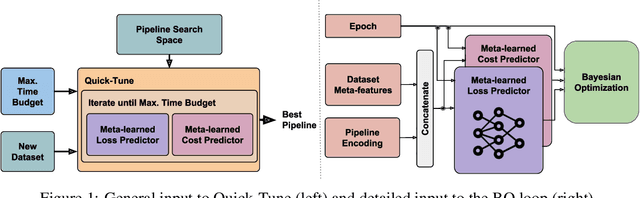



With the ever-increasing number of pretrained models, machine learning practitioners are continuously faced with which pretrained model to use, and how to finetune it for a new dataset. In this paper, we propose a methodology that jointly searches for the optimal pretrained model and the hyperparameters for finetuning it. Our method transfers knowledge about the performance of many pretrained models with multiple hyperparameter configurations on a series of datasets. To this aim, we evaluated over 20k hyperparameter configurations for finetuning 24 pretrained image classification models on 87 datasets to generate a large-scale meta-dataset. We meta-learn a multi-fidelity performance predictor on the learning curves of this meta-dataset and use it for fast hyperparameter optimization on new datasets. We empirically demonstrate that our resulting approach can quickly select an accurate pretrained model for a new dataset together with its optimal hyperparameters.
PFNs4BO: In-Context Learning for Bayesian Optimization
Jun 09, 2023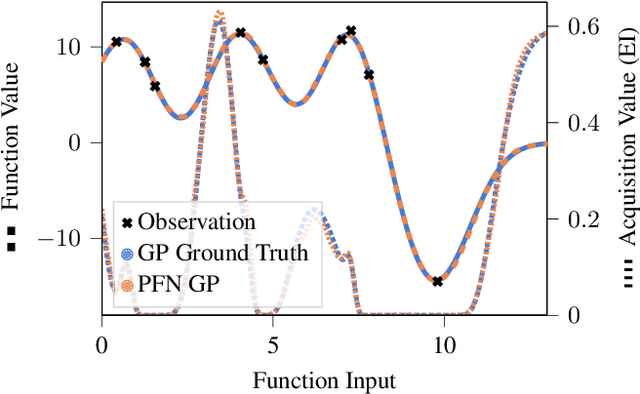
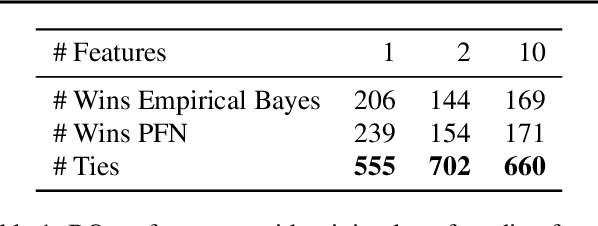
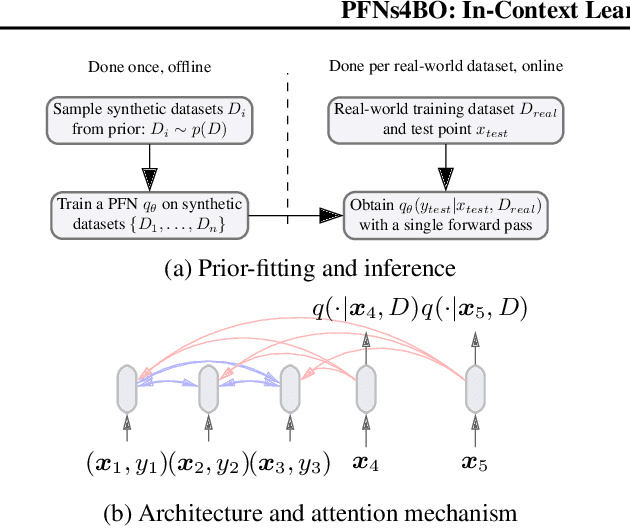
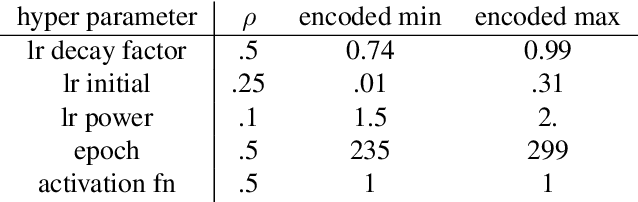
In this paper, we use Prior-data Fitted Networks (PFNs) as a flexible surrogate for Bayesian Optimization (BO). PFNs are neural processes that are trained to approximate the posterior predictive distribution (PPD) through in-context learning on any prior distribution that can be efficiently sampled from. We describe how this flexibility can be exploited for surrogate modeling in BO. We use PFNs to mimic a naive Gaussian process (GP), an advanced GP, and a Bayesian Neural Network (BNN). In addition, we show how to incorporate further information into the prior, such as allowing hints about the position of optima (user priors), ignoring irrelevant dimensions, and performing non-myopic BO by learning the acquisition function. The flexibility underlying these extensions opens up vast possibilities for using PFNs for BO. We demonstrate the usefulness of PFNs for BO in a large-scale evaluation on artificial GP samples and three different hyperparameter optimization testbeds: HPO-B, Bayesmark, and PD1. We publish code alongside trained models at https://github.com/automl/PFNs4BO.
MO-DEHB: Evolutionary-based Hyperband for Multi-Objective Optimization
May 11, 2023Hyperparameter optimization (HPO) is a powerful technique for automating the tuning of machine learning (ML) models. However, in many real-world applications, accuracy is only one of multiple performance criteria that must be considered. Optimizing these objectives simultaneously on a complex and diverse search space remains a challenging task. In this paper, we propose MO-DEHB, an effective and flexible multi-objective (MO) optimizer that extends the recent evolutionary Hyperband method DEHB. We validate the performance of MO-DEHB using a comprehensive suite of 15 benchmarks consisting of diverse and challenging MO problems, including HPO, neural architecture search (NAS), and joint NAS and HPO, with objectives including accuracy, latency and algorithmic fairness. A comparative study against state-of-the-art MO optimizers demonstrates that MO-DEHB clearly achieves the best performance across our 15 benchmarks.
GPT for Semi-Automated Data Science: Introducing CAAFE for Context-Aware Automated Feature Engineering
May 05, 2023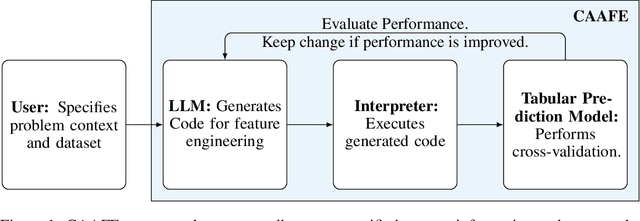
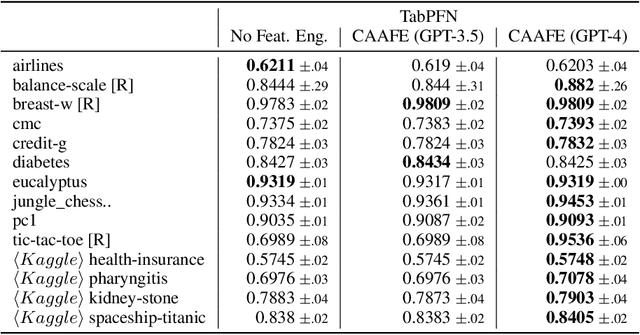
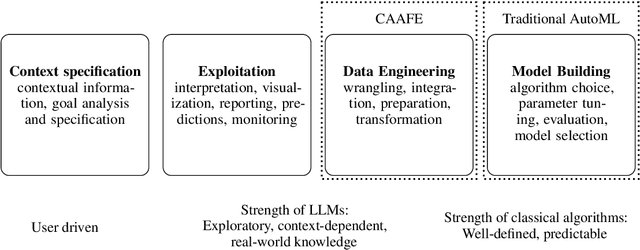
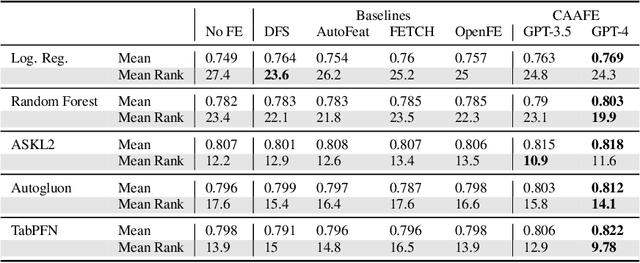
As the field of automated machine learning (AutoML) advances, it becomes increasingly important to include domain knowledge within these systems. We present an approach for doing so by harnessing the power of large language models (LLMs). Specifically, we introduce Context-Aware Automated Feature Engineering (CAAFE), a feature engineering method for tabular datasets that utilizes an LLM to generate additional semantically meaningful features for tabular datasets based on their descriptions. The method produces both Python code for creating new features and explanations for the utility of the generated features. Despite being methodologically simple, CAAFE enhances performance on 11 out of 14 datasets, ties on 2 and looses on 1 - boosting mean ROC AUC performance from 0.798 to 0.822 across all datasets. On the evaluated datasets, this improvement is similar to the average improvement achieved by using a random forest (AUC 0.782) instead of logistic regression (AUC 0.754). Furthermore, our method offers valuable insights into the rationale behind the generated features by providing a textual explanation for each generated feature. CAAFE paves the way for more extensive (semi-)automation in data science tasks and emphasizes the significance of context-aware solutions that can extend the scope of AutoML systems. For reproducability, we release our code and a simple demo.
Self-Correcting Bayesian Optimization through Bayesian Active Learning
Apr 21, 2023Gaussian processes are cemented as the model of choice in Bayesian optimization and active learning. Yet, they are severely dependent on cleverly chosen hyperparameters to reach their full potential, and little effort is devoted to finding the right hyperparameters in the literature. We demonstrate the impact of selecting good hyperparameters for GPs and present two acquisition functions that explicitly prioritize this goal. Statistical distance-based Active Learning (SAL) considers the average disagreement among samples from the posterior, as measured by a statistical distance. It is shown to outperform the state-of-the-art in Bayesian active learning on a number of test functions. We then introduce Self-Correcting Bayesian Optimization (SCoreBO), which extends SAL to perform Bayesian optimization and active hyperparameter learning simultaneously. SCoreBO learns the model hyperparameters at improved rates compared to vanilla BO, while outperforming the latest Bayesian optimization methods on traditional benchmarks. Moreover, the importance of self-correction is demonstrated on an array of exotic Bayesian optimization tasks