 Add to Chrome
 Add to Firefox
 Add to Edge
AdaTurn: Budget-Aware Test-Time Scaling for Active Visual Perception Agents
Jul 16, 2026
Active visual agents solve fine-grained image tasks by interleaving reasoning with image-grounding actions across multiple turns. However, deployment-time rollout budgets are rarely fixed: some requests permit long rollouts, while others require the agent to act under a tight turn limit. Existing methods train the policy as if the rollout budget were hidden, so when the available budget is smaller than the trajectory the agent prefers, the interaction is often truncated before any valid answer is produced; we term this failure \emph{catastrophic truncation}. To overcome this challenge, we present AdaTurn, a budget-aware framework that conditions the agent on the allowed number of turns and explicitly trains the boundary behavior induced by the budget. Our key component, Forced-Answer DAPO (FA-DAPO), converts the over-budget event from a masked or penalized failure into a trainable final-decision step, teaching the model to synthesize partial evidence when further tool use is no longer possible. We further randomize rollout budgets during both training and inference and introduce a load-balanced scheduler that makes such operations practical. AdaTurn substantially improves low-budget accuracy, for example raising VisualProbe-Medium from 36.7% to 47.6% at four turns, while preserving strong scaling at larger budgets and transferring effectively to multiple backbones and general multimodal benchmarks.

SurgAtlas: A Large-Scale Surgical Video-Language Dataset with 2,391 Hours of Open and Minimally Invasive Surgery
Jun 24, 2026We introduce SurgAtlas, the largest surgical video-language dataset to date, comprising 15,291 videos (2,391 hours) spanning 18 surgical specialties and over 5,000 procedure types, sourced entirely from publicly available YouTube content. SurgAtlas is also the first surgical video-language dataset to include open surgery at scale, with 6,182 open procedure videos alongside over 9,000 minimally invasive recordings, and the first to establish standardized benchmarks for open-surgery video understanding. We additionally provide an expert-validated subset with verified visual question-answer pairs across diverse open and minimally invasive procedures, serving as a clinically grounded benchmark for surgical reasoning. Compared with existing surgical video-language datasets, SurgAtlas provides one of the most diverse annotation schemas, combining segment-level captions, step- and phase-level descriptions, video-level surgical descriptions, and reasoning-oriented question-answer pairs organized within a hierarchical taxonomy. These annotations are constructed through an automated multi-tier pipeline with LLM-based enrichment and a staged VQA generation framework with explicit groundedness verification. The scale and diversity of SurgAtlas enable training surgical foundation models with broad procedural coverage: we finetune Qwen3-VL-8B through a two-stage captioning-then-instruction pipeline and achieve competitive or state-of-the-art results on multiple established surgical benchmarks, including phase recognition, triplet detection, and reasoning question answering. More broadly, SurgAtlas provides a large native public video corpus that can support future large-scale pretraining of multimodal surgical AI systems and contribute to the development of next-generation foundation models for surgery.
EchoVQA: Enabling Conversational Assistance for Point-of-Care Cardiac Ultrasound
May 22, 2026Point-of-care transthoracic echocardiography (TTE) enables cardiac assessment in virtually any clinical setting, yet its diagnostic utility remains constrained by the expertise required for image acquisition and interpretation. Visual question answering (VQA) offers a promising paradigm for bridging this expertise gap through interactive clinical assistance, but existing echocardiography VQA datasets are limited in scale, restricted to high-quality images, and only cover a few views. We introduce EchoVQA, the first large-scale VQA dataset for echocardiography, comprising 14,299 images and 74,819 question-answer pairs. The dataset integrates public sources (EchoNet-Dynamic, CAMUS) with our own point-of-care acquisitions from two handheld probes (Lumify, Clarius), spanning diverse views and including both high-quality and suboptimal images. Uniquely, EchoVQA includes acquisition guidance questions to help users optimize transducer positioning toward a diagnostic apical 4-chamber view for left ventricular ejection fraction estimation -- a challenging task for novice operators in point-of-care settings. We further develop a parameter-efficient method based on multimodal learnable prompts achieving state-of-the-art performance on most benchmarks, including EchoVQA, with significantly less trainable parameters than existing state-of-the-art approaches.
Follow Your Heart: Landmark-Guided Transducer Pose Scoring for Point-of-Care Echocardiography
Mar 28, 2026Point-of-care transthoracic echocardiography (TTE) makes it possible to assess a patient's cardiac function in almost any setting. A critical step in the TTE exam is acquisition of the apical 4-chamber (A4CH) view, which is used to evaluate clinically impactful measurements such as left ventricular ejection fraction (LVEF). However, optimizing transducer pose for high-quality image acquisition and subsequent measurement is a challenging task, particularly for novice users. In this work, we present a multi-task network that provides feedback cues for A4CH view acquisition and automatically estimates LVEF in high-quality A4CH images. The network cascades a transducer pose scoring module and an uncertainty-aware LV landmark detector with automated LVEF estimation. A strength is that network training and inference do not require cumbersome or costly setups for transducer position tracking. We evaluate performance on point-of-care TTE data acquired with a spatially dense "sweep" protocol around the optimal A4CH view. The results demonstrate the network's ability to determine when the transducer pose is on target, close to target, or far from target based on the images alone, while generating visual landmark cues that guide anatomical interpretation and orientation. In conclusion, we demonstrate a promising strategy to provide guidance for A4CH view acquisition, which may be useful when deploying point-of-care TTE in limited resource settings.
Deep TPC: Temporal-Prior Conditioning for Time Series Forecasting
Feb 18, 2026LLM-for-time series (TS) methods typically treat time shallowly, injecting positional or prompt-based cues once at the input of a largely frozen decoder, which limits temporal reasoning as this information degrades through the layers. We introduce Temporal-Prior Conditioning (TPC), which elevates time to a first-class modality that conditions the model at multiple depths. TPC attaches a small set of learnable time series tokens to the patch stream; at selected layers these tokens cross-attend to temporal embeddings derived from compact, human-readable temporal descriptors encoded by the same frozen LLM, then feed temporal context back via self-attention. This disentangles time series signal and temporal information while maintaining a low parameter budget. We show that by training only the cross-attention modules and explicitly disentangling time series signal and temporal information, TPC consistently outperforms both full fine-tuning and shallow conditioning strategies, achieving state-of-the-art performance in long-term forecasting across diverse datasets. Code available at: https://github.com/fil-mp/Deep_tpc
Omni-Judge: Can Omni-LLMs Serve as Human-Aligned Judges for Text-Conditioned Audio-Video Generation?
Feb 02, 2026State-of-the-art text-to-video generation models such as Sora 2 and Veo 3 can now produce high-fidelity videos with synchronized audio directly from a textual prompt, marking a new milestone in multi-modal generation. However, evaluating such tri-modal outputs remains an unsolved challenge. Human evaluation is reliable but costly and difficult to scale, while traditional automatic metrics, such as FVD, CLAP, and ViCLIP, focus on isolated modality pairs, struggle with complex prompts, and provide limited interpretability. Omni-modal large language models (omni-LLMs) present a promising alternative: they naturally process audio, video, and text, support rich reasoning, and offer interpretable chain-of-thought feedback. Driven by this, we introduce Omni-Judge, a study assessing whether omni-LLMs can serve as human-aligned judges for text-conditioned audio-video generation. Across nine perceptual and alignment metrics, Omni-Judge achieves correlation comparable to traditional metrics and excels on semantically demanding tasks such as audio-text alignment, video-text alignment, and audio-video-text coherence. It underperforms on high-FPS perceptual metrics, including video quality and audio-video synchronization, due to limited temporal resolution. Omni-Judge provides interpretable explanations that expose semantic or physical inconsistencies, enabling practical downstream uses such as feedback-based refinement. Our findings highlight both the potential and current limitations of omni-LLMs as unified evaluators for multi-modal generation.
When to Think and When to Look: Uncertainty-Guided Lookback
Nov 19, 2025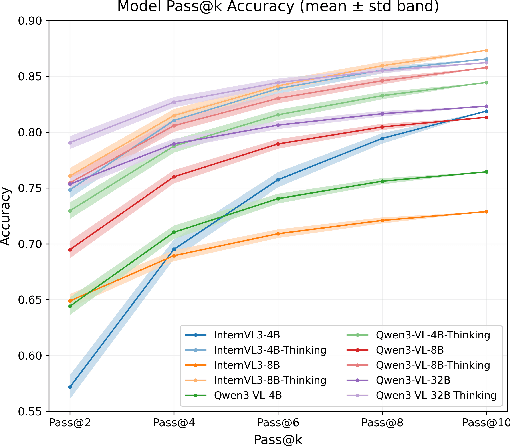

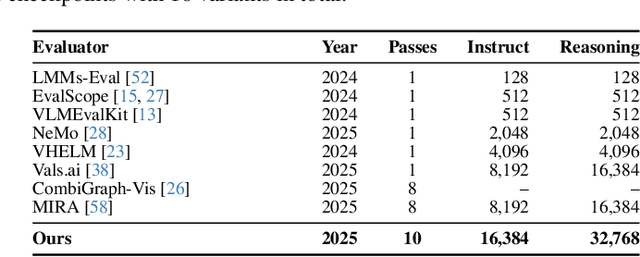
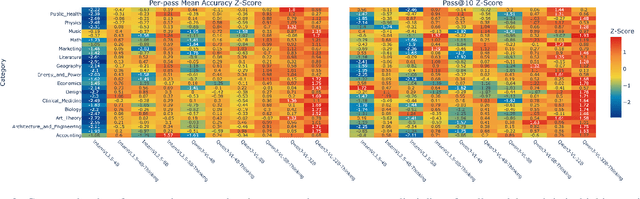
Test-time thinking (that is, generating explicit intermediate reasoning chains) is known to boost performance in large language models and has recently shown strong gains for large vision language models (LVLMs). However, despite these promising results, there is still no systematic analysis of how thinking actually affects visual reasoning. We provide the first such analysis with a large scale, controlled comparison of thinking for LVLMs, evaluating ten variants from the InternVL3.5 and Qwen3-VL families on MMMU-val under generous token budgets and multi pass decoding. We show that more thinking is not always better; long chains often yield long wrong trajectories that ignore the image and underperform the same models run in standard instruct mode. A deeper analysis reveals that certain short lookback phrases, which explicitly refer back to the image, are strongly enriched in successful trajectories and correlate with better visual grounding. Building on this insight, we propose uncertainty guided lookback, a training free decoding strategy that combines an uncertainty signal with adaptive lookback prompts and breadth search. Our method improves overall MMMU performance, delivers the largest gains in categories where standard thinking is weak, and outperforms several strong decoding baselines, setting a new state of the art under fixed model families and token budgets. We further show that this decoding strategy generalizes, yielding consistent improvements on five additional benchmarks, including two broad multimodal suites and math focused visual reasoning datasets.
VITRO: Vocabulary Inversion for Time-series Representation Optimization
Dec 23, 2024Although LLMs have demonstrated remarkable capabilities in processing and generating textual data, their pre-trained vocabularies are ill-suited for capturing the nuanced temporal dynamics and patterns inherent in time series. The discrete, symbolic nature of natural language tokens, which these vocabularies are designed to represent, does not align well with the continuous, numerical nature of time series data. To address this fundamental limitation, we propose VITRO. Our method adapts textual inversion optimization from the vision-language domain in order to learn a new time series per-dataset vocabulary that bridges the gap between the discrete, semantic nature of natural language and the continuous, numerical nature of time series data. We show that learnable time series-specific pseudo-word embeddings represent time series data better than existing general language model vocabularies, with VITRO-enhanced methods achieving state-of-the-art performance in long-term forecasting across most datasets.