 Add to Chrome
 Add to Firefox
 Add to Edge
CatalogAgent: A Supervisor-mediated Self-Learning System Enabling Context Engineering for GenAI Models
Jul 15, 2026
Product catalogs are the backbone of e-commerce sites, yet a large number of structured attributes (SAs) -- such as material, color, and shape -- often have missing values. Typically, SA values are extracted from product information, including titles and descriptions. While LLM-based generator-evaluator frameworks have demonstrated effectiveness for SA prediction -- where an LLM generates SA values and another evaluates them -- they face challenges when the Generator and Evaluator produce conflicting outputs, as either component can make mistakes. We introduce \texttt{CatalogAgent}, a novel agentic system that continuously improves Generator and Evaluator models for e-commerce catalog enrichment. When disagreements arise from (1) internal conflicts between the LLM-based Generator and Evaluator, or (2) external feedback from sellers on LLM outputs, a Supervisor Agent intervenes to mediate these conflicts and make final decisions. The system also incorporates a Memory Base and a Memory Summarizer that stores Supervisor Agent activities from individual cases and aggregates patterns into learnings. These learnings are fed back to the worker Generator and Evaluator LLMs, enabling self-improvement without human intervention. Through context engineering -- injecting learnings and insights into worker LLMs' contexts -- the system successfully transfers the Supervisor's capabilities to the Generator and Evaluator, improving their performance by 15.24\% and 13.98\%, respectively. Our experiments demonstrate a new paradigm of Supervisor Agent-mediated self-learning systems for improving generative AI model accuracy.

When to Think and When to Look: Uncertainty-Guided Lookback
Nov 19, 2025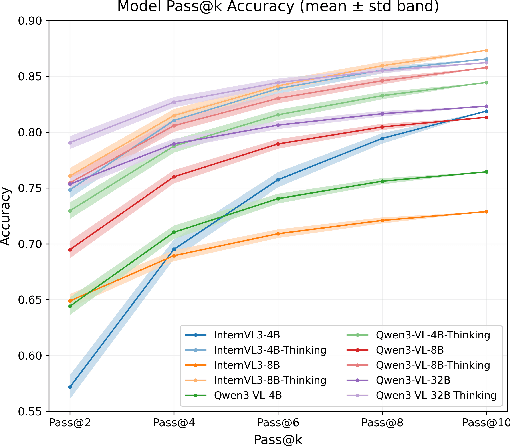

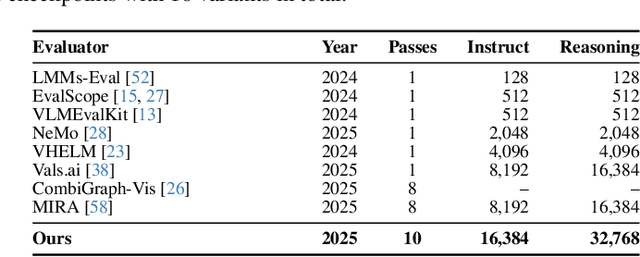
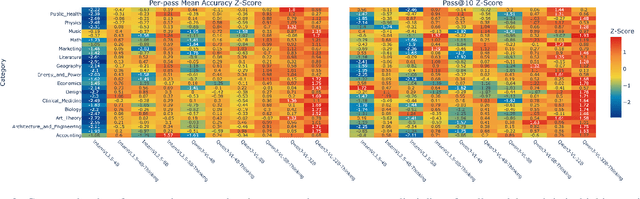
Test-time thinking (that is, generating explicit intermediate reasoning chains) is known to boost performance in large language models and has recently shown strong gains for large vision language models (LVLMs). However, despite these promising results, there is still no systematic analysis of how thinking actually affects visual reasoning. We provide the first such analysis with a large scale, controlled comparison of thinking for LVLMs, evaluating ten variants from the InternVL3.5 and Qwen3-VL families on MMMU-val under generous token budgets and multi pass decoding. We show that more thinking is not always better; long chains often yield long wrong trajectories that ignore the image and underperform the same models run in standard instruct mode. A deeper analysis reveals that certain short lookback phrases, which explicitly refer back to the image, are strongly enriched in successful trajectories and correlate with better visual grounding. Building on this insight, we propose uncertainty guided lookback, a training free decoding strategy that combines an uncertainty signal with adaptive lookback prompts and breadth search. Our method improves overall MMMU performance, delivers the largest gains in categories where standard thinking is weak, and outperforms several strong decoding baselines, setting a new state of the art under fixed model families and token budgets. We further show that this decoding strategy generalizes, yielding consistent improvements on five additional benchmarks, including two broad multimodal suites and math focused visual reasoning datasets.
Understanding and Alleviating Memory Consumption in RLHF for LLMs
Oct 21, 2024


Fine-tuning with Reinforcement Learning with Human Feedback (RLHF) is essential for aligning large language models (LLMs). However, RLHF often encounters significant memory challenges. This study is the first to examine memory usage in the RLHF context, exploring various memory management strategies and unveiling the reasons behind excessive memory consumption. Additionally, we introduce a simple yet effective approach that substantially reduces the memory required for RLHF fine-tuning.