 Add to Chrome
 Add to Firefox
 Add to Edge
Omni-Judge: Can Omni-LLMs Serve as Human-Aligned Judges for Text-Conditioned Audio-Video Generation?
Feb 02, 2026
State-of-the-art text-to-video generation models such as Sora 2 and Veo 3 can now produce high-fidelity videos with synchronized audio directly from a textual prompt, marking a new milestone in multi-modal generation. However, evaluating such tri-modal outputs remains an unsolved challenge. Human evaluation is reliable but costly and difficult to scale, while traditional automatic metrics, such as FVD, CLAP, and ViCLIP, focus on isolated modality pairs, struggle with complex prompts, and provide limited interpretability. Omni-modal large language models (omni-LLMs) present a promising alternative: they naturally process audio, video, and text, support rich reasoning, and offer interpretable chain-of-thought feedback. Driven by this, we introduce Omni-Judge, a study assessing whether omni-LLMs can serve as human-aligned judges for text-conditioned audio-video generation. Across nine perceptual and alignment metrics, Omni-Judge achieves correlation comparable to traditional metrics and excels on semantically demanding tasks such as audio-text alignment, video-text alignment, and audio-video-text coherence. It underperforms on high-FPS perceptual metrics, including video quality and audio-video synchronization, due to limited temporal resolution. Omni-Judge provides interpretable explanations that expose semantic or physical inconsistencies, enabling practical downstream uses such as feedback-based refinement. Our findings highlight both the potential and current limitations of omni-LLMs as unified evaluators for multi-modal generation.

Video-LMM Post-Training: A Deep Dive into Video Reasoning with Large Multimodal Models
Oct 06, 2025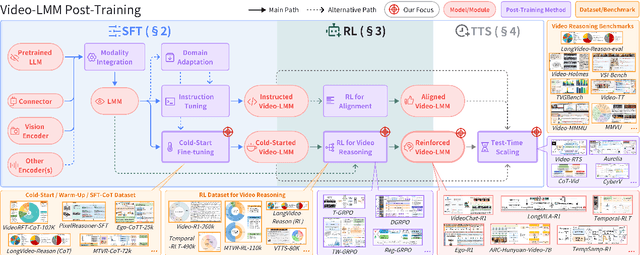
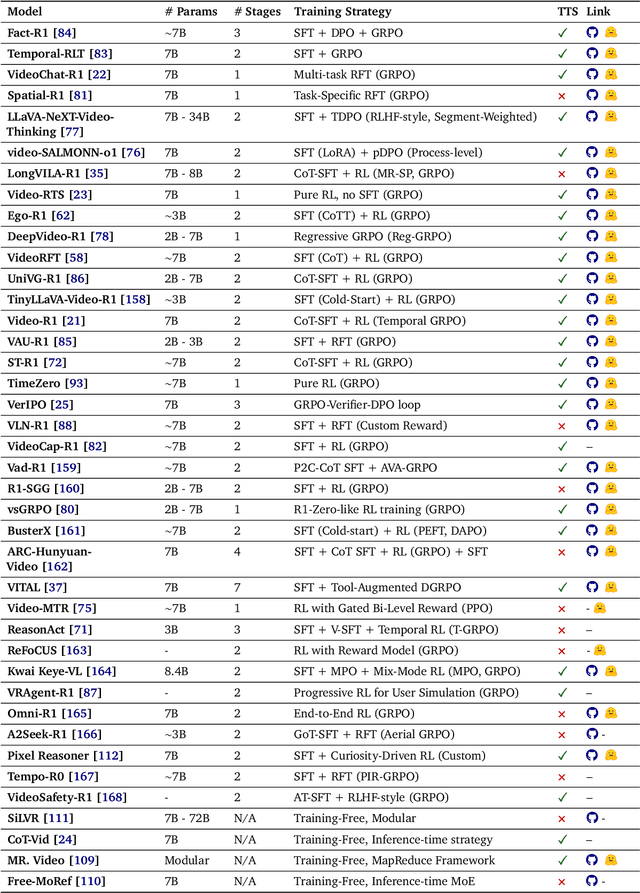
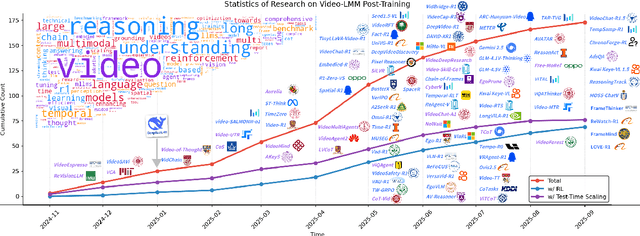
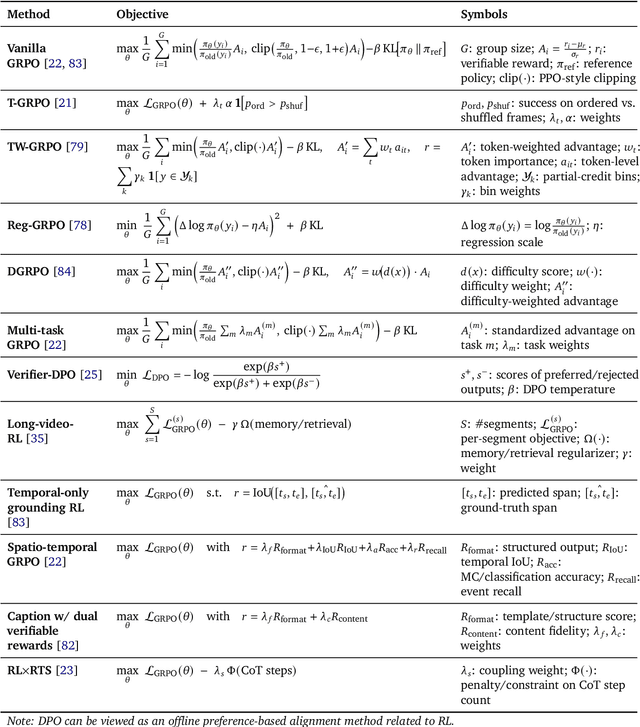
Video understanding represents the most challenging frontier in computer vision, requiring models to reason about complex spatiotemporal relationships, long-term dependencies, and multimodal evidence. The recent emergence of Video-Large Multimodal Models (Video-LMMs), which integrate visual encoders with powerful decoder-based language models, has demonstrated remarkable capabilities in video understanding tasks. However, the critical phase that transforms these models from basic perception systems into sophisticated reasoning engines, post-training, remains fragmented across the literature. This survey provides the first comprehensive examination of post-training methodologies for Video-LMMs, encompassing three fundamental pillars: supervised fine-tuning (SFT) with chain-of-thought, reinforcement learning (RL) from verifiable objectives, and test-time scaling (TTS) through enhanced inference computation. We present a structured taxonomy that clarifies the roles, interconnections, and video-specific adaptations of these techniques, addressing unique challenges such as temporal localization, spatiotemporal grounding, long video efficiency, and multimodal evidence integration. Through systematic analysis of representative methods, we synthesize key design principles, insights, and evaluation protocols while identifying critical open challenges in reward design, scalability, and cost-performance optimization. We further curate essential benchmarks, datasets, and metrics to facilitate rigorous assessment of post-training effectiveness. This survey aims to provide researchers and practitioners with a unified framework for advancing Video-LMM capabilities. Additional resources and updates are maintained at: https://github.com/yunlong10/Awesome-Video-LMM-Post-Training