 Add to Chrome
 Add to Firefox
 Add to Edge
Think Before You Grid-Search: Floor-First Triage for LLM Serving
Jul 08, 2026
LLM serving optimization typically benchmarks many configurations and reaches for heavy profilers when latency targets are missed. We argue for the reverse discipline: estimation is the analytical layer of profiling -- without it, optimization degenerates to grid search. Floor First is a residual-driven triage workflow. Each decode step is modeled as a five-dimensional resource vector (HBM bytes, FLOPs, network bytes, network messages, KV capacity); summing within a resource and maximizing across resources gives an optimistic floor, the plain sum a pessimistic one. Where a measurement lands inside this [max, sum] interval reads out overlap quality before any profiler is opened, and profilers escalate only on residuals above a stated threshold. Deployment alternatives are compared by wall ordering -- which resource wall binds first as load grows -- rather than by point benchmarks. The account is compositional: new attention or state-space variants enter by declaring one module, and the workflow ships as a zero-dependency calculator plus an agent skill that enforces the discipline in agentic optimization loops. As a case study we analyze a DeepSeek-V3.2-style 671B MoE/MLA model on 16 NVIDIA H20 GPUs, whose ridge point of ~74 FLOP/byte (vs ~590 for H100) makes it an extreme decode-oriented part. The floors show TP16 decoding is KV-capacity-limited to ~70 concurrent 8K requests; sparse attention removes the KV-bandwidth term but not the capacity wall; an EP16+DP-attention layout accepts slightly worse same-batch weight traffic for an order-of-magnitude higher capacity wall (~644) -- while single-stream latency favors TP by 2.4x. The layout judgment is thus a computable function of the operating point, explaining why production deployments on identical hardware have shipped opposite attention layouts.

TIDE: Text-Informed Dynamic Extrapolation with Step-Aware Temperature Control for Diffusion Transformers
Mar 09, 2026Diffusion Transformer (DiT) faces challenges when generating images with higher resolution compared at training resolution, causing especially structural degradation due to attention dilution. Previous approaches attempt to mitigate this by sharpening attention distributions, but fail to preserve fine-grained semantic details and introduce obvious artifacts. In this work, we analyze the characteristics of DiTs and propose TIDE, a training-free text-to-image (T2I) extrapolation method that enables generation with arbitrary resolution and aspect ratio without additional sampling overhead. We identify the core factor for prompt information loss, and introduce a text anchoring mechanism to correct the imbalance between text and image tokens. To further eliminate artifacts, we design a dynamic temperature control mechanism that leverages the pattern of spectral progression in the diffusion process. Extensive evaluations demonstrate that TIDE delivers high-quality resolution extrapolation capability and integrates seamlessly with existing state-of-the-art methods.
SDiT: Semantic Region-Adaptive for Diffusion Transformers
Jan 18, 2026Diffusion Transformers (DiTs) achieve state-of-the-art performance in text-to-image synthesis but remain computationally expensive due to the iterative nature of denoising and the quadratic cost of global attention. In this work, we observe that denoising dynamics are spatially non-uniform-background regions converge rapidly while edges and textured areas evolve much more actively. Building on this insight, we propose SDiT, a Semantic Region-Adaptive Diffusion Transformer that allocates computation according to regional complexity. SDiT introduces a training-free framework combining (1) semantic-aware clustering via fast Quickshift-based segmentation, (2) complexity-driven regional scheduling to selectively update informative areas, and (3) boundary-aware refinement to maintain spatial coherence. Without any model retraining or architectural modification, SDiT achieves up to 3.0x acceleration while preserving nearly identical perceptual and semantic quality to full-attention inference.
Understand the Effectiveness of Shortcuts through the Lens of DCA
Dec 13, 2024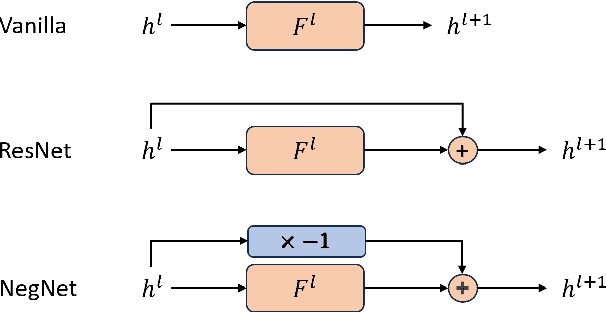
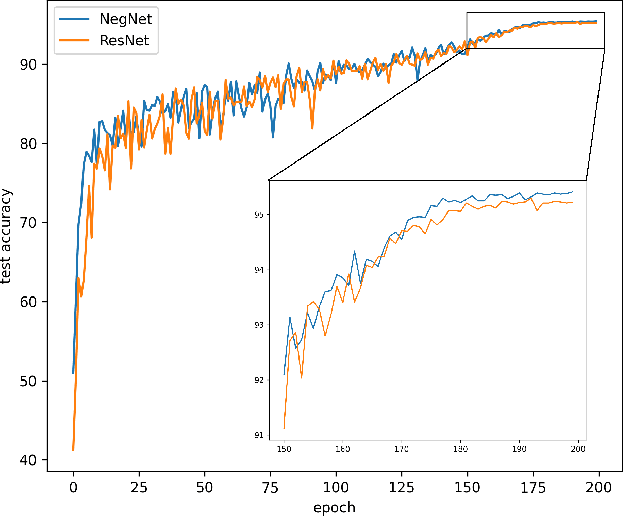
Difference-of-Convex Algorithm (DCA) is a well-known nonconvex optimization algorithm for minimizing a nonconvex function that can be expressed as the difference of two convex ones. Many famous existing optimization algorithms, such as SGD and proximal point methods, can be viewed as special DCAs with specific DC decompositions, making it a powerful framework for optimization. On the other hand, shortcuts are a key architectural feature in modern deep neural networks, facilitating both training and optimization. We showed that the shortcut neural network gradient can be obtained by applying DCA to vanilla neural networks, networks without shortcut connections. Therefore, from the perspective of DCA, we can better understand the effectiveness of networks with shortcuts. Moreover, we proposed a new architecture called NegNet that does not fit the previous interpretation but performs on par with ResNet and can be included in the DCA framework.