 Add to Chrome
 Add to Firefox
 Add to Edge
VDGR-RAG: Vectors, Directories, Graphs, and Reflection Are All You Need for Unified Reasoning over Hierarchical Enterprise Knowledge
Aug 08, 2026
Retrieval-Augmented Generation (RAG) is essential for enterprise knowledge question answering (QA), particularly in domains with complex product documentation like telecommunications. However, existing RAG approaches largely overlook the holistic integration of diverse retrieval strengths, leading to inaccurate domain routing, poor utilization of hierarchical document structures, and consequently limited reasoning capabilities over enterprise knowledge. To address these limitations, we present VDGR-RAG, which integrates vector retrieval, directory-driven reasoning, graph traversal, and iterative reflection in a unified framework for accurate enterprise knowledge QA. Specifically, VDGR-RAG is an agentic GraphRAG system that first constructs a Hierarchical Heterogeneous Knowledge Graph ($\text{H}^2$KG) from document chunks to preserve both hierarchical directory structures and semantic relationships, and then employs a set of atomic tools for knowledge retrieval that can be freely composed to navigate the $\text{H}^2$KG: (1) a directory-enhanced routing tool that uses table-of-contents (TOC) structures to route user queries to appropriate domain-specific $\text{H}^2$KGs; (2) a multi-route retrieval tool that combines vector search, TOC-based agentic search, and graph search for comprehensive knowledge retrieval; (3) a directory backtracking tool that corrects knowledge localization biases; and (4) a dynamic reflection tool that iteratively plans the next retrieval phase. We conduct extensive experiments on our enterprise product documents across four wireless domains (e.g., energy saving and fault management). Experimental results demonstrate that our method significantly outperforms a variety of RAG baselines in terms of both knowledge retrieval recall and QA accuracy.

Active Generation Network of Human Skeleton for Action Recognition
Jan 30, 2024Data generation is a data augmentation technique for enhancing the generalization ability for skeleton-based human action recognition. Most existing data generation methods face challenges to ensure the temporal consistency of the dynamic information for action. In addition, the data generated by these methods lack diversity when only a few training samples are available. To solve those problems, We propose a novel active generative network (AGN), which can adaptively learn various action categories by motion style transfer to generate new actions when the data for a particular action is only a single sample or few samples. The AGN consists of an action generation network and an uncertainty metric network. The former, with ST-GCN as the Backbone, can implicitly learn the morphological features of the target action while preserving the category features of the source action. The latter guides generating actions. Specifically, an action recognition model generates prediction vectors for each action, which is then scored using an uncertainty metric. Finally, UMN provides the uncertainty sampling basis for the generated actions.
Knowledgeable Preference Alignment for LLMs in Domain-specific Question Answering
Nov 11, 2023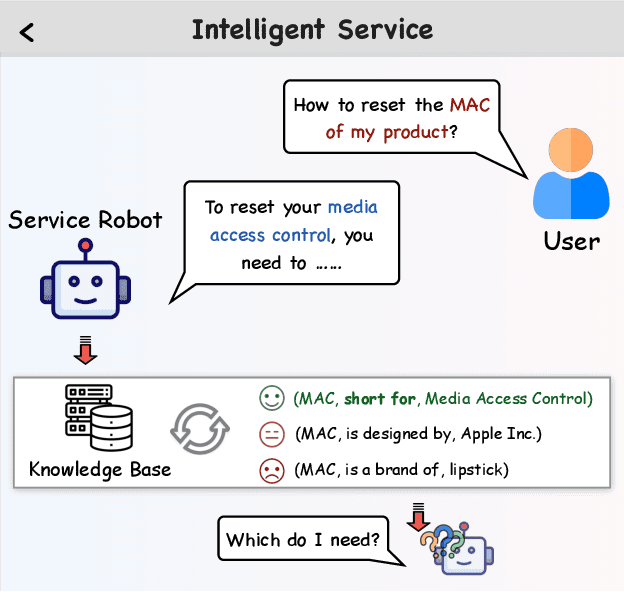
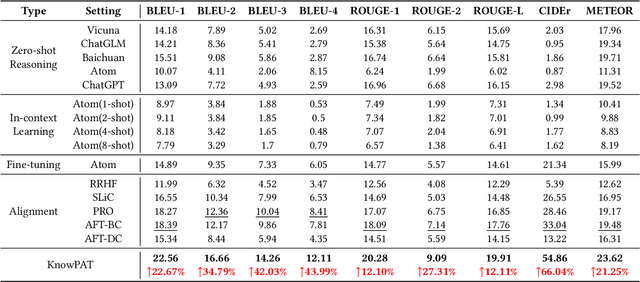
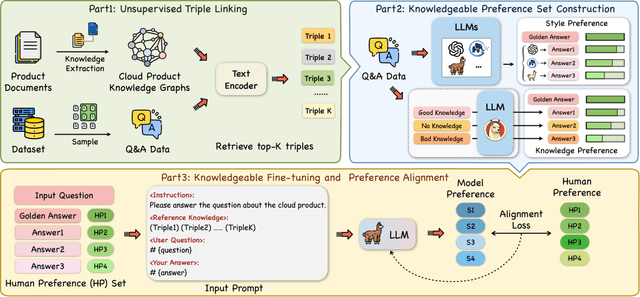
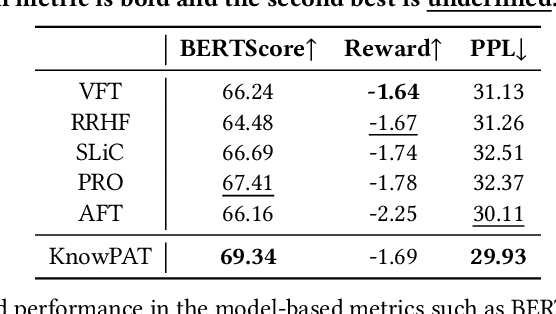
Recently, the development of large language models (LLMs) has attracted wide attention in academia and industry. Deploying LLMs to real scenarios is one of the key directions in the current Internet industry. In this paper, we present a novel pipeline to apply LLMs for domain-specific question answering (QA) that incorporates domain knowledge graphs (KGs), addressing an important direction of LLM application. As a real-world application, the content generated by LLMs should be user-friendly to serve the customers. Additionally, the model needs to utilize domain knowledge properly to generate reliable answers. These two issues are the two major difficulties in the LLM application as vanilla fine-tuning can not adequately address them. We think both requirements can be unified as the model preference problem that needs to align with humans to achieve practical application. Thus, we introduce Knowledgeable Preference AlignmenT (KnowPAT), which constructs two kinds of preference set called style preference set and knowledge preference set respectively to tackle the two issues. Besides, we design a new alignment objective to align the LLM preference with human preference, aiming to train a better LLM for real-scenario domain-specific QA to generate reliable and user-friendly answers. Adequate experiments and comprehensive with 15 baseline methods demonstrate that our KnowPAT is an outperforming pipeline for real-scenario domain-specific QA with LLMs. Our code is open-source at https://github.com/zjukg/KnowPAT.