 Add to Chrome
 Add to Firefox
 Add to Edge
Focused Forcing: Content-Aware Per-Frame KV Selection for Efficient Autoregressive Video Diffusion
May 18, 2026
Recent advances in autoregressive video diffusion have enabled sequential and streaming video generation. However, long-horizon generation requires increasingly large KV caches, making efficient compression without sacrificing quality challenging. Existing methods mostly select historical frames based on attention scores, but their context decisions remain coarse. When multiple frames are generated in the same chunk, these methods often apply a shared history selection to the whole chunk, score historical frames solely by attention, and assign head-wise budgets either uniformly or by attention-pattern heuristics rather than explicit head-importance estimation. We show that frames within the same generated chunk can depend on distinct historical frames, that the same historical frame can receive different attention scores as its relative temporal distance to the current frames changes, and that masking different heads induces unequal generation degradation. Motivated by these findings, we propose \textbf{Focused Forcing}, a training-free KV selection method that focuses cached history along both generated-frame and head dimensions. For each generated frame, Focused Forcing preserves the most relevant and distinctive historical frames by combining attention scores with diversity scores of historical frames, while assigning larger budgets to heads with higher estimated importance. Across multiple autoregressive generation paradigms, Focused Forcing achieves up to $\textbf{1.48}\times$ end-to-end acceleration without training, while \textbf{improving visual quality and text alignment}. \textit{Our code will be released on GitHub.}

D2Pruner: Debiased Importance and Structural Diversity for MLLM Token Pruning
Dec 22, 2025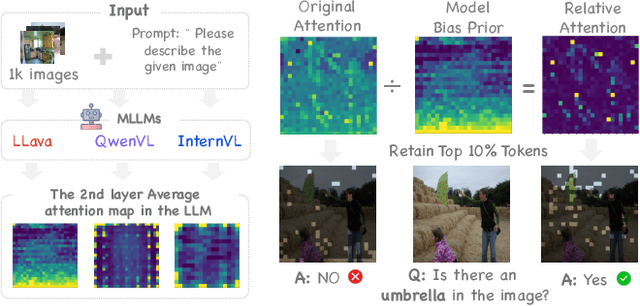
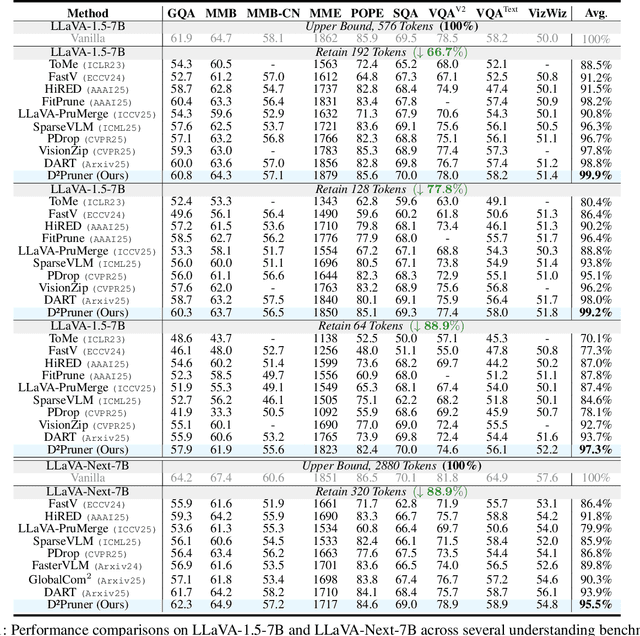
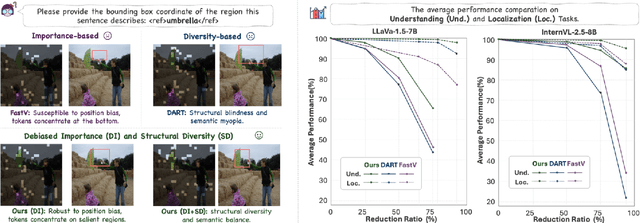
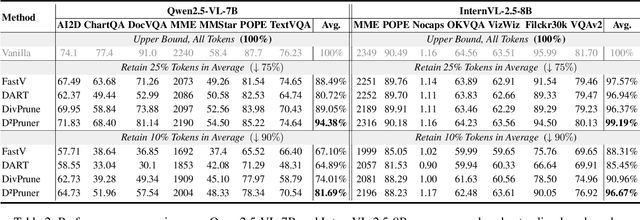
Processing long visual token sequences poses a significant computational burden on Multimodal Large Language Models (MLLMs). While token pruning offers a path to acceleration, we find that current methods, while adequate for general understanding, catastrophically fail on fine-grained localization tasks. We attribute this failure to the inherent flaws of the two prevailing strategies: importance-based methods suffer from a strong positional bias, an inherent model artifact that distracts from semantic content, while diversity-based methods exhibit structural blindness, disregarding the user's prompt and spatial redundancy. To address this, we introduce D2Pruner, a framework that rectifies these issues by uniquely combining debiased importance with a structural pruning mechanism. Our method first secures a core set of the most critical tokens as pivots based on a debiased attention score. It then performs a Maximal Independent Set (MIS) selection on the remaining tokens, which are modeled on a hybrid graph where edges signify spatial proximity and semantic similarity. This process iteratively preserves the most important and available token while removing its neighbors, ensuring that the supplementary tokens are chosen to maximize importance and diversity. Extensive experiments demonstrate that D2Pruner has exceptional efficiency and fidelity. Applied to LLaVA-1.5-7B for general understanding tasks, it reduces FLOPs by 74.2\% while retaining 99.2\% of its original performance. Furthermore, in challenging localization benchmarks with InternVL-2.5-8B, it maintains 85.7\% performance at a 90\% token reduction rate, marking a significant advancement with up to 63. 53\% improvement over existing methods.
Token Pruning for Caching Better: 9 Times Acceleration on Stable Diffusion for Free
Dec 31, 2024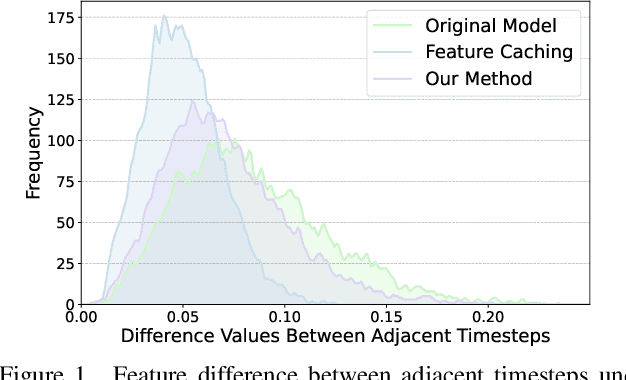
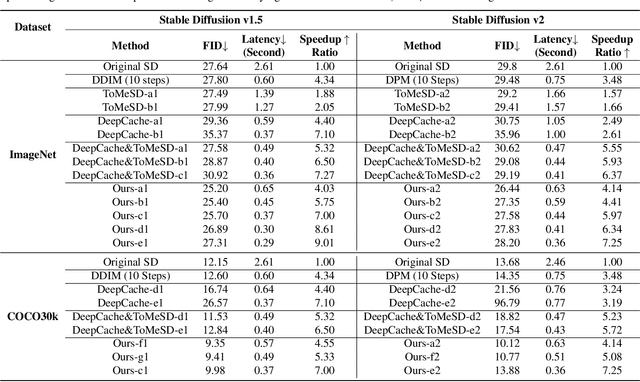
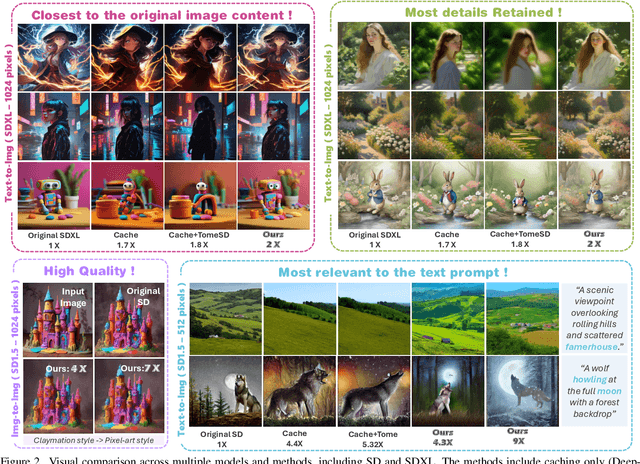
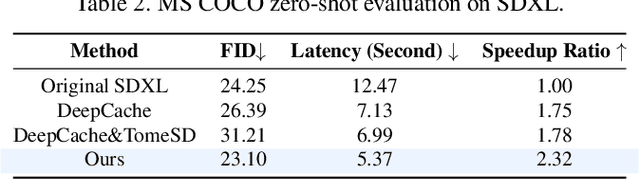
Stable Diffusion has achieved remarkable success in the field of text-to-image generation, with its powerful generative capabilities and diverse generation results making a lasting impact. However, its iterative denoising introduces high computational costs and slows generation speed, limiting broader adoption. The community has made numerous efforts to reduce this computational burden, with methods like feature caching attracting attention due to their effectiveness and simplicity. Nonetheless, simply reusing features computed at previous timesteps causes the features across adjacent timesteps to become similar, reducing the dynamics of features over time and ultimately compromising the quality of generated images. In this paper, we introduce a dynamics-aware token pruning (DaTo) approach that addresses the limitations of feature caching. DaTo selectively prunes tokens with lower dynamics, allowing only high-dynamic tokens to participate in self-attention layers, thereby extending feature dynamics across timesteps. DaTo combines feature caching with token pruning in a training-free manner, achieving both temporal and token-wise information reuse. Applied to Stable Diffusion on the ImageNet, our approach delivered a 9$\times$ speedup while reducing FID by 0.33, indicating enhanced image quality. On the COCO-30k, we observed a 7$\times$ acceleration coupled with a notable FID reduction of 2.17.
Accelerating Diffusion Transformers with Dual Feature Caching
Dec 25, 2024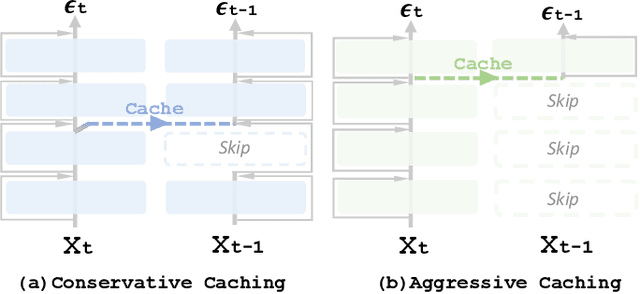
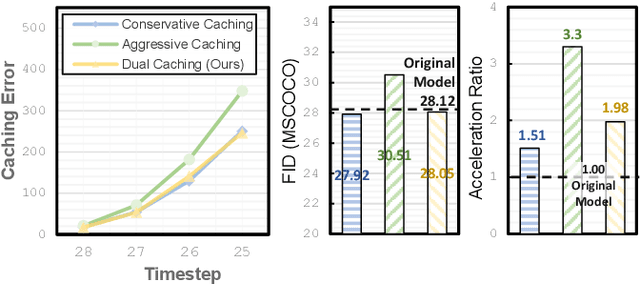


Diffusion Transformers (DiT) have become the dominant methods in image and video generation yet still suffer substantial computational costs. As an effective approach for DiT acceleration, feature caching methods are designed to cache the features of DiT in previous timesteps and reuse them in the next timesteps, allowing us to skip the computation in the next timesteps. However, on the one hand, aggressively reusing all the features cached in previous timesteps leads to a severe drop in generation quality. On the other hand, conservatively caching only the features in the redundant layers or tokens but still computing the important ones successfully preserves the generation quality but results in reductions in acceleration ratios. Observing such a tradeoff between generation quality and acceleration performance, this paper begins by quantitatively studying the accumulated error from cached features. Surprisingly, we find that aggressive caching does not introduce significantly more caching errors in the caching step, and the conservative feature caching can fix the error introduced by aggressive caching. Thereby, we propose a dual caching strategy that adopts aggressive and conservative caching iteratively, leading to significant acceleration and high generation quality at the same time. Besides, we further introduce a V-caching strategy for token-wise conservative caching, which is compatible with flash attention and requires no training and calibration data. Our codes have been released in Github: \textbf{Code: \href{https://github.com/Shenyi-Z/DuCa}{\texttt{\textcolor{cyan}{https://github.com/Shenyi-Z/DuCa}}}}