 Add to Chrome
 Add to Firefox
 Add to Edge
PersonaTree: Structured Lifecycle Memory for Person Understanding in LLM Agents
Jun 03, 2026
Persistent LLM agents require memory representations that make the formation of person understanding explicit across long term interaction. Existing agent memory methods emphasize information retention and retrieval, yet give limited account of how accumulated interaction evidence is abstracted into person understanding. We view this process as schema formation, where situated evidence is abstracted into reusable patterns and stable person level claims. We introduce PersonaTree, a structured lifecycle memory framework that realizes this view as a three level persona tree with explicit support paths from evidence to claims. PersonaTree maintains the tree through conservative writing, confidence guided consolidation, and query conditioned path retrieval, returning only the evidence depth required by each query. Across six person understanding and persistent memory benchmarks with three answer backbones, PersonaTree ranks first in 12 of 18 compact scores and reaches the top two in 16 settings. Ablations show that hierarchy improves abstract person understanding on KnowMe, while support path retrieval improves RealPref alignment under a comparable context budget.

Token Pruning for Caching Better: 9 Times Acceleration on Stable Diffusion for Free
Dec 31, 2024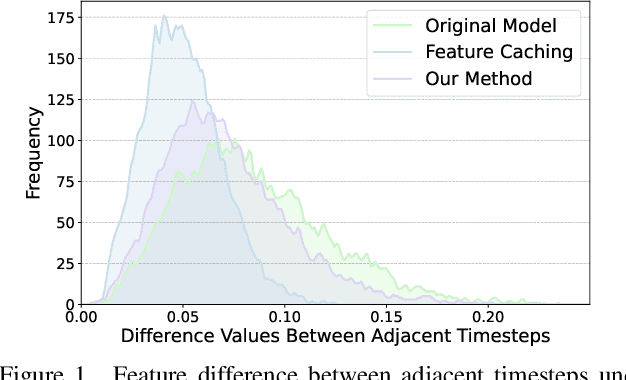
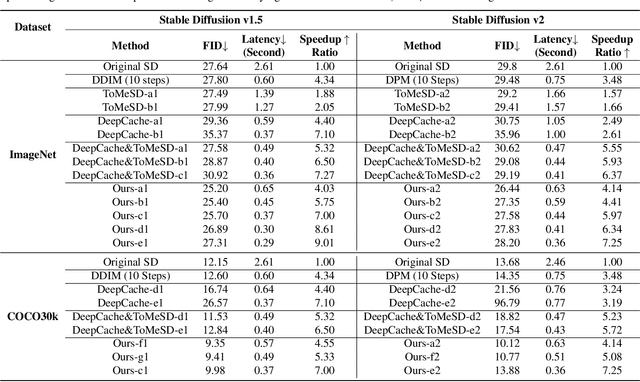
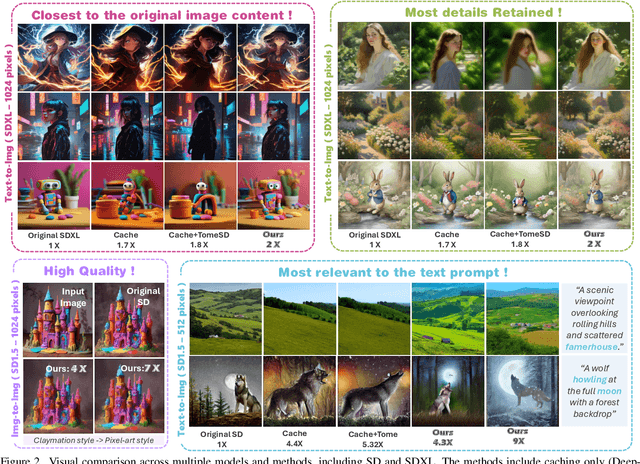
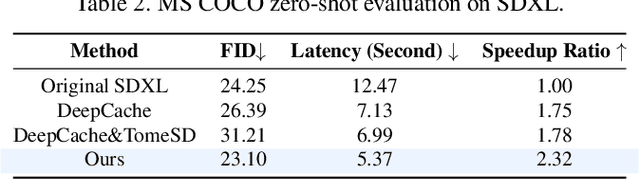
Stable Diffusion has achieved remarkable success in the field of text-to-image generation, with its powerful generative capabilities and diverse generation results making a lasting impact. However, its iterative denoising introduces high computational costs and slows generation speed, limiting broader adoption. The community has made numerous efforts to reduce this computational burden, with methods like feature caching attracting attention due to their effectiveness and simplicity. Nonetheless, simply reusing features computed at previous timesteps causes the features across adjacent timesteps to become similar, reducing the dynamics of features over time and ultimately compromising the quality of generated images. In this paper, we introduce a dynamics-aware token pruning (DaTo) approach that addresses the limitations of feature caching. DaTo selectively prunes tokens with lower dynamics, allowing only high-dynamic tokens to participate in self-attention layers, thereby extending feature dynamics across timesteps. DaTo combines feature caching with token pruning in a training-free manner, achieving both temporal and token-wise information reuse. Applied to Stable Diffusion on the ImageNet, our approach delivered a 9$\times$ speedup while reducing FID by 0.33, indicating enhanced image quality. On the COCO-30k, we observed a 7$\times$ acceleration coupled with a notable FID reduction of 2.17.