 Add to Chrome
 Add to Firefox
 Add to Edge
Arena-T2I Hard: Benchmarking and Improving Faithfulness with Dependency-Aware Checklist
Jun 30, 2026
Faithfulness -- how precisely a generated image aligns with its prompt -- is increasingly central to the real-world utility of text-to-image (T2I) models. Existing faithfulness benchmarks, however, rely on simple atomic instructions, on which top-tier systems already achieve near-perfect scores. As T2I models enter creative workflows, users issue multi-faceted requests combining intricate spatial relationships, stylistic constraints, and complex text rendering. In this setting, a single binary VLM-judge score no longer captures which specific constraints the model fails to satisfy. We introduce Arena-T2I Hard, a 310-prompt stress benchmark drawn from real arena T2I logs, with approximately 30 decomposed yes/no constraints per prompt spanning six categories, including text rendering. The strongest closed-source system we evaluate reaches 0.855 with a 33~pp performance gap across 11 systems, demonstrating substantial discriminative power. Moreover, high public-arena rankings fail to predict faithfulness, confirming that holistic Bradley-Terry (BT) preference scores prioritize aesthetics over fine-grained prompt adherence. We propose a dependency-aware checklist reward that decomposes each prompt into a DAG of yes/no questions and zeroes descendants of failed parents, turning faithfulness into a per-constraint training signal. Combined with a BT aesthetic reward via group-decoupled normalization (GDPO), which standardizes each reward within its rollout group so neither collapses, the recipe attains a strictly better faithfulness-aesthetics trade-off on SD3.5-Medium and FLUX.1-dev under MMRB2 pairwise comparisons than every single-reward, naive weighted-sum, or 4-reward BT-ensemble baseline.

Prompt-to-Leaderboard
Feb 20, 2025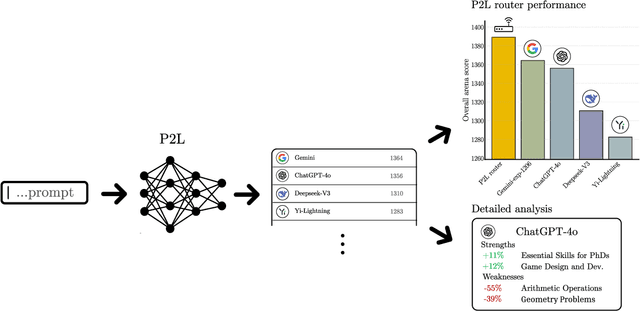
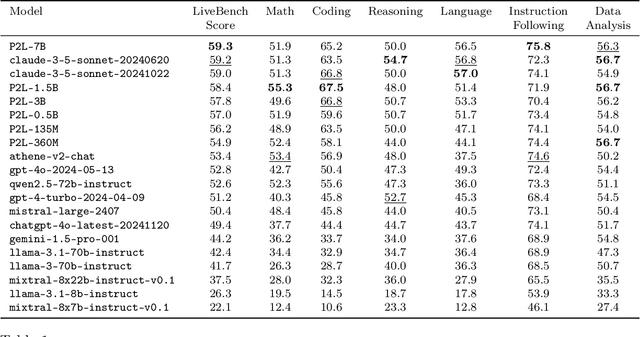
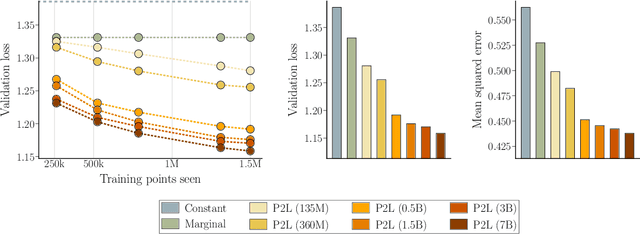
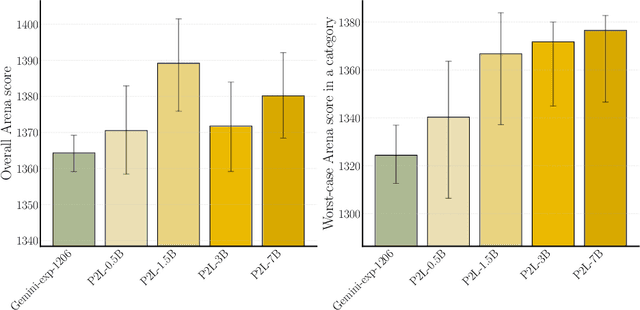
Large language model (LLM) evaluations typically rely on aggregated metrics like accuracy or human preference, averaging across users and prompts. This averaging obscures user- and prompt-specific variations in model performance. To address this, we propose Prompt-to-Leaderboard (P2L), a method that produces leaderboards specific to a prompt. The core idea is to train an LLM taking natural language prompts as input to output a vector of Bradley-Terry coefficients which are then used to predict the human preference vote. The resulting prompt-dependent leaderboards allow for unsupervised task-specific evaluation, optimal routing of queries to models, personalization, and automated evaluation of model strengths and weaknesses. Data from Chatbot Arena suggest that P2L better captures the nuanced landscape of language model performance than the averaged leaderboard. Furthermore, our findings suggest that P2L's ability to produce prompt-specific evaluations follows a power law scaling similar to that observed in LLMs themselves. In January 2025, the router we trained based on this methodology achieved the \#1 spot in the Chatbot Arena leaderboard. Our code is available at this GitHub link: https://github.com/lmarena/p2l.
How to Evaluate Reward Models for RLHF
Oct 18, 2024


We introduce a new benchmark for reward models that quantifies their ability to produce strong language models through RLHF (Reinforcement Learning from Human Feedback). The gold-standard approach is to run a full RLHF training pipeline and directly probe downstream LLM performance. However, this process is prohibitively expensive. To address this, we build a predictive model of downstream LLM performance by evaluating the reward model on proxy tasks. These proxy tasks consist of a large-scale human preference and a verifiable correctness preference dataset, in which we measure 12 metrics across 12 domains. To investigate which reward model metrics are most correlated to gold-standard RLHF outcomes, we launch an end-to-end RLHF experiment on a large-scale crowdsourced human preference platform to view real reward model downstream performance as ground truth. Ultimately, we compile our data and findings into Preference Proxy Evaluations (PPE), the first reward model benchmark explicitly linked to post-RLHF real-world human preference performance, which we open-source for public use and further development. Our code and evaluations can be found at https://github.com/lmarena/PPE .
From Crowdsourced Data to High-Quality Benchmarks: Arena-Hard and BenchBuilder Pipeline
Jun 17, 2024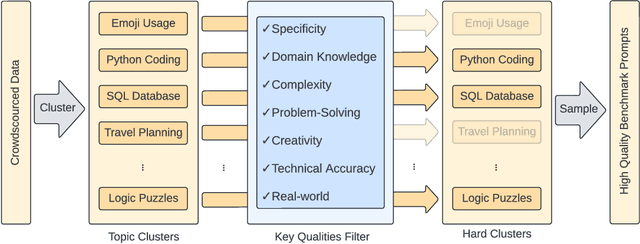

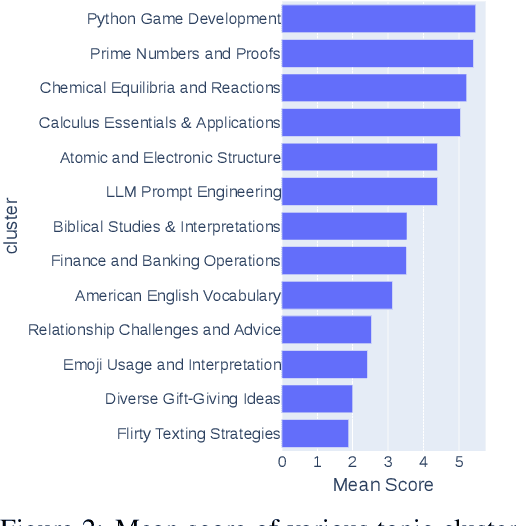
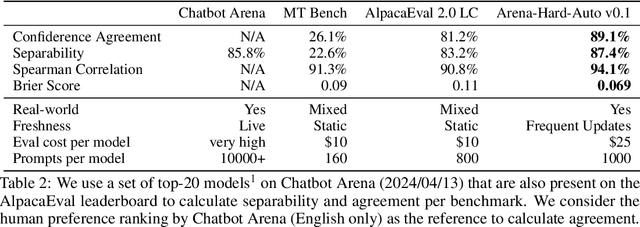
The rapid evolution of language models has necessitated the development of more challenging benchmarks. Current static benchmarks often struggle to consistently distinguish between the capabilities of different models and fail to align with real-world user preferences. On the other hand, live crowd-sourced platforms like the Chatbot Arena collect a wide range of natural prompts and user feedback. However, these prompts vary in sophistication and the feedback cannot be applied offline to new models. In order to ensure that benchmarks keep up with the pace of LLM development, we address how one can evaluate benchmarks on their ability to confidently separate models and their alignment with human preference. Under these principles, we developed BenchBuilder, a living benchmark that filters high-quality prompts from live data sources to enable offline evaluation on fresh, challenging prompts. BenchBuilder identifies seven indicators of a high-quality prompt, such as the requirement for domain knowledge, and utilizes an LLM annotator to select a high-quality subset of prompts from various topic clusters. The LLM evaluation process employs an LLM judge to ensure a fully automated, high-quality, and constantly updating benchmark. We apply BenchBuilder on prompts from the Chatbot Arena to create Arena-Hard-Auto v0.1: 500 challenging user prompts from a wide range of tasks. Arena-Hard-Auto v0.1 offers 3x tighter confidence intervals than MT-Bench and achieves a state-of-the-art 89.1% agreement with human preference rankings, all at a cost of only $25 and without human labelers. The BenchBuilder pipeline enhances evaluation benchmarks and provides a valuable tool for developers, enabling them to extract high-quality benchmarks from extensive data with minimal effort.