 Add to Chrome
 Add to Firefox
 Add to Edge
TaoBench: Do Automated Theorem Prover LLMs Generalize Beyond MathLib?
Mar 13, 2026
Automated theorem proving (ATP) benchmarks largely consist of problems formalized in MathLib, so current ATP training and evaluation are heavily biased toward MathLib's definitional framework. However, frontier mathematics is often exploratory and prototype-heavy, relying on bespoke constructions that deviate from standard libraries. In this work, we evaluate the robustness of current ATP systems when applied to a novel definitional framework, specifically examining the performance gap between standard library problems and bespoke mathematical constructions. We introduce TaoBench, an undergraduate-level benchmark derived from Terence Tao's Analysis I, which formalizes analysis by constructing core mathematical concepts from scratch, without relying on standard Mathlib definitions, as well as by mixing from-scratch and MathLib constructions. For fair evaluation, we build an agentic pipeline that automatically extracts a compilable, self-contained local environment for each problem. To isolate the effect of definitional frameworks, we additionally translate every problem into a mathematically equivalent Mathlib formulation, yielding paired TaoBench-Mathlib statements for direct comparison. While state-of-the-art ATP models perform capably within the MathLib framework, performance drops by an average of roughly 26% on the definitionally equivalent Tao formulation. This indicates that the main bottleneck is limited generalization across definitional frameworks rather than task difficulty. TaoBench thus highlights a gap between benchmark performance and applicability, and provides a concrete foundation for developing and testing provers better aligned with research mathematics.

Are Large-Language Models Graph Algorithmic Reasoners?
Oct 29, 2024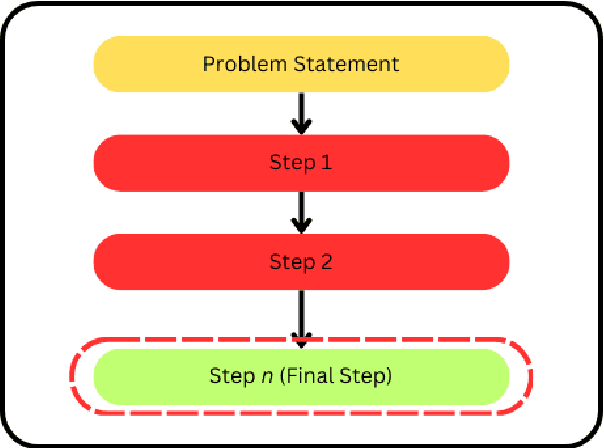
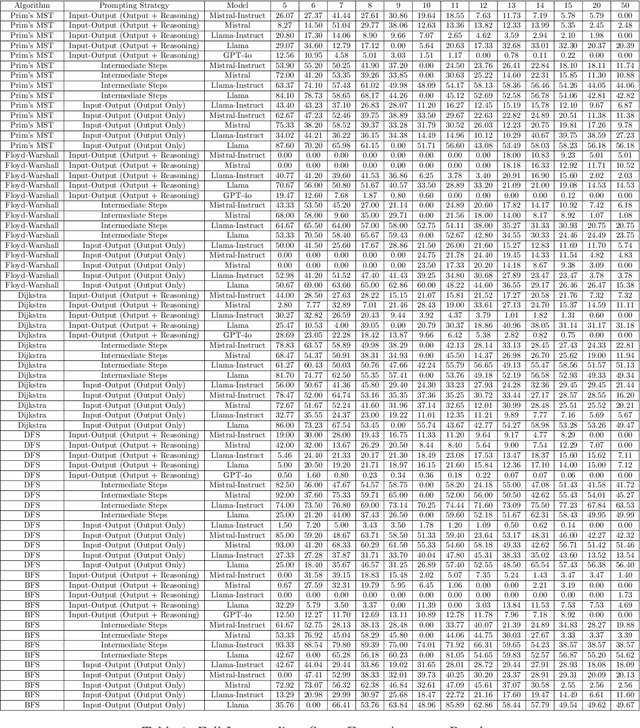
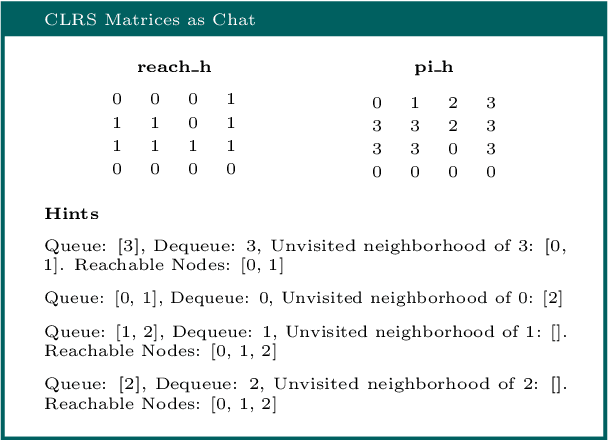
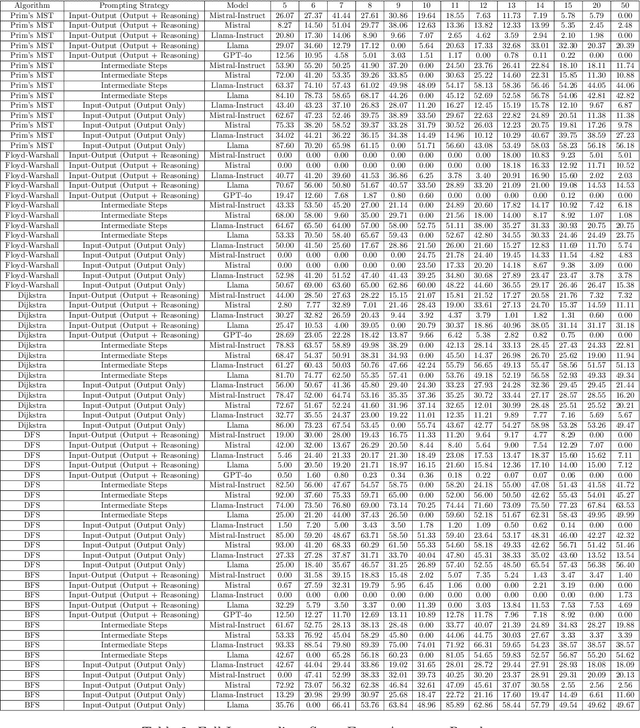
We seek to address a core challenge facing current Large Language Models (LLMs). LLMs have demonstrated superior performance in many tasks, yet continue to struggle with reasoning problems on explicit graphs that require multiple steps. To address this gap, we introduce a novel benchmark designed to evaluate LLM performance on classical algorithmic reasoning tasks on explicit graphs. Our benchmark encompasses five fundamental algorithms: Breadth-First Search (BFS) and Depth-First Search (DFS) for connectivity, Dijkstra's algorithm and Floyd-Warshall algorithm for all nodes shortest path, and Prim's Minimum Spanning Tree (MST-Prim's) algorithm. Through extensive experimentation, we assess the capabilities of state-of-the-art LLMs in executing these algorithms step-by-step and systematically evaluate their performance at each stage. Our findings highlight the persistent challenges LLMs face in this domain and underscore the necessity for advanced prompting techniques and algorithmic instruction to enhance their graph reasoning abilities. This work presents MAGMA, the first comprehensive benchmark focused on LLMs completing classical graph algorithms, and provides a critical step toward understanding and improving their structured problem-solving skills.