 Add to Chrome
 Add to Firefox
 Add to Edge
A Taxonomy of Mental Health and Technology Needs for Alzheimer's and Dementia Caregivers
Jun 17, 2026
Family members caring for individuals with Alzheimer's disease and related dementias (AD/ADRD) provide the foundation of long-term care worldwide. In 2023, more than 11 million U.S. family and friends contributed 18 billion hours of unpaid care, often at the cost of their own physical and mental health. These informal caregivers -- also referred as the "invisible second patients" -- experience elevated rates of mental health problems. Yet research commonly reduces their complex psychosocial experiences to a single construct of caregiver burden, obscuring which specific needs are unmet or effectively supported. At the same time, digital and AI-enabled technologies are rapidly expanding, from smartphone apps and videoconferencing to sensor platforms and AI chatbots. However, the absence of shared frameworks across medicine, psychology, and technology research limits cumulative progress. This study introduces a Caregiver Mental Health and Technology Taxonomy that systematically links AD/ADRD caregiver needs with corresponding classes of technology-based interventions. Drawing from an interdisciplinary literature review and two qualitative studies with caregivers, the taxonomy identifies mismatches between caregiver priorities and existing technological support, highlights under-served domains such as relational strain and compassion fatigue, and proposes design directions for adaptive, responsive systems. The framework offers a shared vocabulary to guide clinicians, researchers, and technology designers in developing more person-centered and clinically grounded innovation in dementia care.

When AI Says "I have been in similar situations": Synthetic Lived Experience in Peer-Like Caregiver Support
Jun 16, 2026Caregivers often turn to online communities for informational and emotional support. In these spaces, peer supporters frequently draw on personal narratives to respond to emotionally complex caregiving situations. As LLMs are increasingly designed as peer-like sources of support, they introduce a critical tension: AI can provide immediate, private, and nonjudgmental support, but it cannot authentically possess the lived experiences that make human peer support meaningful. Yet, when prompted to sound peer-like, LLMs may generate language that implies lived experience. This creates a synthetic lived experience paradox: the same experiential language that may make AI support feel warm, relatable, and peer-like can also falsely position the system as someone with lived experience. We examine this paradox in the context of family caregivers of people living with Alzheimer's Disease and Related Dementias (ADRD). Drawing on caregiver support exchanges from online communities and prompted peer-like responses from three LLMs -- LLaMA, GPT-4o-mini, and MedGemma -- we analyze how human peers use personal narratives and how AI incorporates similar narrative forms. Psycholinguistic analysis shows that peer responses used significantly more first-person and past-focused language than peer-like AI responses. Qualitatively, we identify seven types of personal narratives in human peer support and show that AI often captures their emotional work, but can fabricate experiential grounding. These findings reveal a narrative authenticity gap: peer-like AI can generate synthetic lived experience without the real experience that makes peer support meaningful. We argue that caregiver-support AI systems need mechanisms to distinguish supportive peer-like framing from fabricated lived experience, ensuring that models can offer warmth and validation without falsely positioning themselves as experiential peers.
Inform, Coach, Relate, Listen: Auditing LLM Caregiving Support Roles
May 28, 2026Language models are increasingly being deployed for conversational support in informal caregiving contexts, where interactions often extend beyond information-seeking: caregivers seek emotional reassurance, guidance, and help, while navigating uncertain, relationally complex care decisions. Yet most safety evaluations assess model behavior under generic prompts, leaving a critical question unexamined: does a model's safety profile change with its support role? We study this by operationalizing four expert-reviewed support roles grounded in social support theory: Inform, Coach, Relate, and Listen, and comparing them against two baseline controls: a basic prompting condition and a retrieval-augmented generation (RAG) condition. We evaluate across three language models (GPT-4o-mini, Llama-3.1-8B-Instruct, and MedGemma-1.5-4b-it) on 5,000 real-world queries from online Alzheimer's Disease and Related Dementias (ADRD) communities. We find that the LLM's support role systematically shapes both the prevalence and composition of interactional risks. Furthermore, a human evaluation study reveals a perceived quality--safety tension: more directive, information-oriented roles are rated as more helpful and trustworthy despite exhibiting elevated interactional risk profiles. We release ~90,000 support role-conditioned model responses with risk annotations as an ecologically grounded resource for research on safer LLM-mediated conversational support.
AI Psychosis: Does Conversational AI Amplify Delusion-Related Language?
Mar 20, 2026Conversational AI systems are increasingly used for personal reflection and emotional disclosure, raising concerns about their effects on vulnerable users. Recent anecdotal reports suggest that prolonged interactions with AI may reinforce delusional thinking -- a phenomenon sometimes described as AI Psychosis. However, empirical evidence on this phenomenon remains limited. In this work, we examine how delusion-related language evolves during multi-turn interactions with conversational AI. We construct simulated users (SimUsers) from Reddit users' longitudinal posting histories and generate extended conversations with three model families (GPT, LLaMA, and Qwen). We develop DelusionScore, a linguistic measure that quantifies the intensity of delusion-related language across conversational turns. We find that SimUsers derived from users with prior delusion-related discourse (Treatment) exhibit progressively increasing DelusionScore trajectories, whereas those derived from users without such discourse (Control) remain stable or decline. We further find that this amplification varies across themes, with reality skepticism and compulsive reasoning showing the strongest increases. Finally, conditioning AI responses on current DelusionScore substantially reduces these trajectories. These findings provide empirical evidence that conversational AI interactions can amplify delusion-related language over extended use and highlight the importance of state-aware safety mechanisms for mitigating such risks.
RubRIX: Rubric-Driven Risk Mitigation in Caregiver-AI Interactions
Jan 19, 2026Caregivers seeking AI-mediated support express complex needs -- information-seeking, emotional validation, and distress cues -- that warrant careful evaluation of response safety and appropriateness. Existing AI evaluation frameworks, primarily focused on general risks (toxicity, hallucinations, policy violations, etc), may not adequately capture the nuanced risks of LLM-responses in caregiving-contexts. We introduce RubRIX (Rubric-based Risk Index), a theory-driven, clinician-validated framework for evaluating risks in LLM caregiving responses. Grounded in the Elements of an Ethic of Care, RubRIX operationalizes five empirically-derived risk dimensions: Inattention, Bias & Stigma, Information Inaccuracy, Uncritical Affirmation, and Epistemic Arrogance. We evaluate six state-of-the-art LLMs on over 20,000 caregiver queries from Reddit and ALZConnected. Rubric-guided refinement consistently reduced risk-components by 45-98% after one iteration across models. This work contributes a methodological approach for developing domain-sensitive, user-centered evaluation frameworks for high-burden contexts. Our findings highlight the importance of domain-sensitive, interactional risk evaluation for the responsible deployment of LLMs in caregiving support contexts. We release benchmark datasets to enable future research on contextual risk evaluation in AI-mediated support.
PAIR-SAFE: A Paired-Agent Approach for Runtime Auditing and Refining AI-Mediated Mental Health Support
Jan 19, 2026Large language models (LLMs) are increasingly used for mental health support, yet they can produce responses that are overly directive, inconsistent, or clinically misaligned, particularly in sensitive or high-risk contexts. Existing approaches to mitigating these risks largely rely on implicit alignment through training or prompting, offering limited transparency and runtime accountability. We introduce PAIR-SAFE, a paired-agent framework for auditing and refining AI-generated mental health support that integrates a Responder agent with a supervisory Judge agent grounded in the clinically validated Motivational Interviewing Treatment Integrity (MITI-4) framework. The Judgeaudits each response and provides structuredALLOW or REVISE decisions that guide runtime response refinement. We simulate counseling interactions using a support-seeker simulator derived from human-annotated motivational interviewing data. We find that Judge-supervised interactions show significant improvements in key MITI dimensions, including Partnership, Seek Collaboration, and overall Relational quality. Our quantitative findings are supported by qualitative expert evaluation, which further highlights the nuances of runtime supervision. Together, our results reveal that such pairedagent approach can provide clinically grounded auditing and refinement for AI-assisted conversational mental health support.
Designing Beyond Language: Sociotechnical Barriers in AI Health Technologies for Limited English Proficiency
Nov 10, 2025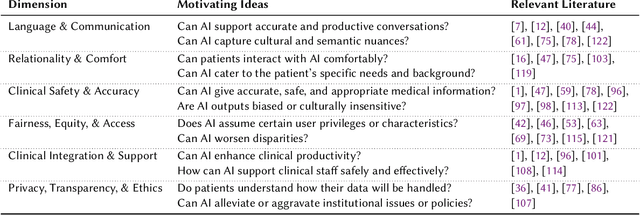
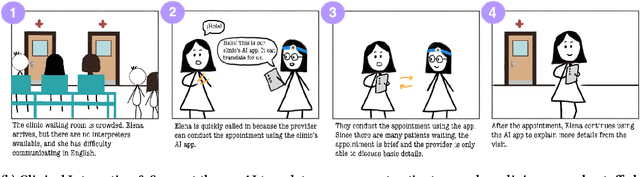
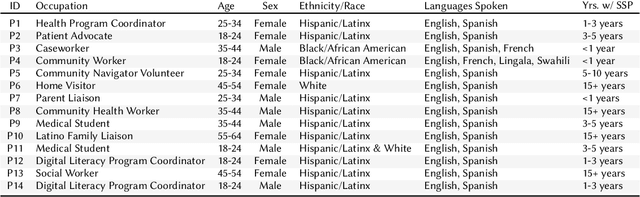
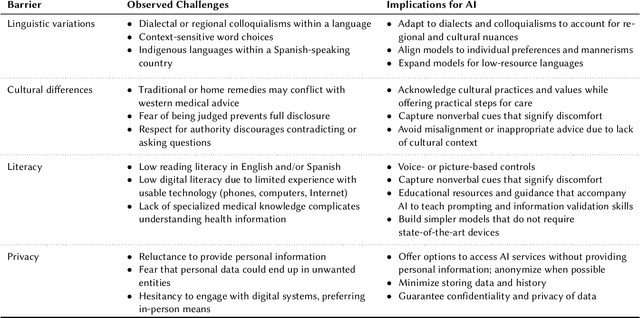
Limited English proficiency (LEP) patients in the U.S. face systemic barriers to healthcare beyond language and interpreter access, encompassing procedural and institutional constraints. AI advances may support communication and care through on-demand translation and visit preparation, but also risk exacerbating existing inequalities. We conducted storyboard-driven interviews with 14 patient navigators to explore how AI could shape care experiences for Spanish-speaking LEP individuals. We identified tensions around linguistic and cultural misunderstandings, privacy concerns, and opportunities and risks for AI to augment care workflows. Participants highlighted structural factors that can undermine trust in AI systems, including sensitive information disclosure, unstable technology access, and low digital literacy. While AI tools can potentially alleviate social barriers and institutional constraints, there are risks of misinformation and uprooting human camaraderie. Our findings contribute design considerations for AI that support LEP patients and care teams via rapport-building, education, and language support, and minimizing disruptions to existing practices.
Mapping Caregiver Needs to AI Chatbot Design: Strengths and Gaps in Mental Health Support for Alzheimer's and Dementia Caregivers
Jun 18, 2025Family caregivers of individuals with Alzheimer's Disease and Related Dementia (AD/ADRD) face significant emotional and logistical challenges that place them at heightened risk for stress, anxiety, and depression. Although recent advances in generative AI -- particularly large language models (LLMs) -- offer new opportunities to support mental health, little is known about how caregivers perceive and engage with such technologies. To address this gap, we developed Carey, a GPT-4o-based chatbot designed to provide informational and emotional support to AD/ADRD caregivers. Using Carey as a technology probe, we conducted semi-structured interviews with 16 family caregivers following scenario-driven interactions grounded in common caregiving stressors. Through inductive coding and reflexive thematic analysis, we surface a systemic understanding of caregiver needs and expectations across six themes -- on-demand information access, emotional support, safe space for disclosure, crisis management, personalization, and data privacy. For each of these themes, we also identified the nuanced tensions in the caregivers' desires and concerns. We present a mapping of caregiver needs, AI chatbot's strengths, gaps, and design recommendations. Our findings offer theoretical and practical insights to inform the design of proactive, trustworthy, and caregiver-centered AI systems that better support the evolving mental health needs of AD/ADRD caregivers.
AI Chatbots for Mental Health: Values and Harms from Lived Experiences of Depression
Apr 26, 2025Recent advancements in LLMs enable chatbots to interact with individuals on a range of queries, including sensitive mental health contexts. Despite uncertainties about their effectiveness and reliability, the development of LLMs in these areas is growing, potentially leading to harms. To better identify and mitigate these harms, it is critical to understand how the values of people with lived experiences relate to the harms. In this study, we developed a technology probe, a GPT-4o based chatbot called Zenny, enabling participants to engage with depression self-management scenarios informed by previous research. We used Zenny to interview 17 individuals with lived experiences of depression. Our thematic analysis revealed key values: informational support, emotional support, personalization, privacy, and crisis management. This work explores the relationship between lived experience values, potential harms, and design recommendations for mental health AI chatbots, aiming to enhance self-management support while minimizing risks.
Interpersonal Theory of Suicide as a Lens to Examine Suicidal Ideation in Online Spaces
Apr 17, 2025Suicide is a critical global public health issue, with millions experiencing suicidal ideation (SI) each year. Online spaces enable individuals to express SI and seek peer support. While prior research has revealed the potential of detecting SI using machine learning and natural language analysis, a key limitation is the lack of a theoretical framework to understand the underlying factors affecting high-risk suicidal intent. To bridge this gap, we adopted the Interpersonal Theory of Suicide (IPTS) as an analytic lens to analyze 59,607 posts from Reddit's r/SuicideWatch, categorizing them into SI dimensions (Loneliness, Lack of Reciprocal Love, Self Hate, and Liability) and risk factors (Thwarted Belongingness, Perceived Burdensomeness, and Acquired Capability of Suicide). We found that high-risk SI posts express planning and attempts, methods and tools, and weaknesses and pain. In addition, we also examined the language of supportive responses through psycholinguistic and content analyses to find that individuals respond differently to different stages of Suicidal Ideation (SI) posts. Finally, we explored the role of AI chatbots in providing effective supportive responses to suicidal ideation posts. We found that although AI improved structural coherence, expert evaluations highlight persistent shortcomings in providing dynamic, personalized, and deeply empathetic support. These findings underscore the need for careful reflection and deeper understanding in both the development and consideration of AI-driven interventions for effective mental health support.