 Add to Chrome
 Add to Firefox
 Add to Edge
GESTO: Human-Centric Spatio-Temporal Memory for Reasoning in Dynamic Scenes
Aug 11, 2026
Robots operating in human environments need memories that capture not only what objects exist and where, but also how people use them over time and how individual interactions compose into goal-directed activities. Existing 4D scene graphs preserve object and place histories but omit activity structure, whereas activity representations are either not grounded in persistent 3D scenes or rely on externally provided event boundaries and object associations. We present GESTO (Grounded Event and Spatio-Temporal memOry), a spatio-temporal memory that couples a persistent 4D scene graph with a two-level hierarchy of atomic human--object interactions and goal-driven events. From an RGB-D observation stream, GESTO automatically extracts timestamped interactions, grounds them to persistent scene entities, groups them into events, and uses event context to refine uncertain object associations. A relation-aware tool-calling agent queries the resulting memory for activity-centric spatio-temporal reasoning. We evaluate GESTO on the reproducible text, binary, and time categories of an existing benchmark, together with 40 new Space2Event and Event2Space queries. GESTO achieves scores of 0.71, 0.75, and 0.70 on the standard categories, approaching a method supplied with ground-truth event and object grounding, while substantially outperforming the same reasoning framework when these inputs are removed. It further achieves 0.73 and 0.75 on Space2Event and Event2Space queries. Ablations show that hierarchical event structure and context-aware grounding refinement provide complementary benefits, supporting activity-grounded hierarchical memory for retrospective reasoning in dynamic human environments.

Long-Term Planning Around Humans in Domestic Environments with 3D Scene Graphs
Mar 12, 2025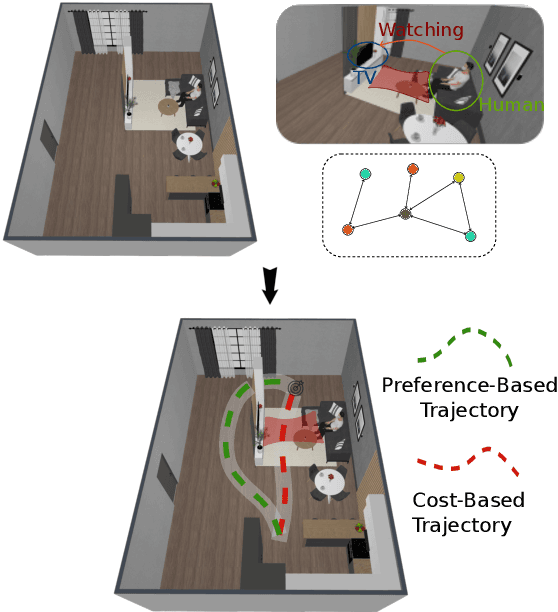
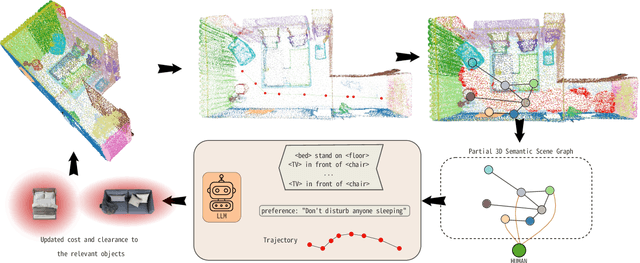
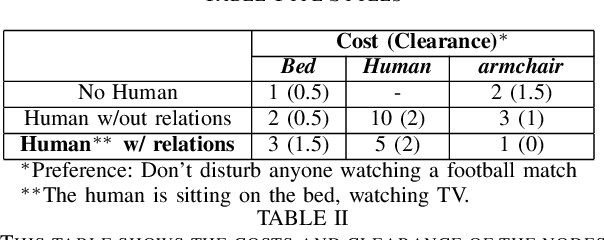
Long-term planning for robots operating in domestic environments poses unique challenges due to the interactions between humans, objects, and spaces. Recent advancements in trajectory planning have leveraged vision-language models (VLMs) to extract contextual information for robots operating in real-world environments. While these methods achieve satisfying performance, they do not explicitly model human activities. Such activities influence surrounding objects and reshape spatial constraints. This paper presents a novel approach to trajectory planning that integrates human preferences, activities, and spatial context through an enriched 3D scene graph (3DSG) representation. By incorporating activity-based relationships, our method captures the spatial impact of human actions, leading to more context-sensitive trajectory adaptation. Preliminary results demonstrate that our approach effectively assigns costs to spaces influenced by human activities, ensuring that the robot trajectory remains contextually appropriate and sensitive to the ongoing environment. This balance between task efficiency and social appropriateness enhances context-aware human-robot interactions in domestic settings. Future work includes implementing a full planning pipeline and conducting user studies to evaluate trajectory acceptability.
Streaming Network for Continual Learning of Object Relocations under Household Context Drifts
Nov 08, 2024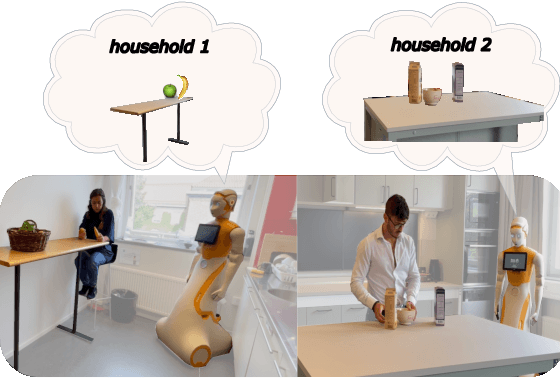
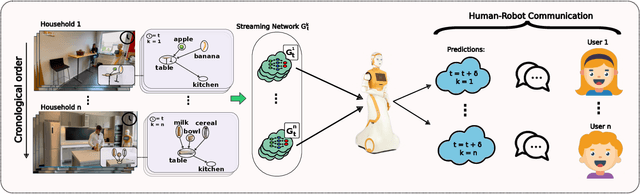
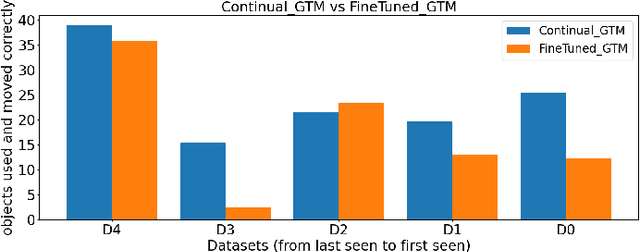
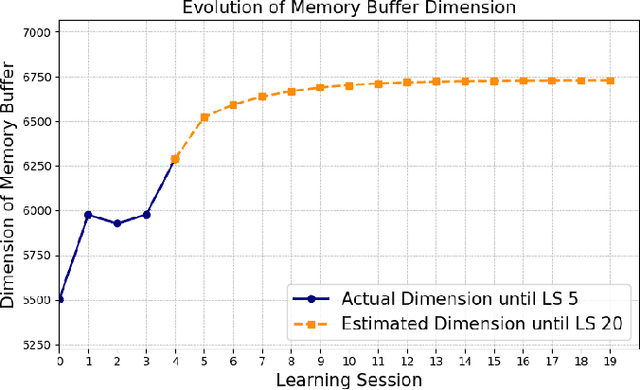
In most applications, robots need to adapt to new environments and be multi-functional without forgetting previous information. This requirement gains further importance in real-world scenarios where robots operate in coexistence with humans. In these complex environments, human actions inevitably lead to changes, requiring robots to adapt accordingly. To effectively address these dynamics, the concept of continual learning proves essential. It not only enables learning models to integrate new knowledge while preserving existing information but also facilitates the acquisition of insights from diverse contexts. This aspect is particularly relevant to the issue of context-switching, where robots must navigate and adapt to changing situational dynamics. Our approach introduces a novel approach to effectively tackle the problem of context drifts by designing a Streaming Graph Neural Network that incorporates both regularization and rehearsal techniques. Our Continual\_GTM model enables us to retain previous knowledge from different contexts, and it is more effective than traditional fine-tuning approaches. We evaluated the efficacy of Continual\_GTM in predicting human routines within household environments, leveraging spatio-temporal object dynamics across diverse scenarios.