 Add to Chrome
 Add to Firefox
 Add to Edge
ShapeSplat: A Large-scale Dataset of Gaussian Splats and Their Self-Supervised Pretraining
Aug 20, 2024

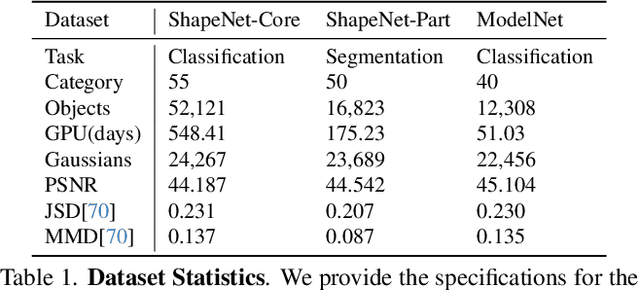
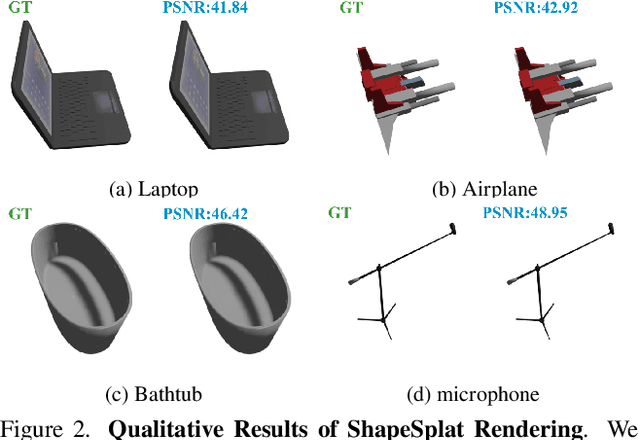
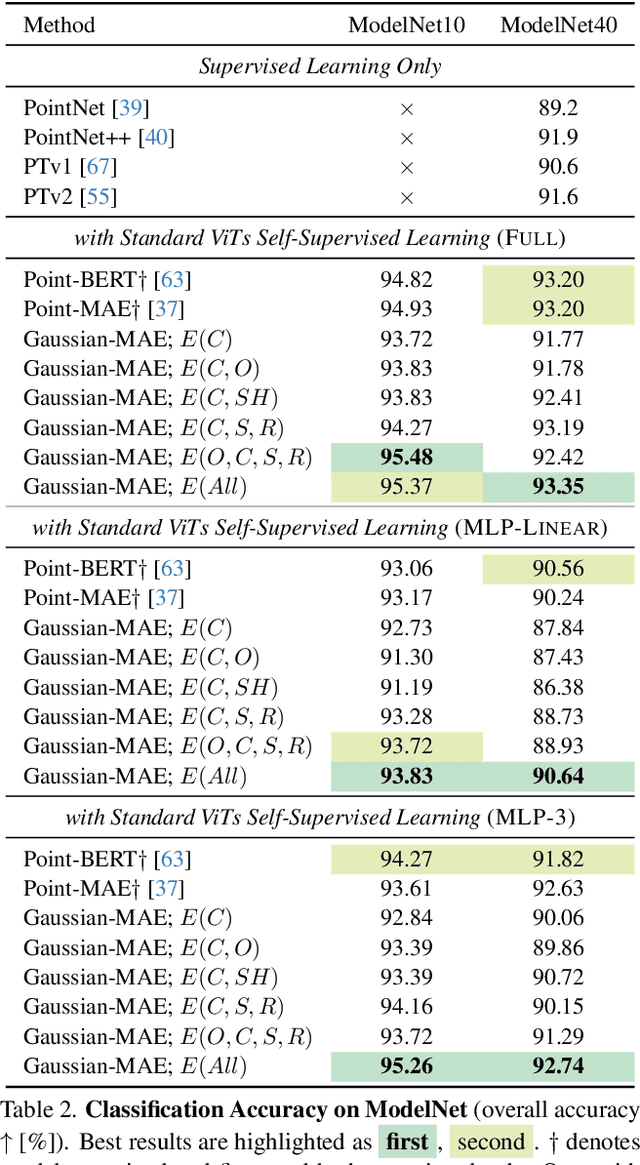
3D Gaussian Splatting (3DGS) has become the de facto method of 3D representation in many vision tasks. This calls for the 3D understanding directly in this representation space. To facilitate the research in this direction, we first build a large-scale dataset of 3DGS using the commonly used ShapeNet and ModelNet datasets. Our dataset ShapeSplat consists of 65K objects from 87 unique categories, whose labels are in accordance with the respective datasets. The creation of this dataset utilized the compute equivalent of 2 GPU years on a TITAN XP GPU. We utilize our dataset for unsupervised pretraining and supervised finetuning for classification and segmentation tasks. To this end, we introduce \textbf{\textit{Gaussian-MAE}}, which highlights the unique benefits of representation learning from Gaussian parameters. Through exhaustive experiments, we provide several valuable insights. In particular, we show that (1) the distribution of the optimized GS centroids significantly differs from the uniformly sampled point cloud (used for initialization) counterpart; (2) this change in distribution results in degradation in classification but improvement in segmentation tasks when using only the centroids; (3) to leverage additional Gaussian parameters, we propose Gaussian feature grouping in a normalized feature space, along with splats pooling layer, offering a tailored solution to effectively group and embed similar Gaussians, which leads to notable improvement in finetuning tasks.

Implicit-Zoo: A Large-Scale Dataset of Neural Implicit Functions for 2D Images and 3D Scenes
Jun 25, 2024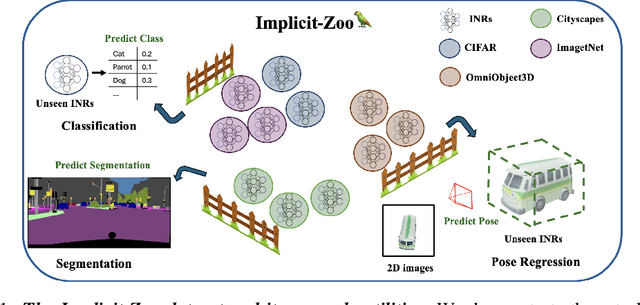

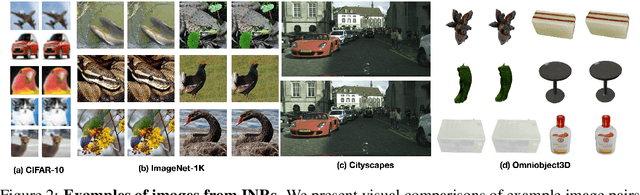
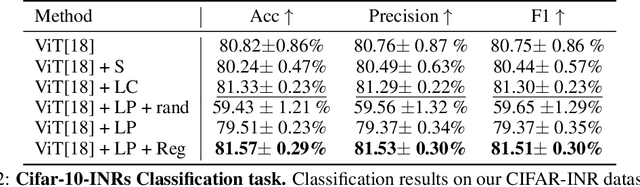
Neural implicit functions have demonstrated significant importance in various areas such as computer vision, graphics. Their advantages include the ability to represent complex shapes and scenes with high fidelity, smooth interpolation capabilities, and continuous representations. Despite these benefits, the development and analysis of implicit functions have been limited by the lack of comprehensive datasets and the substantial computational resources required for their implementation and evaluation. To address these challenges, we introduce "Implicit-Zoo": a large-scale dataset requiring thousands of GPU training days designed to facilitate research and development in this field. Our dataset includes diverse 2D and 3D scenes, such as CIFAR-10, ImageNet-1K, and Cityscapes for 2D image tasks, and the OmniObject3D dataset for 3D vision tasks. We ensure high quality through strict checks, refining or filtering out low-quality data. Using Implicit-Zoo, we showcase two immediate benefits as it enables to: (1) learn token locations for transformer models; (2) directly regress 3D cameras poses of 2D images with respect to NeRF models. This in turn leads to an improved performance in all three task of image classification, semantic segmentation, and 3D pose regression, thereby unlocking new avenues for research.
Uncertainty modeling for fine-tuned implicit functions
Jun 17, 2024

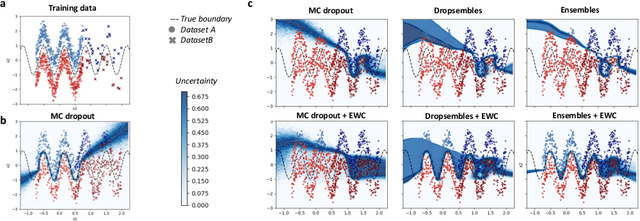
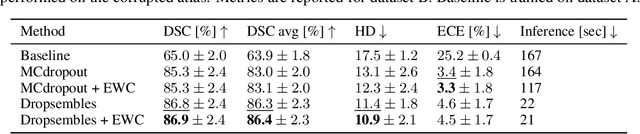
Implicit functions such as Neural Radiance Fields (NeRFs), occupancy networks, and signed distance functions (SDFs) have become pivotal in computer vision for reconstructing detailed object shapes from sparse views. Achieving optimal performance with these models can be challenging due to the extreme sparsity of inputs and distribution shifts induced by data corruptions. To this end, large, noise-free synthetic datasets can serve as shape priors to help models fill in gaps, but the resulting reconstructions must be approached with caution. Uncertainty estimation is crucial for assessing the quality of these reconstructions, particularly in identifying areas where the model is uncertain about the parts it has inferred from the prior. In this paper, we introduce Dropsembles, a novel method for uncertainty estimation in tuned implicit functions. We demonstrate the efficacy of our approach through a series of experiments, starting with toy examples and progressing to a real-world scenario. Specifically, we train a Convolutional Occupancy Network on synthetic anatomical data and test it on low-resolution MRI segmentations of the lumbar spine. Our results show that Dropsembles achieve the accuracy and calibration levels of deep ensembles but with significantly less computational cost.
Vision-Based Neurosurgical Guidance: Unsupervised Localization and Camera-Pose Prediction
May 15, 2024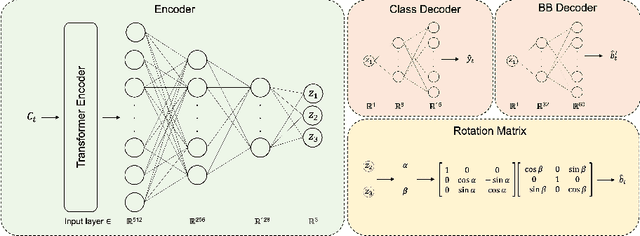
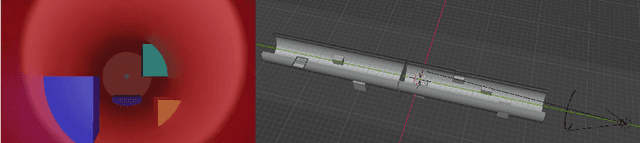
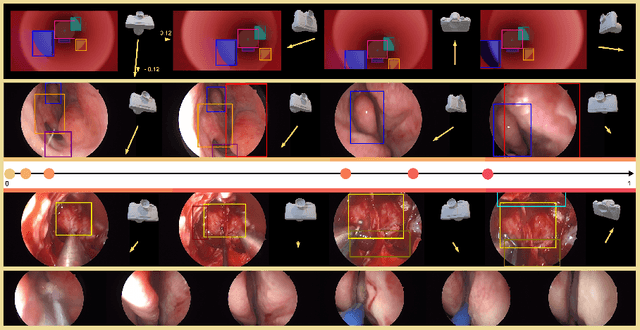
Localizing oneself during endoscopic procedures can be problematic due to the lack of distinguishable textures and landmarks, as well as difficulties due to the endoscopic device such as a limited field of view and challenging lighting conditions. Expert knowledge shaped by years of experience is required for localization within the human body during endoscopic procedures. In this work, we present a deep learning method based on anatomy recognition, that constructs a surgical path in an unsupervised manner from surgical videos, modelling relative location and variations due to different viewing angles. At inference time, the model can map an unseen video's frames on the path and estimate the viewing angle, aiming to provide guidance, for instance, to reach a particular destination. We test the method on a dataset consisting of surgical videos of transsphenoidal adenomectomies, as well as on a synthetic dataset. An online tool that lets researchers upload their surgical videos to obtain anatomy detections and the weights of the trained YOLOv7 model are available at: https://surgicalvision.bmic.ethz.ch.
Canonical normalizing flows for manifold learning
Oct 31, 2023Manifold learning flows are a class of generative modelling techniques that assume a low-dimensional manifold description of the data. The embedding of such a manifold into the high-dimensional space of the data is achieved via learnable invertible transformations. Therefore, once the manifold is properly aligned via a reconstruction loss, the probability density is tractable on the manifold and maximum likelihood can be used to optimize the network parameters. Naturally, the lower-dimensional representation of the data requires an injective-mapping. Recent approaches were able to enforce that the density aligns with the modelled manifold, while efficiently calculating the density volume-change term when embedding to the higher-dimensional space. However, unless the injective-mapping is analytically predefined, the learned manifold is not necessarily an efficient representation of the data. Namely, the latent dimensions of such models frequently learn an entangled intrinsic basis, with degenerate information being stored in each dimension. Alternatively, if a locally orthogonal and/or sparse basis is to be learned, here coined canonical intrinsic basis, it can serve in learning a more compact latent space representation. Toward this end, we propose a canonical manifold learning flow method, where a novel optimization objective enforces the transformation matrix to have few prominent and non-degenerate basis functions. We demonstrate that by minimizing the off-diagonal manifold metric elements $\ell_1$-norm, we can achieve such a basis, which is simultaneously sparse and/or orthogonal. Canonical manifold flow yields a more efficient use of the latent space, automatically generating fewer prominent and distinct dimensions to represent data, and a better approximation of target distributions than other manifold flow methods in most experiments we conducted, resulting in lower FID scores.
* NeurIPS 2023
Expert load matters: operating networks at high accuracy and low manual effort
Aug 09, 2023In human-AI collaboration systems for critical applications, in order to ensure minimal error, users should set an operating point based on model confidence to determine when the decision should be delegated to human experts. Samples for which model confidence is lower than the operating point would be manually analysed by experts to avoid mistakes. Such systems can become truly useful only if they consider two aspects: models should be confident only for samples for which they are accurate, and the number of samples delegated to experts should be minimized. The latter aspect is especially crucial for applications where available expert time is limited and expensive, such as healthcare. The trade-off between the model accuracy and the number of samples delegated to experts can be represented by a curve that is similar to an ROC curve, which we refer to as confidence operating characteristic (COC) curve. In this paper, we argue that deep neural networks should be trained by taking into account both accuracy and expert load and, to that end, propose a new complementary loss function for classification that maximizes the area under this COC curve. This promotes simultaneously the increase in network accuracy and the reduction in number of samples delegated to humans. We perform experiments on multiple computer vision and medical image datasets for classification. Our results demonstrate that the proposed loss improves classification accuracy and delegates less number of decisions to experts, achieves better out-of-distribution samples detection and on par calibration performance compared to existing loss functions.
Quantification of Predictive Uncertainty via Inference-Time Sampling
Aug 03, 2023Predictive variability due to data ambiguities has typically been addressed via construction of dedicated models with built-in probabilistic capabilities that are trained to predict uncertainty estimates as variables of interest. These approaches require distinct architectural components and training mechanisms, may include restrictive assumptions and exhibit overconfidence, i.e., high confidence in imprecise predictions. In this work, we propose a post-hoc sampling strategy for estimating predictive uncertainty accounting for data ambiguity. The method can generate different plausible outputs for a given input and does not assume parametric forms of predictive distributions. It is architecture agnostic and can be applied to any feed-forward deterministic network without changes to the architecture or training procedure. Experiments on regression tasks on imaging and non-imaging input data show the method's ability to generate diverse and multi-modal predictive distributions, and a desirable correlation of the estimated uncertainty with the prediction error.
Explicitly Minimizing the Blur Error of Variational Autoencoders
Apr 12, 2023


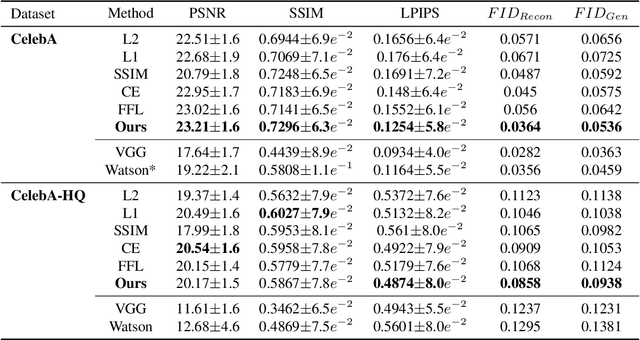
Variational autoencoders (VAEs) are powerful generative modelling methods, however they suffer from blurry generated samples and reconstructions compared to the images they have been trained on. Significant research effort has been spent to increase the generative capabilities by creating more flexible models but often flexibility comes at the cost of higher complexity and computational cost. Several works have focused on altering the reconstruction term of the evidence lower bound (ELBO), however, often at the expense of losing the mathematical link to maximizing the likelihood of the samples under the modeled distribution. Here we propose a new formulation of the reconstruction term for the VAE that specifically penalizes the generation of blurry images while at the same time still maximizing the ELBO under the modeled distribution. We show the potential of the proposed loss on three different data sets, where it outperforms several recently proposed reconstruction losses for VAEs.
Live image-based neurosurgical guidance and roadmap generation using unsupervised embedding
Mar 31, 2023Advanced minimally invasive neurosurgery navigation relies mainly on Magnetic Resonance Imaging (MRI) guidance. MRI guidance, however, only provides pre-operative information in the majority of the cases. Once the surgery begins, the value of this guidance diminishes to some extent because of the anatomical changes due to surgery. Guidance with live image feedback coming directly from the surgical device, e.g., endoscope, can complement MRI-based navigation or be an alternative if MRI guidance is not feasible. With this motivation, we present a method for live image-only guidance leveraging a large data set of annotated neurosurgical videos.First, we report the performance of a deep learning-based object detection method, YOLO, on detecting anatomical structures in neurosurgical images. Second, we present a method for generating neurosurgical roadmaps using unsupervised embedding without assuming exact anatomical matches between patients, presence of an extensive anatomical atlas, or the need for simultaneous localization and mapping. A generated roadmap encodes the common anatomical paths taken in surgeries in the training set. At inference, the roadmap can be used to map a surgeon's current location using live image feedback on the path to provide guidance by being able to predict which structures should appear going forward or backward, much like a mapping application. Even though the embedding is not supervised by position information, we show that it is correlated to the location inside the brain and on the surgical path. We trained and evaluated the proposed method with a data set of 166 transsphenoidal adenomectomy procedures.
InOR-Net: Incremental 3D Object Recognition Network for Point Cloud Representation
Feb 20, 2023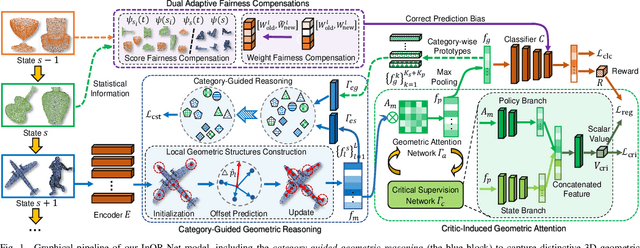
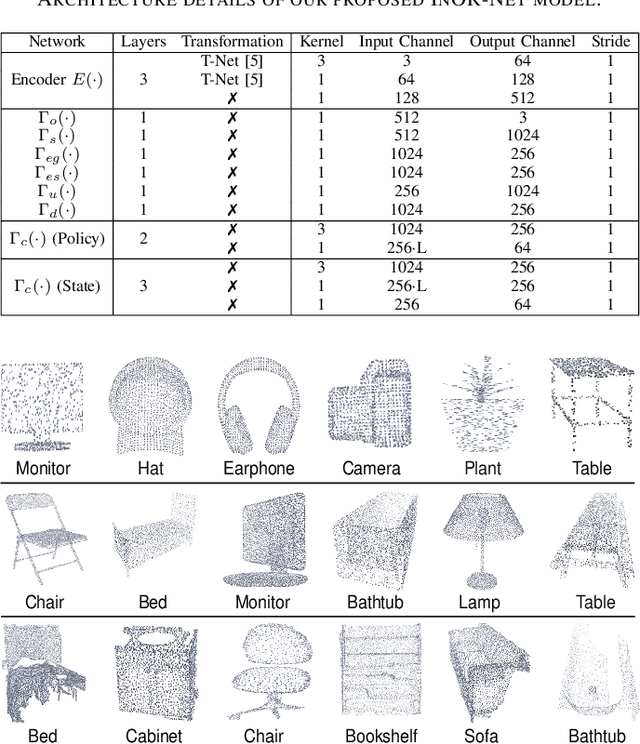
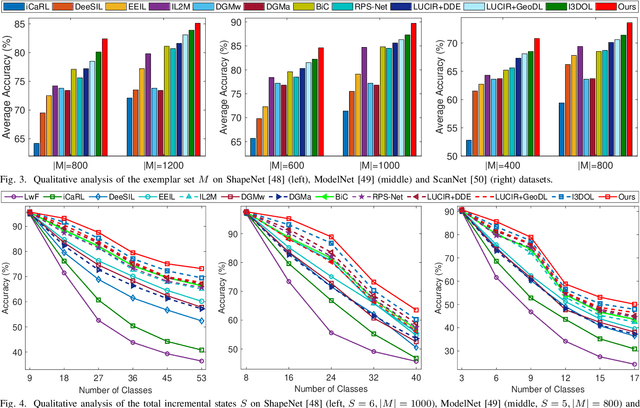
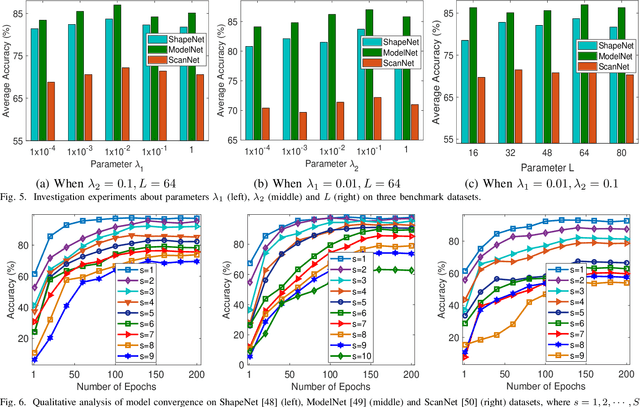
3D object recognition has successfully become an appealing research topic in the real-world. However, most existing recognition models unreasonably assume that the categories of 3D objects cannot change over time in the real-world. This unrealistic assumption may result in significant performance degradation for them to learn new classes of 3D objects consecutively, due to the catastrophic forgetting on old learned classes. Moreover, they cannot explore which 3D geometric characteristics are essential to alleviate the catastrophic forgetting on old classes of 3D objects. To tackle the above challenges, we develop a novel Incremental 3D Object Recognition Network (i.e., InOR-Net), which could recognize new classes of 3D objects continuously via overcoming the catastrophic forgetting on old classes. Specifically, a category-guided geometric reasoning is proposed to reason local geometric structures with distinctive 3D characteristics of each class by leveraging intrinsic category information. We then propose a novel critic-induced geometric attention mechanism to distinguish which 3D geometric characteristics within each class are beneficial to overcome the catastrophic forgetting on old classes of 3D objects, while preventing the negative influence of useless 3D characteristics. In addition, a dual adaptive fairness compensations strategy is designed to overcome the forgetting brought by class imbalance, by compensating biased weights and predictions of the classifier. Comparison experiments verify the state-of-the-art performance of the proposed InOR-Net model on several public point cloud datasets.