 Add to Chrome
 Add to Firefox
 Add to Edge
MedSAM2-Anatomy: Training-Free Inference-Time Optimization for Musculoskeletal Segmentation
Jul 31, 2026
High-resolution 3D segmentation of hip and shoulder anatomy from CT and MRI is essential for surgical planning, yet frozen segmentation models often fail under domain shift. CNN-based expert models are fully automatic but lack adaptability, whereas promptable foundation models generalize better but require manual prompting. We present MedSAM2-Anatomy, a training-free inference-time optimization framework that improves frozen segmentation models without retraining or human interaction. A frozen expert model generates anatomical priors that are automatically converted into multiple prompt hypotheses for a frozen 3D foundation model. Candidate masks are fused while anatomically implausible priors are rejected. No model weights are updated and no manual prompts are required. TotalSegmentator and MedSAM2 are used as representative expert and foundation models, allowing the contribution of the inference policy to be isolated. Evaluation on the independent Balgrist-V0 CT and MRI cohorts shows that inference-time optimization increases median Dice from 0.71 to 0.92 on hip MRI and from 0.89 to 0.92 on shoulder CT, while reducing median HD95 on hip MRI from 22.0 mm to 5.0 mm. On public TotalSegmentator benchmarks, the expert model remains strongest, indicating that the optimal fusion strategy depends on the reliability of the expert prior. These results demonstrate that training-free inference-time optimization provides a practical strategy for improving frozen segmentation models without manual prompting.

Generalizable Single-Source Cross-modality Medical Image Segmentation via Invariant Causal Mechanisms
Nov 07, 2024Single-source domain generalization (SDG) aims to learn a model from a single source domain that can generalize well on unseen target domains. This is an important task in computer vision, particularly relevant to medical imaging where domain shifts are common. In this work, we consider a challenging yet practical setting: SDG for cross-modality medical image segmentation. We combine causality-inspired theoretical insights on learning domain-invariant representations with recent advancements in diffusion-based augmentation to improve generalization across diverse imaging modalities. Guided by the ``intervention-augmentation equivariant'' principle, we use controlled diffusion models (DMs) to simulate diverse imaging styles while preserving the content, leveraging rich generative priors in large-scale pretrained DMs to comprehensively perturb the multidimensional style variable. Extensive experiments on challenging cross-modality segmentation tasks demonstrate that our approach consistently outperforms state-of-the-art SDG methods across three distinct anatomies and imaging modalities. The source code is available at \href{https://github.com/ratschlab/ICMSeg}{https://github.com/ratschlab/ICMSeg}.
Uncertainty modeling for fine-tuned implicit functions
Jun 17, 2024

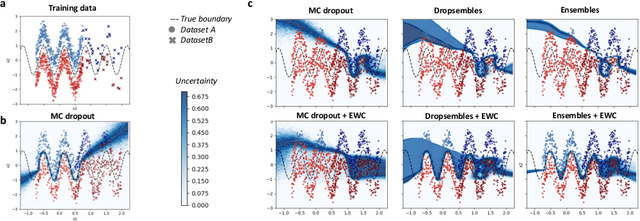
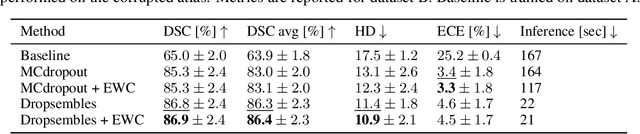
Implicit functions such as Neural Radiance Fields (NeRFs), occupancy networks, and signed distance functions (SDFs) have become pivotal in computer vision for reconstructing detailed object shapes from sparse views. Achieving optimal performance with these models can be challenging due to the extreme sparsity of inputs and distribution shifts induced by data corruptions. To this end, large, noise-free synthetic datasets can serve as shape priors to help models fill in gaps, but the resulting reconstructions must be approached with caution. Uncertainty estimation is crucial for assessing the quality of these reconstructions, particularly in identifying areas where the model is uncertain about the parts it has inferred from the prior. In this paper, we introduce Dropsembles, a novel method for uncertainty estimation in tuned implicit functions. We demonstrate the efficacy of our approach through a series of experiments, starting with toy examples and progressing to a real-world scenario. Specifically, we train a Convolutional Occupancy Network on synthetic anatomical data and test it on low-resolution MRI segmentations of the lumbar spine. Our results show that Dropsembles achieve the accuracy and calibration levels of deep ensembles but with significantly less computational cost.