 Add to Chrome
 Add to Firefox
 Add to Edge
BEA-GS: BEyond RAdiance Supervision in 3DGS for Precise Object Extraction
May 10, 2026
Most Gaussian Splatting techniques that provide a 3D semantic representation of the scene do not optimize the underlying 3D geometry, making object-level editing or asset extraction challenging. Recent methods, such as COBGS, Trace3D, ObjectGS, acknowledge this limitation and propose approaches that modify the scene's geometry to represent the underlying semantics. We advance this concept further by proposing a novel solution that provides near perfect boundaries in object extraction. We do so by introducing two new losses in the optimization that take care of: 1) a loss that modifies the geometry of visible Gaussians to respect semantic boundaries, and 2) a loss that adjusts the geometry of non-visible Gaussians that appear once the object is extracted. Our first loss propagates gradients directly through the rasterization, allowing for seamless integration within the optimization of the Gaussian parameters. The second loss also propagates gradients to Gaussian parameters but does so without passing through the rasterization, enabling modification of the scene's geometry even when little transmittance reaches a Gaussian (partial or non-visible). Exhaustive comparisons with 12 state of the art methods across 4 datasets, using six metrics, demonstrate that our approach produces overall the best boundary segmentation to date.

VIRGi: View-dependent Instant Recoloring of 3D Gaussians Splats
Mar 03, 20263D Gaussian Splatting (3DGS) has recently transformed the fields of novel view synthesis and 3D reconstruction due to its ability to accurately model complex 3D scenes and its unprecedented rendering performance. However, a significant challenge persists: the absence of an efficient and photorealistic method for editing the appearance of the scene's content. In this paper we introduce VIRGi, a novel approach for rapidly editing the color of scenes modeled by 3DGS while preserving view-dependent effects such as specular highlights. Key to our method are a novel architecture that separates color into diffuse and view-dependent components, and a multi-view training strategy that integrates image patches from multiple viewpoints. Improving over the conventional single-view batch training, our 3DGS representation provides more accurate reconstruction and serves as a solid representation for the recoloring task. For 3DGS recoloring, we then introduce a rapid scheme requiring only one manually edited image of the scene from the end-user. By fine-tuning the weights of a single MLP, alongside a module for single-shot segmentation of the editable area, the color edits are seamlessly propagated to the entire scene in just two seconds, facilitating real-time interaction and providing control over the strength of the view-dependent effects. An exhaustive validation on diverse datasets demonstrates significant quantitative and qualitative advancements over competitors based on Neural Radiance Fields representations.
IReNe: Instant Recoloring of Neural Radiance Fields
Jun 10, 2024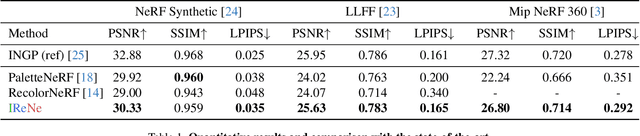
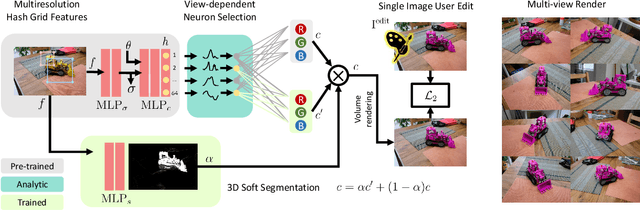
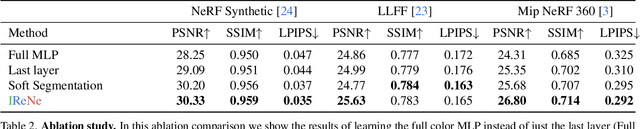
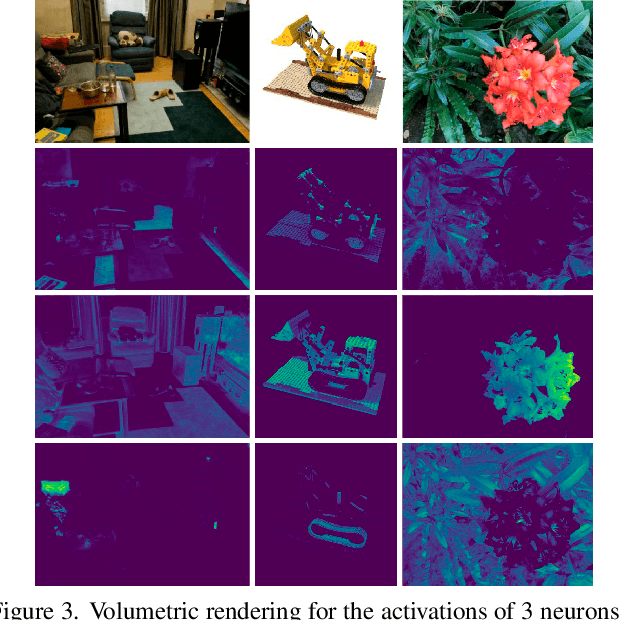
Advances in NERFs have allowed for 3D scene reconstructions and novel view synthesis. Yet, efficiently editing these representations while retaining photorealism is an emerging challenge. Recent methods face three primary limitations: they're slow for interactive use, lack precision at object boundaries, and struggle to ensure multi-view consistency. We introduce IReNe to address these limitations, enabling swift, near real-time color editing in NeRF. Leveraging a pre-trained NeRF model and a single training image with user-applied color edits, IReNe swiftly adjusts network parameters in seconds. This adjustment allows the model to generate new scene views, accurately representing the color changes from the training image while also controlling object boundaries and view-specific effects. Object boundary control is achieved by integrating a trainable segmentation module into the model. The process gains efficiency by retraining only the weights of the last network layer. We observed that neurons in this layer can be classified into those responsible for view-dependent appearance and those contributing to diffuse appearance. We introduce an automated classification approach to identify these neuron types and exclusively fine-tune the weights of the diffuse neurons. This further accelerates training and ensures consistent color edits across different views. A thorough validation on a new dataset, with edited object colors, shows significant quantitative and qualitative advancements over competitors, accelerating speeds by 5x to 500x.
IReNe: Instant Recoloring in Neural Radiance Fields
May 30, 2024Advances in NERFs have allowed for 3D scene reconstructions and novel view synthesis. Yet, efficiently editing these representations while retaining photorealism is an emerging challenge. Recent methods face three primary limitations: they're slow for interactive use, lack precision at object boundaries, and struggle to ensure multi-view consistency. We introduce IReNe to address these limitations, enabling swift, near real-time color editing in NeRF. Leveraging a pre-trained NeRF model and a single training image with user-applied color edits, IReNe swiftly adjusts network parameters in seconds. This adjustment allows the model to generate new scene views, accurately representing the color changes from the training image while also controlling object boundaries and view-specific effects. Object boundary control is achieved by integrating a trainable segmentation module into the model. The process gains efficiency by retraining only the weights of the last network layer. We observed that neurons in this layer can be classified into those responsible for view-dependent appearance and those contributing to diffuse appearance. We introduce an automated classification approach to identify these neuron types and exclusively fine-tune the weights of the diffuse neurons. This further accelerates training and ensures consistent color edits across different views. A thorough validation on a new dataset, with edited object colors, shows significant quantitative and qualitative advancements over competitors, accelerating speeds by 5x to 500x.