 Add to Chrome
 Add to Firefox
 Add to Edge
PETRA: Transforming Web Text for Petroleum-Engineering Domain Adaptation
Jun 23, 2026
Petroleum-engineering search exposes a supervision gap for strong general retrievers: relevant evidence exists in public web text, but domain relevance labels are scarce. To address this gap, we propose PETRA, a large-scale Petroleum Engineering Text for Retrieval Adaptation dataset and pipeline that converts noisy public web data into a curated domain corpus and synthetic supervision for dense retrieval and reranking. PETRA contains 1.36M curated chunks, approximately 2B token equivalents, $\approx$859k, embedding training rows from $\approx$224k anchors, and roughly 400k teacher-scored reranker candidate rows. Its construction combines high-recall energy-domain curation, an energy-domain classifier with 98.4% test accuracy, chunk-grounded query generation, LLM-written hard negatives, and retrieval-mined candidate lists. PETRA improves first-stage in-domain Normalized Discounted Cumulative Gain (nDCG) from 0.703 to 0.763 through score fusion. Reranker adaptation improves the public Earth Science benchmark by 44% relative and a six-task reasoning-intensive panel by 23%. Failed training recipes show that high train-holdout accuracy on synthetic labels does not predict retrieval gains; retrieval-mined data helps only after being repackaged as teacher-scored candidate lists sampled from the inference-time candidate distribution.

IReNe: Instant Recoloring of Neural Radiance Fields
Jun 10, 2024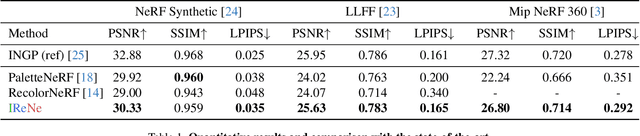
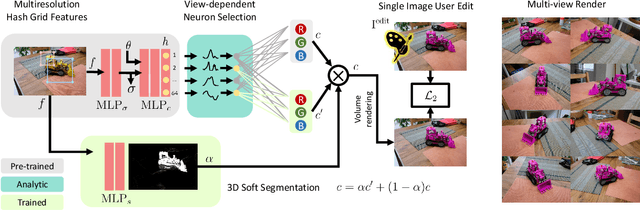
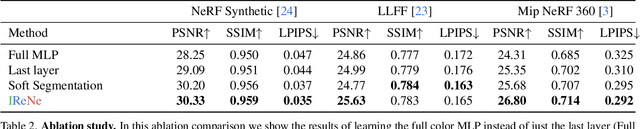
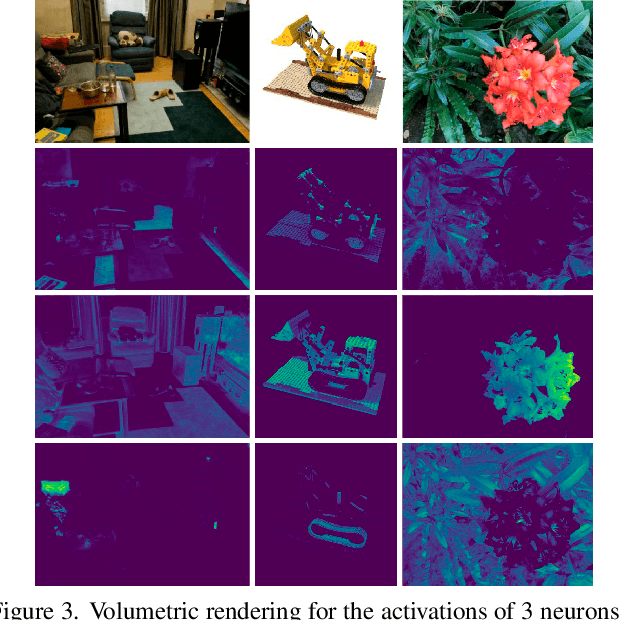
Advances in NERFs have allowed for 3D scene reconstructions and novel view synthesis. Yet, efficiently editing these representations while retaining photorealism is an emerging challenge. Recent methods face three primary limitations: they're slow for interactive use, lack precision at object boundaries, and struggle to ensure multi-view consistency. We introduce IReNe to address these limitations, enabling swift, near real-time color editing in NeRF. Leveraging a pre-trained NeRF model and a single training image with user-applied color edits, IReNe swiftly adjusts network parameters in seconds. This adjustment allows the model to generate new scene views, accurately representing the color changes from the training image while also controlling object boundaries and view-specific effects. Object boundary control is achieved by integrating a trainable segmentation module into the model. The process gains efficiency by retraining only the weights of the last network layer. We observed that neurons in this layer can be classified into those responsible for view-dependent appearance and those contributing to diffuse appearance. We introduce an automated classification approach to identify these neuron types and exclusively fine-tune the weights of the diffuse neurons. This further accelerates training and ensures consistent color edits across different views. A thorough validation on a new dataset, with edited object colors, shows significant quantitative and qualitative advancements over competitors, accelerating speeds by 5x to 500x.
IReNe: Instant Recoloring in Neural Radiance Fields
May 30, 2024Advances in NERFs have allowed for 3D scene reconstructions and novel view synthesis. Yet, efficiently editing these representations while retaining photorealism is an emerging challenge. Recent methods face three primary limitations: they're slow for interactive use, lack precision at object boundaries, and struggle to ensure multi-view consistency. We introduce IReNe to address these limitations, enabling swift, near real-time color editing in NeRF. Leveraging a pre-trained NeRF model and a single training image with user-applied color edits, IReNe swiftly adjusts network parameters in seconds. This adjustment allows the model to generate new scene views, accurately representing the color changes from the training image while also controlling object boundaries and view-specific effects. Object boundary control is achieved by integrating a trainable segmentation module into the model. The process gains efficiency by retraining only the weights of the last network layer. We observed that neurons in this layer can be classified into those responsible for view-dependent appearance and those contributing to diffuse appearance. We introduce an automated classification approach to identify these neuron types and exclusively fine-tune the weights of the diffuse neurons. This further accelerates training and ensures consistent color edits across different views. A thorough validation on a new dataset, with edited object colors, shows significant quantitative and qualitative advancements over competitors, accelerating speeds by 5x to 500x.