 Add to Chrome
 Add to Firefox
 Add to Edge
AutoSew: A Geometric Approach to Stitching Prediction with Graph Neural Networks
Feb 25, 2026
Automating garment assembly from sewing patterns remains a significant challenge due to the lack of standardized annotation protocols and the frequent absence of semantic cues. Existing methods often rely on panel labels or handcrafted heuristics, which limit their applicability to real-world, non-conforming patterns. We present AutoSew, a fully automatic, geometry-based approach for predicting stitch correspondences directly from 2D pattern contours. AutoSew formulates the problem as a graph matching task, leveraging a Graph Neural Network to capture local and global geometric context, and employing a differentiable optimal transport solver to infer stitching relationships-including multi-edge connections. To support this task, we update the GarmentCodeData dataset modifying over 18k patterns with realistic multi-edge annotations, reflecting industrial assembly scenarios. AutoSew achieves 96% F1-score and successfully assembles 73.3% of test garments without error, outperforming existing methods while relying solely on geometric input. Our results demonstrate that geometry alone can robustly guide stitching prediction, enabling scalable garment assembly without manual input.

Visual Semantic Navigation with Real Robots
Nov 28, 2023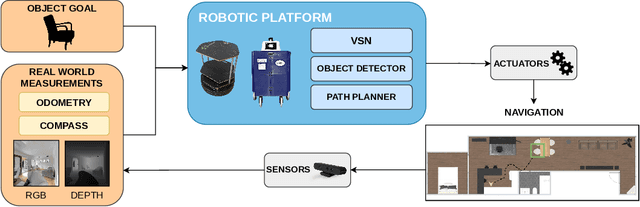

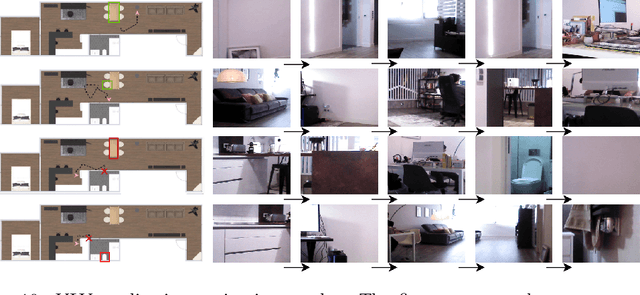
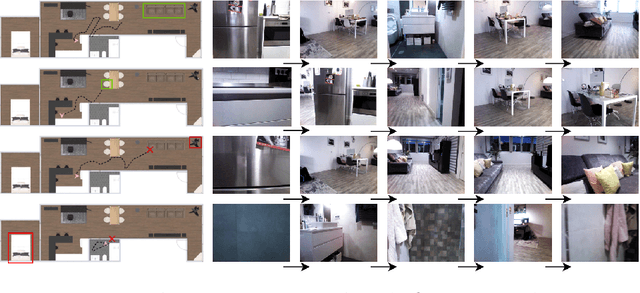
Visual Semantic Navigation (VSN) is the ability of a robot to learn visual semantic information for navigating in unseen environments. These VSN models are typically tested in those virtual environments where they are trained, mainly using reinforcement learning based approaches. Therefore, we do not yet have an in-depth analysis of how these models would behave in the real world. In this work, we propose a new solution to integrate VSN models into real robots, so that we have true embodied agents. We also release a novel ROS-based framework for VSN, ROS4VSN, so that any VSN-model can be easily deployed in any ROS-compatible robot and tested in a real setting. Our experiments with two different robots, where we have embedded two state-of-the-art VSN agents, confirm that there is a noticeable performance difference of these VSN solutions when tested in real-world and simulation environments. We hope that this research will endeavor to provide a foundation for addressing this consequential issue, with the ultimate aim of advancing the performance and efficiency of embodied agents within authentic real-world scenarios. Code to reproduce all our experiments can be found at https://github.com/gramuah/ros4vsn.