 Add to Chrome
 Add to Firefox
 Add to Edge
OpenAI GPT-5 System Card
Dec 19, 2025
This is the system card published alongside the OpenAI GPT-5 launch, August 2025. GPT-5 is a unified system with a smart and fast model that answers most questions, a deeper reasoning model for harder problems, and a real-time router that quickly decides which model to use based on conversation type, complexity, tool needs, and explicit intent (for example, if you say 'think hard about this' in the prompt). The router is continuously trained on real signals, including when users switch models, preference rates for responses, and measured correctness, improving over time. Once usage limits are reached, a mini version of each model handles remaining queries. This system card focuses primarily on gpt-5-thinking and gpt-5-main, while evaluations for other models are available in the appendix. The GPT-5 system not only outperforms previous models on benchmarks and answers questions more quickly, but -- more importantly -- is more useful for real-world queries. We've made significant advances in reducing hallucinations, improving instruction following, and minimizing sycophancy, and have leveled up GPT-5's performance in three of ChatGPT's most common uses: writing, coding, and health. All of the GPT-5 models additionally feature safe-completions, our latest approach to safety training to prevent disallowed content. Similarly to ChatGPT agent, we have decided to treat gpt-5-thinking as High capability in the Biological and Chemical domain under our Preparedness Framework, activating the associated safeguards. While we do not have definitive evidence that this model could meaningfully help a novice to create severe biological harm -- our defined threshold for High capability -- we have chosen to take a precautionary approach.

Learning from Negative User Feedback and Measuring Responsiveness for Sequential Recommenders
Aug 23, 2023


Sequential recommenders have been widely used in industry due to their strength in modeling user preferences. While these models excel at learning a user's positive interests, less attention has been paid to learning from negative user feedback. Negative user feedback is an important lever of user control, and comes with an expectation that recommenders should respond quickly and reduce similar recommendations to the user. However, negative feedback signals are often ignored in the training objective of sequential retrieval models, which primarily aim at predicting positive user interactions. In this work, we incorporate explicit and implicit negative user feedback into the training objective of sequential recommenders in the retrieval stage using a "not-to-recommend" loss function that optimizes for the log-likelihood of not recommending items with negative feedback. We demonstrate the effectiveness of this approach using live experiments on a large-scale industrial recommender system. Furthermore, we address a challenge in measuring recommender responsiveness to negative feedback by developing a counterfactual simulation framework to compare recommender responses between different user actions, showing improved responsiveness from the modeling change.
Value of Exploration: Measurements, Findings and Algorithms
May 12, 2023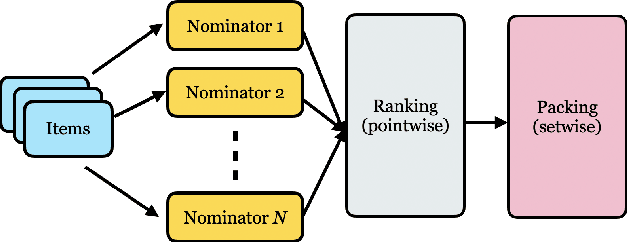
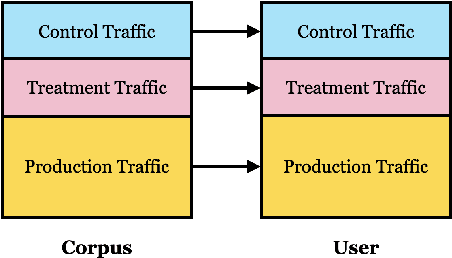

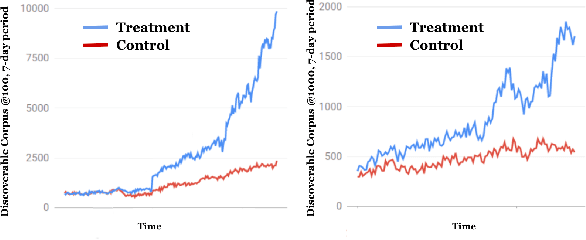
Effective exploration is believed to positively influence the long-term user experience on recommendation platforms. Determining its exact benefits, however, has been challenging. Regular A/B tests on exploration often measure neutral or even negative engagement metrics while failing to capture its long-term benefits. To address this, we present a systematic study to formally quantify the value of exploration by examining its effects on the content corpus, a key entity in the recommender system that directly affects user experiences. Specifically, we introduce new metrics and the associated experiment design to measure the benefit of exploration on the corpus change, and further connect the corpus change to the long-term user experience. Furthermore, we investigate the possibility of introducing the Neural Linear Bandit algorithm to build an exploration-based ranking system, and use it as the backbone algorithm for our case study. We conduct extensive live experiments on a large-scale commercial recommendation platform that serves billions of users to validate the new experiment designs, quantify the long-term values of exploration, and to verify the effectiveness of the adopted neural linear bandit algorithm for exploration.