 Add to Chrome
 Add to Firefox
 Add to Edge
Efficient Data Collection for Robotic Manipulation via Compositional Generalization
Mar 08, 2024
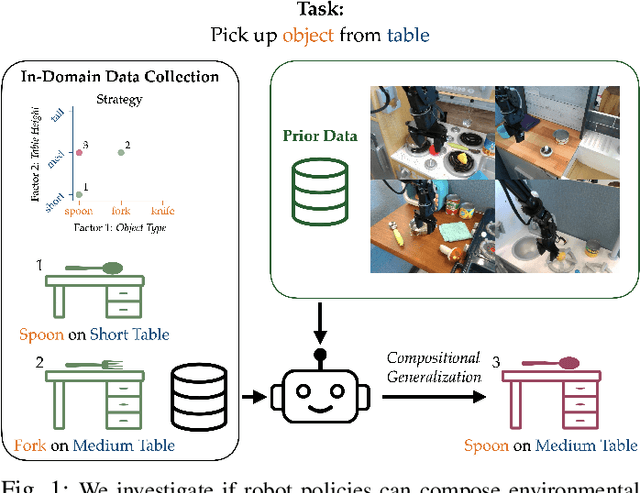
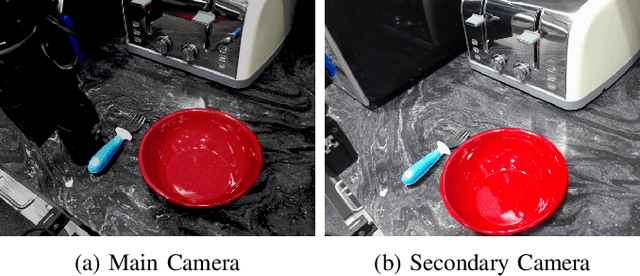
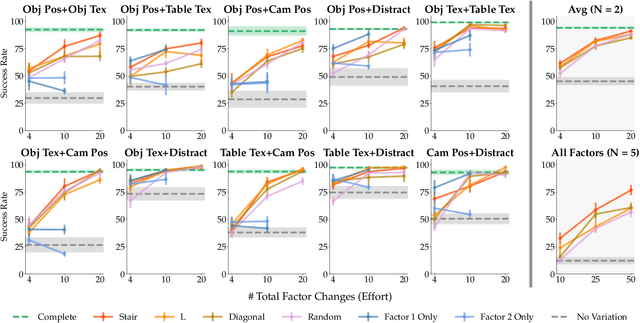
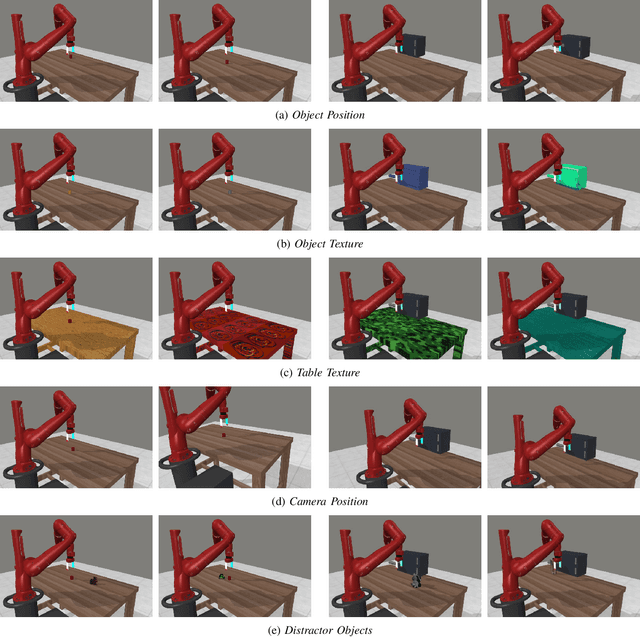
Data collection has become an increasingly important problem in robotic manipulation, yet there still lacks much understanding of how to effectively collect data to facilitate broad generalization. Recent works on large-scale robotic data collection typically vary a wide range of environmental factors during data collection, such as object types and table textures. While these works attempt to cover a diverse variety of scenarios, they do not explicitly account for the possible compositional abilities of policies trained on the data. If robot policies are able to compose different environmental factors of variation (e.g., object types, table heights) from their training data to succeed when encountering unseen factor combinations, then we can exploit this to avoid collecting data for situations that composition would address. To investigate this possibility, we conduct thorough empirical studies both in simulation and on a real robot that compare data collection strategies and assess whether visual imitation learning policies can compose environmental factors. We find that policies do exhibit composition, although leveraging prior robotic datasets is critical for this on a real robot. We use these insights to provide better practices for in-domain data collection by proposing data collection strategies that exploit composition, which can induce better generalization than naive approaches for the same amount of effort during data collection. We further demonstrate that a real robot policy trained on data from such a strategy achieves a success rate of 77.5% when transferred to entirely new environments that encompass unseen combinations of environmental factors, whereas policies trained using data collected without accounting for environmental variation fail to transfer effectively, with a success rate of only 2.5%. We provide videos at http://iliad.stanford.edu/robot-data-comp/.

RT-Sketch: Goal-Conditioned Imitation Learning from Hand-Drawn Sketches
Mar 05, 2024


Natural language and images are commonly used as goal representations in goal-conditioned imitation learning (IL). However, natural language can be ambiguous and images can be over-specified. In this work, we propose hand-drawn sketches as a modality for goal specification in visual imitation learning. Sketches are easy for users to provide on the fly like language, but similar to images they can also help a downstream policy to be spatially-aware and even go beyond images to disambiguate task-relevant from task-irrelevant objects. We present RT-Sketch, a goal-conditioned policy for manipulation that takes a hand-drawn sketch of the desired scene as input, and outputs actions. We train RT-Sketch on a dataset of paired trajectories and corresponding synthetically generated goal sketches. We evaluate this approach on six manipulation skills involving tabletop object rearrangements on an articulated countertop. Experimentally we find that RT-Sketch is able to perform on a similar level to image or language-conditioned agents in straightforward settings, while achieving greater robustness when language goals are ambiguous or visual distractors are present. Additionally, we show that RT-Sketch has the capacity to interpret and act upon sketches with varied levels of specificity, ranging from minimal line drawings to detailed, colored drawings. For supplementary material and videos, please refer to our website: http://rt-sketch.github.io.
RT-H: Action Hierarchies Using Language
Mar 04, 2024
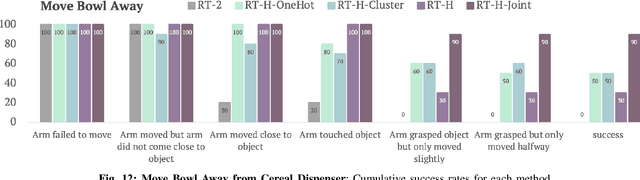
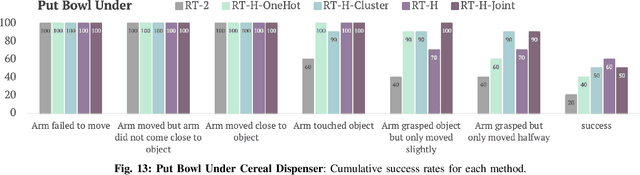

Language provides a way to break down complex concepts into digestible pieces. Recent works in robot imitation learning use language-conditioned policies that predict actions given visual observations and the high-level task specified in language. These methods leverage the structure of natural language to share data between semantically similar tasks (e.g., "pick coke can" and "pick an apple") in multi-task datasets. However, as tasks become more semantically diverse (e.g., "pick coke can" and "pour cup"), sharing data between tasks becomes harder, so learning to map high-level tasks to actions requires much more demonstration data. To bridge tasks and actions, our insight is to teach the robot the language of actions, describing low-level motions with more fine-grained phrases like "move arm forward". Predicting these language motions as an intermediate step between tasks and actions forces the policy to learn the shared structure of low-level motions across seemingly disparate tasks. Furthermore, a policy that is conditioned on language motions can easily be corrected during execution through human-specified language motions. This enables a new paradigm for flexible policies that can learn from human intervention in language. Our method RT-H builds an action hierarchy using language motions: it first learns to predict language motions, and conditioned on this and the high-level task, it predicts actions, using visual context at all stages. We show that RT-H leverages this language-action hierarchy to learn policies that are more robust and flexible by effectively tapping into multi-task datasets. We show that these policies not only allow for responding to language interventions, but can also learn from such interventions and outperform methods that learn from teleoperated interventions. Our website and videos are found at https://rt-hierarchy.github.io.
Pushing the Limits of Cross-Embodiment Learning for Manipulation and Navigation
Feb 29, 2024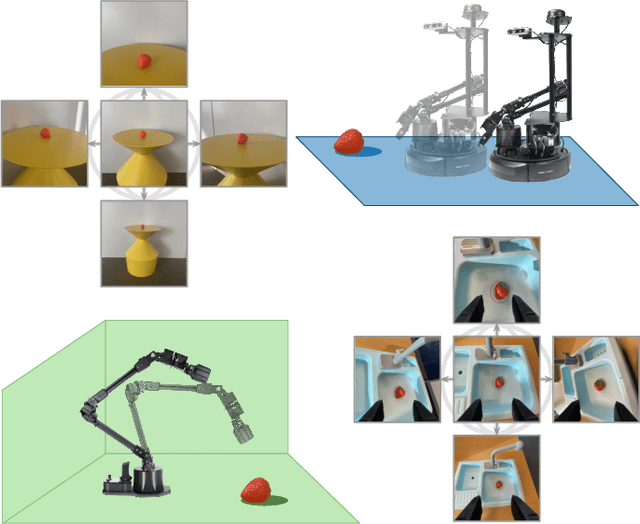
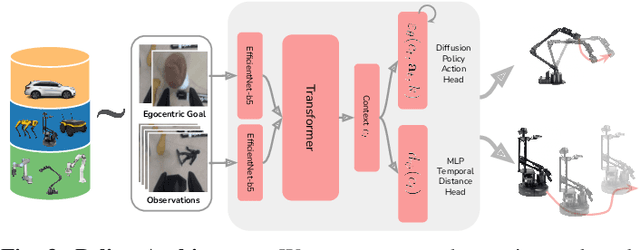
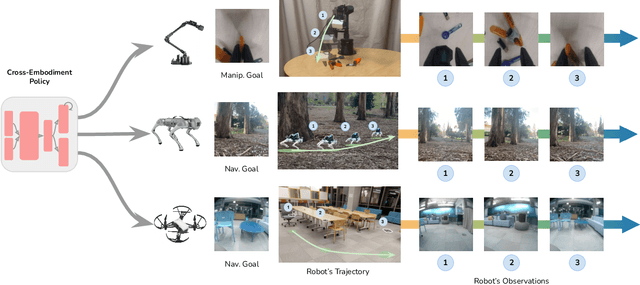

Recent years in robotics and imitation learning have shown remarkable progress in training large-scale foundation models by leveraging data across a multitude of embodiments. The success of such policies might lead us to wonder: just how diverse can the robots in the training set be while still facilitating positive transfer? In this work, we study this question in the context of heterogeneous embodiments, examining how even seemingly very different domains, such as robotic navigation and manipulation, can provide benefits when included in the training data for the same model. We train a single goal-conditioned policy that is capable of controlling robotic arms, quadcopters, quadrupeds, and mobile bases. We then investigate the extent to which transfer can occur across navigation and manipulation on these embodiments by framing them as a single goal-reaching task. We find that co-training with navigation data can enhance robustness and performance in goal-conditioned manipulation with a wrist-mounted camera. We then deploy our policy trained only from navigation-only and static manipulation-only data on a mobile manipulator, showing that it can control a novel embodiment in a zero-shot manner. These results provide evidence that large-scale robotic policies can benefit from data collected across various embodiments. Further information and robot videos can be found on our project website http://extreme-cross-embodiment.github.io.
Batch Active Learning of Reward Functions from Human Preferences
Feb 24, 2024Data generation and labeling are often expensive in robot learning. Preference-based learning is a concept that enables reliable labeling by querying users with preference questions. Active querying methods are commonly employed in preference-based learning to generate more informative data at the expense of parallelization and computation time. In this paper, we develop a set of novel algorithms, batch active preference-based learning methods, that enable efficient learning of reward functions using as few data samples as possible while still having short query generation times and also retaining parallelizability. We introduce a method based on determinantal point processes (DPP) for active batch generation and several heuristic-based alternatives. Finally, we present our experimental results for a variety of robotics tasks in simulation. Our results suggest that our batch active learning algorithm requires only a few queries that are computed in a short amount of time. We showcase one of our algorithms in a study to learn human users' preferences.
Learning to Learn Faster from Human Feedback with Language Model Predictive Control
Feb 18, 2024

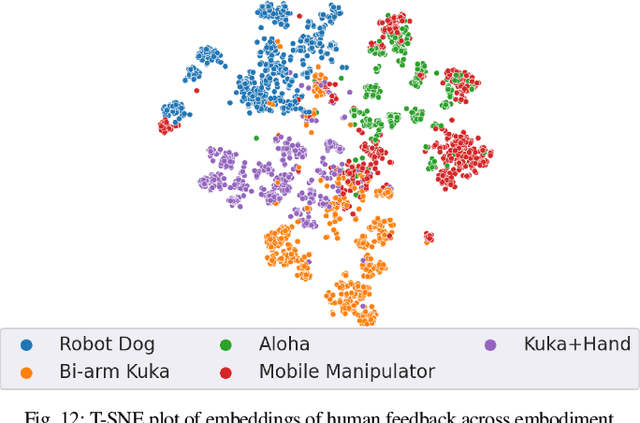

Large language models (LLMs) have been shown to exhibit a wide range of capabilities, such as writing robot code from language commands -- enabling non-experts to direct robot behaviors, modify them based on feedback, or compose them to perform new tasks. However, these capabilities (driven by in-context learning) are limited to short-term interactions, where users' feedback remains relevant for only as long as it fits within the context size of the LLM, and can be forgotten over longer interactions. In this work, we investigate fine-tuning the robot code-writing LLMs, to remember their in-context interactions and improve their teachability i.e., how efficiently they adapt to human inputs (measured by average number of corrections before the user considers the task successful). Our key observation is that when human-robot interactions are formulated as a partially observable Markov decision process (in which human language inputs are observations, and robot code outputs are actions), then training an LLM to complete previous interactions can be viewed as training a transition dynamics model -- that can be combined with classic robotics techniques such as model predictive control (MPC) to discover shorter paths to success. This gives rise to Language Model Predictive Control (LMPC), a framework that fine-tunes PaLM 2 to improve its teachability on 78 tasks across 5 robot embodiments -- improving non-expert teaching success rates of unseen tasks by 26.9% while reducing the average number of human corrections from 2.4 to 1.9. Experiments show that LMPC also produces strong meta-learners, improving the success rate of in-context learning new tasks on unseen robot embodiments and APIs by 31.5%. See videos, code, and demos at: https://robot-teaching.github.io/.
Prismatic VLMs: Investigating the Design Space of Visually-Conditioned Language Models
Feb 12, 2024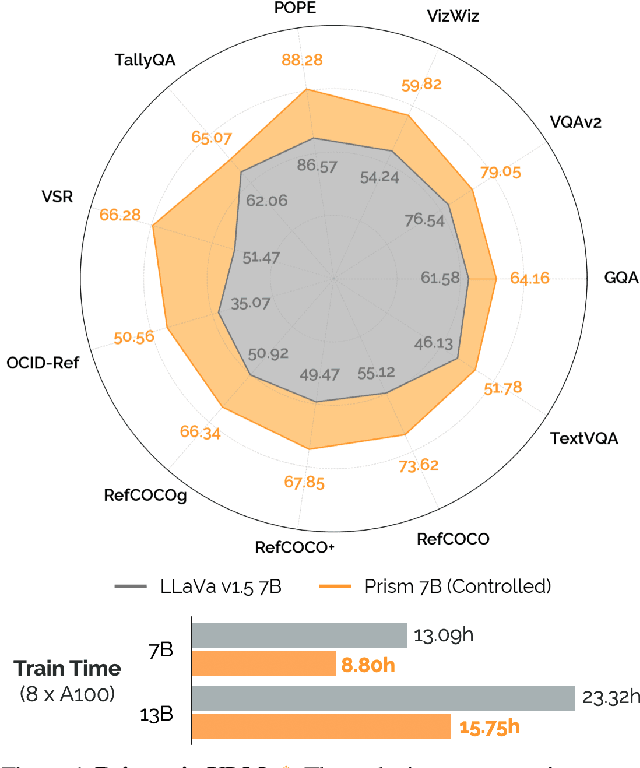
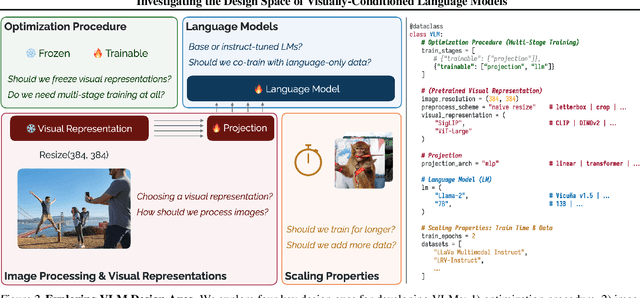
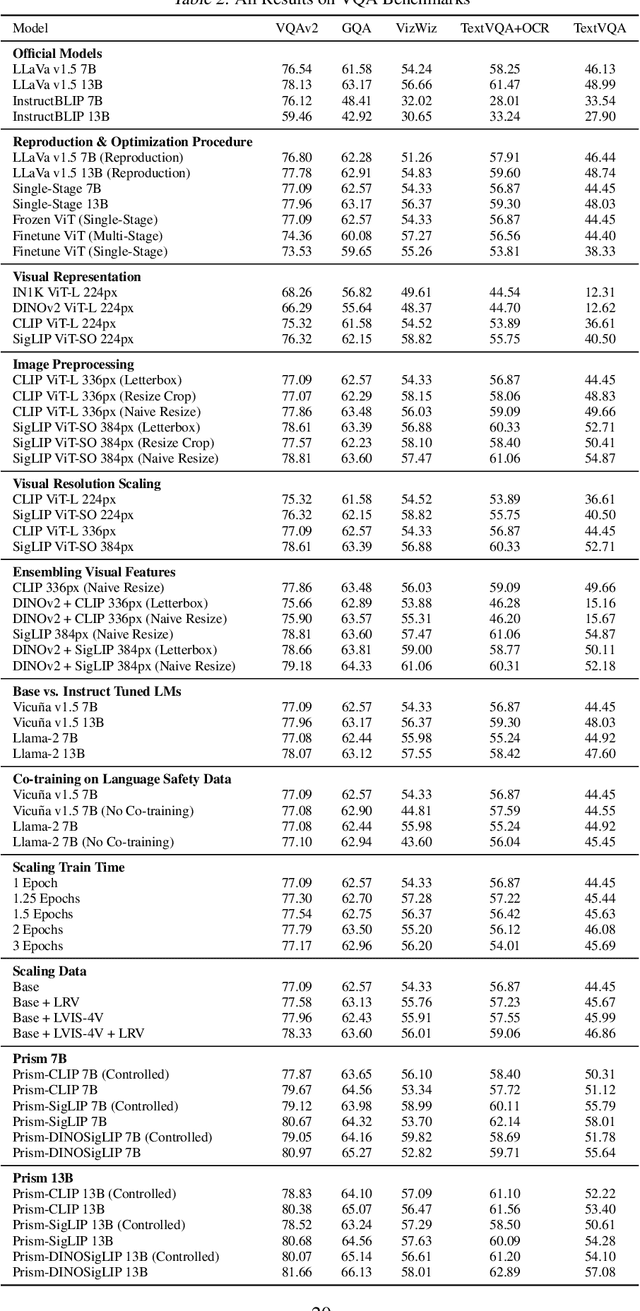
Visually-conditioned language models (VLMs) have seen growing adoption in applications such as visual dialogue, scene understanding, and robotic task planning; adoption that has fueled a wealth of new models such as LLaVa, InstructBLIP, and PaLI-3. Despite the volume of new releases, key design decisions around image preprocessing, architecture, and optimization are under-explored, making it challenging to understand what factors account for model performance $-$ a challenge further complicated by the lack of objective, consistent evaluations. To address these gaps, we first compile a suite of standardized evaluations spanning visual question answering, object localization from language, and targeted challenge sets that probe properties such as hallucination; evaluations that provide calibrated, fine-grained insight into a VLM's capabilities. Second, we rigorously investigate VLMs along key design axes, including pretrained visual representations and quantifying the tradeoffs of using base vs. instruct-tuned language models, amongst others. We couple our analysis with three resource contributions: (1) a unified framework for evaluating VLMs, (2) optimized, flexible code for VLM training, and (3) checkpoints for all models, including a family of VLMs at the 7-13B scale that strictly outperform InstructBLIP and LLaVa v1.5, the state-of-the-art in open-source VLMs.
Generative Expressive Robot Behaviors using Large Language Models
Jan 30, 2024People employ expressive behaviors to effectively communicate and coordinate their actions with others, such as nodding to acknowledge a person glancing at them or saying "excuse me" to pass people in a busy corridor. We would like robots to also demonstrate expressive behaviors in human-robot interaction. Prior work proposes rule-based methods that struggle to scale to new communication modalities or social situations, while data-driven methods require specialized datasets for each social situation the robot is used in. We propose to leverage the rich social context available from large language models (LLMs) and their ability to generate motion based on instructions or user preferences, to generate expressive robot motion that is adaptable and composable, building upon each other. Our approach utilizes few-shot chain-of-thought prompting to translate human language instructions into parametrized control code using the robot's available and learned skills. Through user studies and simulation experiments, we demonstrate that our approach produces behaviors that users found to be competent and easy to understand. Supplementary material can be found at https://generative-expressive-motion.github.io/.
AutoRT: Embodied Foundation Models for Large Scale Orchestration of Robotic Agents
Jan 23, 2024Foundation models that incorporate language, vision, and more recently actions have revolutionized the ability to harness internet scale data to reason about useful tasks. However, one of the key challenges of training embodied foundation models is the lack of data grounded in the physical world. In this paper, we propose AutoRT, a system that leverages existing foundation models to scale up the deployment of operational robots in completely unseen scenarios with minimal human supervision. AutoRT leverages vision-language models (VLMs) for scene understanding and grounding, and further uses large language models (LLMs) for proposing diverse and novel instructions to be performed by a fleet of robots. Guiding data collection by tapping into the knowledge of foundation models enables AutoRT to effectively reason about autonomy tradeoffs and safety while significantly scaling up data collection for robot learning. We demonstrate AutoRT proposing instructions to over 20 robots across multiple buildings and collecting 77k real robot episodes via both teleoperation and autonomous robot policies. We experimentally show that such "in-the-wild" data collected by AutoRT is significantly more diverse, and that AutoRT's use of LLMs allows for instruction following data collection robots that can align to human preferences.
SpatialVLM: Endowing Vision-Language Models with Spatial Reasoning Capabilities
Jan 22, 2024Understanding and reasoning about spatial relationships is a fundamental capability for Visual Question Answering (VQA) and robotics. While Vision Language Models (VLM) have demonstrated remarkable performance in certain VQA benchmarks, they still lack capabilities in 3D spatial reasoning, such as recognizing quantitative relationships of physical objects like distances or size differences. We hypothesize that VLMs' limited spatial reasoning capability is due to the lack of 3D spatial knowledge in training data and aim to solve this problem by training VLMs with Internet-scale spatial reasoning data. To this end, we present a system to facilitate this approach. We first develop an automatic 3D spatial VQA data generation framework that scales up to 2 billion VQA examples on 10 million real-world images. We then investigate various factors in the training recipe, including data quality, training pipeline, and VLM architecture. Our work features the first internet-scale 3D spatial reasoning dataset in metric space. By training a VLM on such data, we significantly enhance its ability on both qualitative and quantitative spatial VQA. Finally, we demonstrate that this VLM unlocks novel downstream applications in chain-of-thought spatial reasoning and robotics due to its quantitative estimation capability. Project website: https://spatial-vlm.github.io/