 Add to Chrome
 Add to Firefox
 Add to Edge
Fewer Tokens, Smaller Cache: Reward-Coordinated Efficient Reasoning
Aug 05, 2026
Large Reasoning Models (LRMs) excel on complex tasks through long chain-of-thought (CoT) reasoning, but their lengthy intermediate steps cause severe overthinking that inflates inference cost. KV-cache compression is a common solution, yet existing reasoning-oriented methods apply a uniform policy across the trajectory and judge compression only by what it removes from the cache. Two observations point the other way. First, a reasoning state's tolerance to context loss varies along the trajectory, and process reward tracks it: deleting tokens at high-reward steps preserves accuracy far better than deleting the same budget at random. Second, compression is not free on the generation side, since a smaller cache leads the model to generate more tokens, partly canceling the saving. Together these motivate coordinating both sides under a single process reward. We propose ReCo (Reward-Coordinated Compression), a step-wise framework in which a lightweight process-reward estimator scores each completed step and drives three components: (1) reward-adaptive KV-cache compression that shrinks the retained cache harder at high-reward steps and less at low-reward ones, (2) a reward-banded penalty on reflection tokens that curbs redundant generation, and (3) confidence-based early stopping that triggers when the reasoning is reliable. Across three reasoning models and six benchmarks, ReCo reduces generated tokens by 37%-65% and end-to-end latency by 2.08x-2.35x over Full CoT, all while largely preserving accuracy.

NoRA: Nested Low-Rank Adaptation for Efficient Fine-Tuning Large Models
Aug 18, 2024

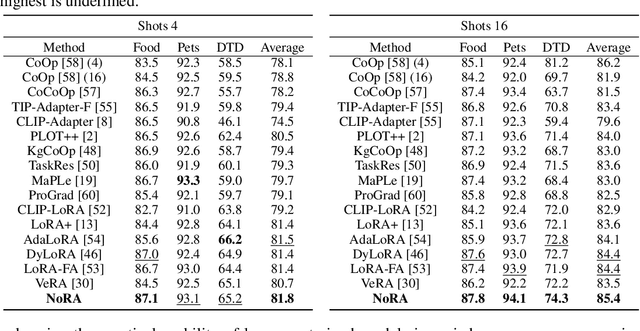

In this paper, we introduce Nested Low-Rank Adaptation (NoRA), a novel approach to parameter-efficient fine-tuning that extends the capabilities of Low-Rank Adaptation (LoRA) techniques. Vanilla LoRA overlooks pre-trained weight inheritance and still requires fine-tuning numerous parameters. To addresses these issues, our NoRA adopts a dual-layer nested structure with Singular Value Decomposition (SVD), effectively leveraging original matrix knowledge while reducing tunable parameters. Specifically, NoRA freezes the outer LoRA weights and utilizes an inner LoRA design, providing enhanced control over model optimization. This approach allows the model to more precisely adapt to specific tasks while maintaining a compact parameter space. By freezing outer LoRA weights and using an inner LoRA design, NoRA enables precise task adaptation with a compact parameter space. Evaluations on tasks including commonsense reasoning with large language models, fine-tuning vision-language models, and subject-driven generation demonstrate NoRA's superiority over LoRA and its variants. Notably, NoRA reduces fine-tuning parameters|training-time|memory-usage by 4\%|22.5\%|20.7\% compared to LoRA on LLaMA-3 8B, while achieving 2.2\% higher performance. Code will be released upon acceptance.