 Add to Chrome
 Add to Firefox
 Add to Edge
Revisiting Label Inference Attacks in Vertical Federated Learning: Why They Are Vulnerable and How to Defend
Mar 19, 2026
Vertical federated learning (VFL) allows an active party with a top model, and multiple passive parties with bottom models to collaborate. In this scenario, passive parties possessing only features may attempt to infer active party's private labels, making label inference attacks (LIAs) a significant threat. Previous LIA studies have claimed that well-trained bottom models can effectively represent labels. However, we demonstrate that this view is misleading and exposes the vulnerability of existing LIAs. By leveraging mutual information, we present the first observation of the "model compensation" phenomenon in VFL. We theoretically prove that, in VFL, the mutual information between layer outputs and labels increases with layer depth, indicating that bottom models primarily extract feature information while the top model handles label mapping. Building on this insight, we introduce task reassignment to show that the success of existing LIAs actually stems from the distribution alignment between features and labels. When this alignment is disrupted, the performance of LIAs declines sharply or even fails entirely. Furthermore, the implications of this insight for defenses are also investigated. We propose a zero-overhead defense technique based on layer adjustment. Extensive experiments across five datasets and five representative model architectures indicate that shifting cut layers forward to increase the proportion of top model layers in the entire model not only improves resistance to LIAs but also enhances other defenses.

MedMKEB: A Comprehensive Knowledge Editing Benchmark for Medical Multimodal Large Language Models
Aug 07, 2025Recent advances in multimodal large language models (MLLMs) have significantly improved medical AI, enabling it to unify the understanding of visual and textual information. However, as medical knowledge continues to evolve, it is critical to allow these models to efficiently update outdated or incorrect information without retraining from scratch. Although textual knowledge editing has been widely studied, there is still a lack of systematic benchmarks for multimodal medical knowledge editing involving image and text modalities. To fill this gap, we present MedMKEB, the first comprehensive benchmark designed to evaluate the reliability, generality, locality, portability, and robustness of knowledge editing in medical multimodal large language models. MedMKEB is built on a high-quality medical visual question-answering dataset and enriched with carefully constructed editing tasks, including counterfactual correction, semantic generalization, knowledge transfer, and adversarial robustness. We incorporate human expert validation to ensure the accuracy and reliability of the benchmark. Extensive single editing and sequential editing experiments on state-of-the-art general and medical MLLMs demonstrate the limitations of existing knowledge-based editing approaches in medicine, highlighting the need to develop specialized editing strategies. MedMKEB will serve as a standard benchmark to promote the development of trustworthy and efficient medical knowledge editing algorithms.
DatawiseAgent: A Notebook-Centric LLM Agent Framework for Automated Data Science
Mar 10, 2025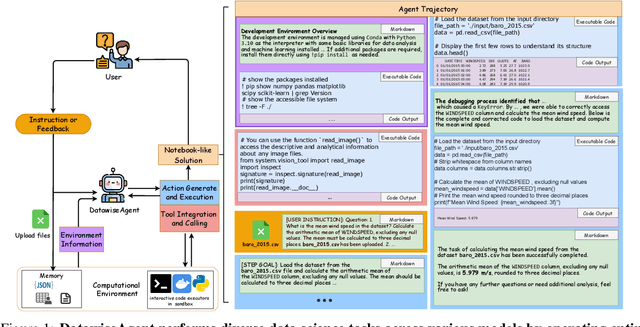

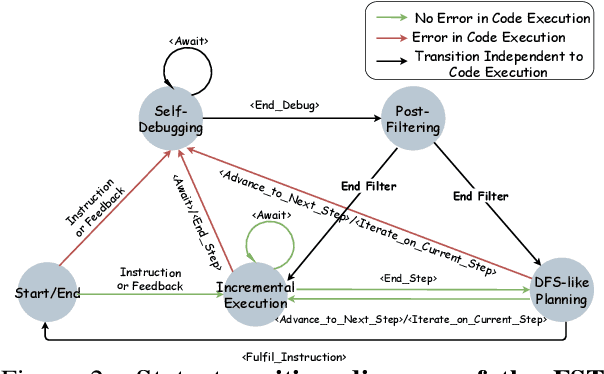
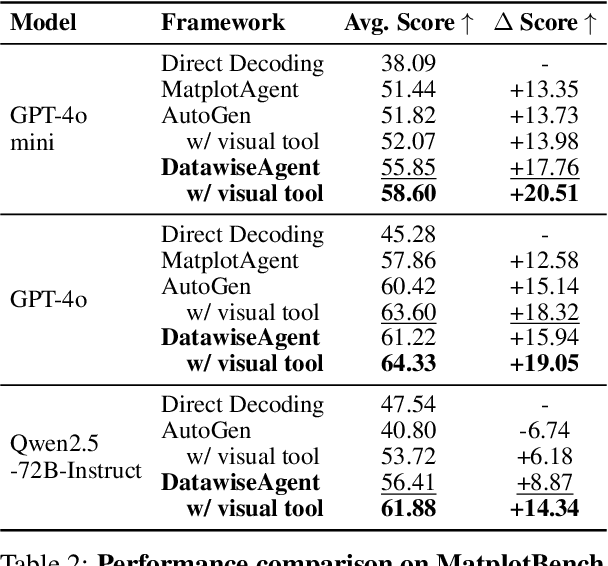
Data Science tasks are multifaceted, dynamic, and often domain-specific. Existing LLM-based approaches largely concentrate on isolated phases, neglecting the interdependent nature of many data science tasks and limiting their capacity for comprehensive end-to-end support. We propose DatawiseAgent, a notebook-centric LLM agent framework that unifies interactions among user, agent and the computational environment through markdown and executable code cells, supporting flexible and adaptive automated data science. Built on a Finite State Transducer(FST), DatawiseAgent orchestrates four stages, including DSF-like planning, incremental execution, self-debugging, and post-filtering. Specifically, the DFS-like planning stage systematically explores the solution space, while incremental execution harnesses real-time feedback and accommodates LLM's limited capabilities to progressively complete tasks. The self-debugging and post-filtering modules further enhance reliability by diagnosing and correcting errors and pruning extraneous information. Extensive experiments on diverse tasks, including data analysis, visualization, and data modeling, show that DatawiseAgent consistently outperforms or matches state-of-the-art methods across multiple model settings. These results highlight its potential to generalize across data science scenarios and lay the groundwork for more efficient, fully automated workflows.
STAMPsy: Towards SpatioTemporal-Aware Mixed-Type Dialogues for Psychological Counseling
Dec 21, 2024
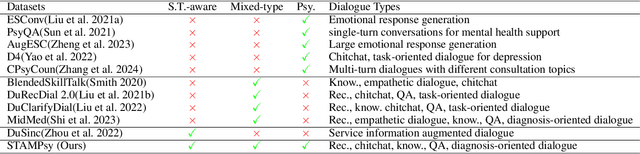


Online psychological counseling dialogue systems are trending, offering a convenient and accessible alternative to traditional in-person therapy. However, existing psychological counseling dialogue systems mainly focus on basic empathetic dialogue or QA with minimal professional knowledge and without goal guidance. In many real-world counseling scenarios, clients often seek multi-type help, such as diagnosis, consultation, therapy, console, and common questions, but existing dialogue systems struggle to combine different dialogue types naturally. In this paper, we identify this challenge as how to construct mixed-type dialogue systems for psychological counseling that enable clients to clarify their goals before proceeding with counseling. To mitigate the challenge, we collect a mixed-type counseling dialogues corpus termed STAMPsy, covering five dialogue types, task-oriented dialogue for diagnosis, knowledge-grounded dialogue, conversational recommendation, empathetic dialogue, and question answering, over 5,000 conversations. Moreover, spatiotemporal-aware knowledge enables systems to have world awareness and has been proven to affect one's mental health. Therefore, we link dialogues in STAMPsy to spatiotemporal state and propose a spatiotemporal-aware mixed-type psychological counseling dataset. Additionally, we build baselines on STAMPsy and develop an iterative self-feedback psychological dialogue generation framework, named Self-STAMPsy. Results indicate that clarifying dialogue goals in advance and utilizing spatiotemporal states are effective.