 Add to Chrome
 Add to Firefox
 Add to Edge
DenoiseFlow: Uncertainty-Aware Denoising for Reliable LLM Agentic Workflows
Feb 28, 2026
Autonomous agents are increasingly entrusted with complex, long-horizon tasks, ranging from mathematical reasoning to software generation. While agentic workflows facilitate these tasks by decomposing them into multi-step reasoning chains, reliability degrades significantly as the sequence lengthens. Specifically, minor interpretation errors in natural-language instructions tend to compound silently across steps. We term this failure mode accumulated semantic ambiguity. Existing approaches to mitigate this often lack runtime adaptivity, relying instead on static exploration budgets, reactive error recovery, or single-path execution that ignores uncertainty entirely. We formalize the multi-step reasoning process as a Noisy MDP and propose DenoiseFlow, a closed-loop framework that performs progressive denoising through three coordinated stages: (1)Sensing estimates per-step semantic uncertainty; (2)Regulating adaptively allocates computation by routing between fast single-path execution and parallel exploration based on estimated risk; and (3)Correcting performs targeted recovery via influence-based root-cause localization. Online self-calibration continuously aligns decision boundaries with verifier feedback, requiring no ground-truth labels. Experiments on six benchmarks spanning mathematical reasoning, code generation, and multi-hop QA show that DenoiseFlow achieves the highest accuracy on every benchmark (83.3% average, +1.3% over the strongest baseline) while reducing cost by 40--56% through adaptive branching. Detailed ablation studies further confirm framework-level's robustness and generality. Code is available at https://anonymous.4open.science/r/DenoiseFlow-21D3/.

DatawiseAgent: A Notebook-Centric LLM Agent Framework for Automated Data Science
Mar 10, 2025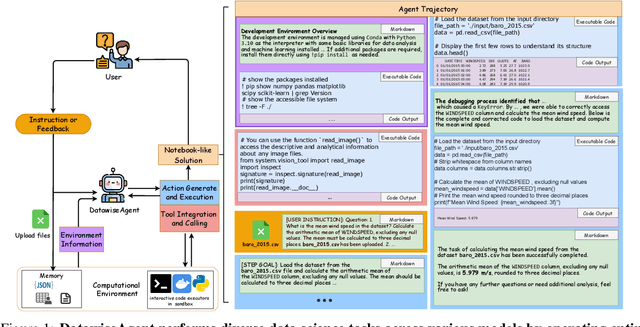

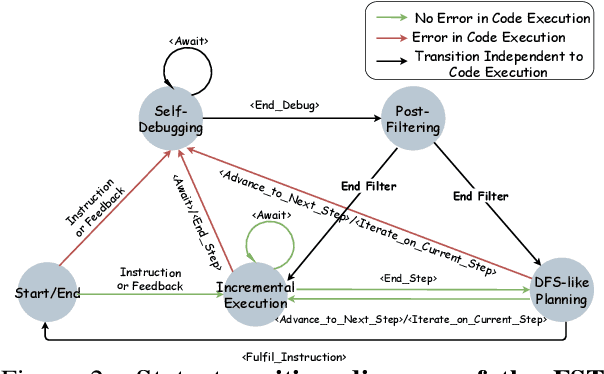
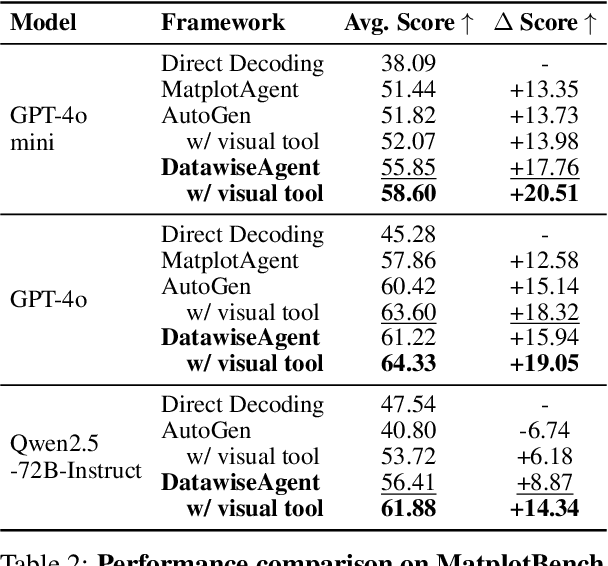
Data Science tasks are multifaceted, dynamic, and often domain-specific. Existing LLM-based approaches largely concentrate on isolated phases, neglecting the interdependent nature of many data science tasks and limiting their capacity for comprehensive end-to-end support. We propose DatawiseAgent, a notebook-centric LLM agent framework that unifies interactions among user, agent and the computational environment through markdown and executable code cells, supporting flexible and adaptive automated data science. Built on a Finite State Transducer(FST), DatawiseAgent orchestrates four stages, including DSF-like planning, incremental execution, self-debugging, and post-filtering. Specifically, the DFS-like planning stage systematically explores the solution space, while incremental execution harnesses real-time feedback and accommodates LLM's limited capabilities to progressively complete tasks. The self-debugging and post-filtering modules further enhance reliability by diagnosing and correcting errors and pruning extraneous information. Extensive experiments on diverse tasks, including data analysis, visualization, and data modeling, show that DatawiseAgent consistently outperforms or matches state-of-the-art methods across multiple model settings. These results highlight its potential to generalize across data science scenarios and lay the groundwork for more efficient, fully automated workflows.