 Add to Chrome
 Add to Firefox
 Add to Edge
PolarVSR: A Unified Framework and Benchmark for Continuous Space-Time Polarization Video Reconstruction
May 11, 2026
Polarimetric imaging captures surface polarization characteristics, such as the Degree of Linear Polarization (DoLP) and the Angle of Polarization (AoP). In mainstream Division of-Focal-Plane (DoFP) color polarization imaging, recovering polarization parameters from captured mosaic arrays remains a challenging inverse problem. Existing DoFP cameras also face hardware bottlenecks and often cannot support high-frame-rate acquisition, limiting polarimetric imaging in dynamic video tasks. These limitations motivate joint spatial and temporal enhancement. To this end, we propose the first space-time polarization video reconstruction architecture. The method jointly models polarization directions in space and time and uses a polarization-aware implicit neural representation for continuous, high-fidelity upsampling. By analyzing temporal variations in polarization parameters, we further introduce a flow-guided polarization variation loss to supervise polarization dynamics. We also establish the first large-scale color DoFP polarization video benchmark to support this research direction. Extensive experiments on this benchmark demonstrate the effectiveness of the method.

Polarization Uncertainty-Guided Diffusion Model for Color Polarization Image Demosaicking
Feb 27, 2026Color polarization demosaicking (CPDM) aims to reconstruct full-resolution polarization images of four directions from the color-polarization filter array (CPFA) raw image. Due to the challenge of predicting numerous missing pixels and the scarcity of high-quality training data, existing network-based methods, despite effectively recovering scene intensity information, still exhibit significant errors in reconstructing polarization characteristics (degree of polarization, DOP, and angle of polarization, AOP). To address this problem, we introduce the image diffusion prior from text-to-image (T2I) models to overcome the performance bottleneck of network-based methods, with the additional diffusion prior compensating for limited representational capacity caused by restricted data distribution. To effectively leverage the diffusion prior, we explicitly model the polarization uncertainty during reconstruction and use uncertainty to guide the diffusion model in recovering high error regions. Extensive experiments demonstrate that the proposed method accurately recovers scene polarization characteristics with both high fidelity and strong visual perception.
Proximity Matters: Local Proximity Preserved Balancing for Treatment Effect Estimation
Jul 01, 2024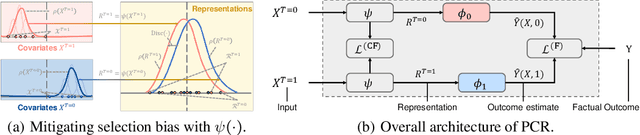



Heterogeneous treatment effect (HTE) estimation from observational data poses significant challenges due to treatment selection bias. Existing methods address this bias by minimizing distribution discrepancies between treatment groups in latent space, focusing on global alignment. However, the fruitful aspect of local proximity, where similar units exhibit similar outcomes, is often overlooked. In this study, we propose Proximity-aware Counterfactual Regression (PCR) to exploit proximity for representation balancing within the HTE estimation context. Specifically, we introduce a local proximity preservation regularizer based on optimal transport to depict the local proximity in discrepancy calculation. Furthermore, to overcome the curse of dimensionality that renders the estimation of discrepancy ineffective, exacerbated by limited data availability for HTE estimation, we develop an informative subspace projector, which trades off minimal distance precision for improved sample complexity. Extensive experiments demonstrate that PCR accurately matches units across different treatment groups, effectively mitigates treatment selection bias, and significantly outperforms competitors. Code is available at https://anonymous.4open.science/status/ncr-B697.
FreDF: Learning to Forecast in Frequency Domain
Feb 04, 2024Time series modeling is uniquely challenged by the presence of autocorrelation in both historical and label sequences. Current research predominantly focuses on handling autocorrelation within the historical sequence but often neglects its presence in the label sequence. Specifically, emerging forecast models mainly conform to the direct forecast (DF) paradigm, generating multi-step forecasts under the assumption of conditional independence within the label sequence. This assumption disregards the inherent autocorrelation in the label sequence, thereby limiting the performance of DF-based models. In response to this gap, we introduce the Frequency-enhanced Direct Forecast (FreDF), which bypasses the complexity of label autocorrelation by learning to forecast in the frequency domain. Our experiments demonstrate that FreDF substantially outperforms existing state-of-the-art methods including iTransformer and is compatible with a variety of forecast models.