 Add to Chrome
 Add to Firefox
 Add to Edge
RigPI: Dynamic Parameter Identification of Rigid Body via VLM-Seeded Differentiable Simulation
Jun 25, 2026
Accurate physical parameter identification of manipulated objects is fundamental to advanced robotic manipulation and the construction of faithful digital twins. However, acquiring physically consistent inertial and frictional properties from real-world interactions remains challenging due to sensing noise, modeling errors, and limited prior knowledge. This paper presents RigPI, a systematic framework for identifying dynamic parameters of both unconstrained rigid bodies and multi-link rigid bodies during robot-object interaction. RigPI integrates vision-based semantic priors, force-torque measurements, and motion observations within a differentiable simulation pipeline. A vision-language model (VLM) provides informed initialization and a constrained search space, while gradient information from a differentiable physics simulator enables efficient and stable parameter refinement. The proposed two-stage optimization strategy alleviates sensitivity to noise and avoids physically implausible solutions. Extensive real-world experiments on objects with revolute and prismatic joints demonstrate that RigPI achieves accurate and stable parameter estimates, and successfully reproduces manipulation trajectories on a real robot with parameter-aware predictive validity. These results highlight the effectiveness and robustness of RigPI for real-world robotic system identification tasks.

MISID: A Multimodal Multi-turn Dataset for Complex Intent Recognition in Strategic Deception Games
Apr 14, 2026Understanding human intent in complex multi-turn interactions remains a fundamental challenge in human-computer interaction and behavioral analysis. While existing intent recognition datasets focus mainly on single utterances or simple dialogues, real-world scenarios often involve sophisticated strategic interactions where participants must maintain complex deceptive narratives over extended periods. To address this gap, we introduce MISID, a comprehensive multimodal, multi-turn, and multi-participant benchmark for intent recognition. Sourced from high-stakes social strategy games, MISID features a fine-grained, two-tier multi-dimensional annotation scheme tailored for long-context discourse analysis and evidence-based causal tracking. Our systematic evaluation of state-of-the-art Multimodal Large Language Models (MLLMs) on MISID reveals critical deficiencies in complex scenarios, including text-prior visual hallucination, impaired cross-modal synergy, and limited capacity in chaining causal cues. Consequently, we propose FRACTAM as a baseline framework. Using a ``Decouple-Anchor-Reason'' paradigm, FRACTAM reduces text bias by extracting pure unimodal factual representations, employs two-stage retrieval for long-range factual anchoring, and constructs explicit cross-modal evidence chains. Extensive experiments demonstrate that FRACTAM enhances mainstream models' performance in complex strategic tasks, improving hidden intent detection and inference while maintaining robust perceptual accuracy. Our dataset is available at https://naislab.cn/datasets/MISID.
Using Deep Neural Networks to Automate Large Scale Statistical Analysis for Big Data Applications
Aug 09, 2017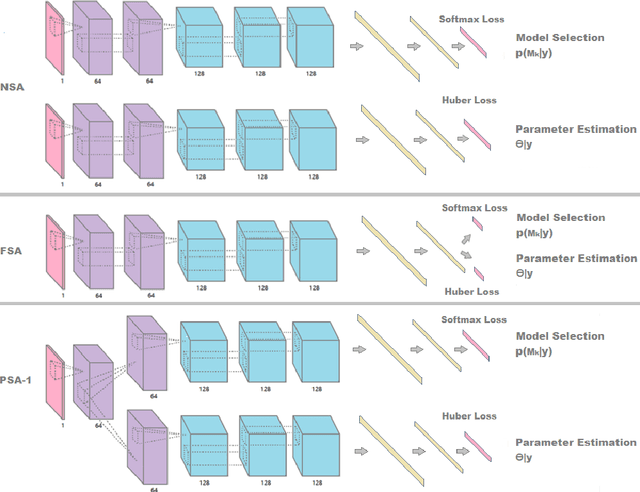

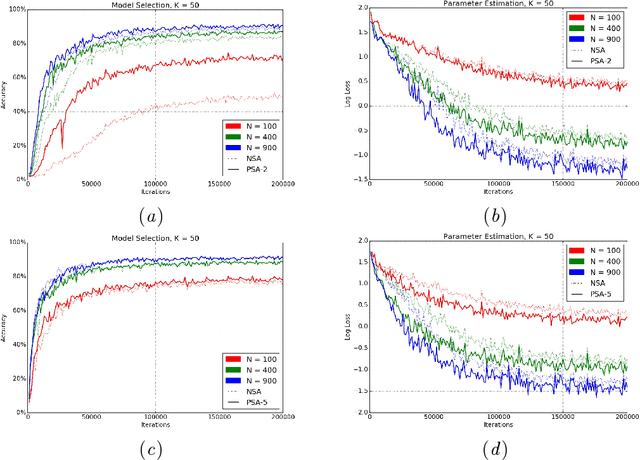
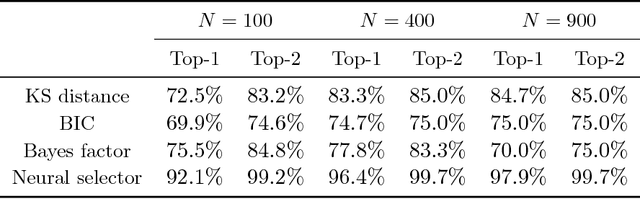
Statistical analysis (SA) is a complex process to deduce population properties from analysis of data. It usually takes a well-trained analyst to successfully perform SA, and it becomes extremely challenging to apply SA to big data applications. We propose to use deep neural networks to automate the SA process. In particular, we propose to construct convolutional neural networks (CNNs) to perform automatic model selection and parameter estimation, two most important SA tasks. We refer to the resulting CNNs as the neural model selector and the neural model estimator, respectively, which can be properly trained using labeled data systematically generated from candidate models. Simulation study shows that both the selector and estimator demonstrate excellent performances. The idea and proposed framework can be further extended to automate the entire SA process and have the potential to revolutionize how SA is performed in big data analytics.