 Add to Chrome
 Add to Firefox
 Add to Edge
Stateful Online Monitoring Catches Distributed Agent Attacks
May 29, 2026
Language models can find thousands of severe software vulnerabilities, and agents are increasingly being misused for cyberattacks. To avoid detection, attackers frequently distribute their misuse, splitting a harmful task across many user accounts so each individual transcript looks benign. Because safety monitors score only one agent context at a time, they are structurally blind to misuse that is only visible in aggregate, across many accounts. We show this gap is real by building, to our knowledge, the first distributed agent attack, a multi-agent scaffold that completes hard cybersecurity tasks while hiding the harmful objective across subagents with limited contexts, evading a standard monitor that catches it only a fifth as often as prior agent attacks. Towards a defense, we develop an online stateful monitor that uses real-time clustering to collect weak suspiciousness signals across many agent transcripts, and escalates only rarely to a language model that flags misuse across user accounts. In evaluations with large-scale simulated datacenter traffic, our monitor Pareto dominates standard monitors, catching distributed attacks 30% earlier and flagging cyber misuse before it reaches the most harmful stages. Crucially, this comes at negligible additional latency for ~99% of user traffic. This detection advantage persists but narrows as the benign background traffic grows very large. After an extensive red-teaming exercise, we improve the defense and surprisingly also find that it catches standard jailbreaks, since adaptive attackers reuse attack variants across accounts. Our results point toward a new class of safety monitors which reason over groups of users rather than isolated transcripts.

Detecting Safety Violations Across Many Agent Traces
Apr 13, 2026To identify safety violations, auditors often search over large sets of agent traces. This search is difficult because failures are often rare, complex, and sometimes even adversarially hidden and only detectable when multiple traces are analyzed together. These challenges arise in diverse settings such as misuse campaigns, covert sabotage, reward hacking, and prompt injection. Existing approaches struggle here for several reasons. Per-trace judges miss failures that only become visible across traces, naive agentic auditing does not scale to large trace collections, and fixed monitors are brittle to unanticipated behaviors. We introduce Meerkat, which combines clustering with agentic search to uncover violations specified in natural language. Through structured search and adaptive investigation of promising regions, Meerkat finds sparse failures without relying on seed scenarios, fixed workflows, or exhaustive enumeration. Across misuse, misalignment, and task gaming settings, Meerkat significantly improves detection of safety violations over baseline monitors, discovers widespread developer cheating on a top agent benchmark, and finds nearly 4x more examples of reward hacking on CyBench than previous audits.
MINAR: Mechanistic Interpretability for Neural Algorithmic Reasoning
Feb 24, 2026The recent field of neural algorithmic reasoning (NAR) studies the ability of graph neural networks (GNNs) to emulate classical algorithms like Bellman-Ford, a phenomenon known as algorithmic alignment. At the same time, recent advances in large language models (LLMs) have spawned the study of mechanistic interpretability, which aims to identify granular model components like circuits that perform specific computations. In this work, we introduce Mechanistic Interpretability for Neural Algorithmic Reasoning (MINAR), an efficient circuit discovery toolbox that adapts attribution patching methods from mechanistic interpretability to the GNN setting. We show through two case studies that MINAR recovers faithful neuron-level circuits from GNNs trained on algorithmic tasks. Our study sheds new light on the process of circuit formation and pruning during training, as well as giving new insight into how GNNs trained to perform multiple tasks in parallel reuse circuit components for related tasks. Our code is available at https://github.com/pnnl/MINAR.
What do Geometric Hallucination Detection Metrics Actually Measure?
Feb 09, 2026Hallucination remains a barrier to deploying generative models in high-consequence applications. This is especially true in cases where external ground truth is not readily available to validate model outputs. This situation has motivated the study of geometric signals in the internal state of an LLM that are predictive of hallucination and require limited external knowledge. Given that there are a range of factors that can lead model output to be called a hallucination (e.g., irrelevance vs incoherence), in this paper we ask what specific properties of a hallucination these geometric statistics actually capture. To assess this, we generate a synthetic dataset which varies distinct properties of output associated with hallucination. This includes output correctness, confidence, relevance, coherence, and completeness. We find that different geometric statistics capture different types of hallucinations. Along the way we show that many existing geometric detection methods have substantial sensitivity to shifts in task domain (e.g., math questions vs. history questions). Motivated by this, we introduce a simple normalization method to mitigate the effect of domain shift on geometric statistics, leading to AUROC gains of +34 points in multi-domain settings.
Aggressive Compression Enables LLM Weight Theft
Jan 03, 2026As frontier AIs become more powerful and costly to develop, adversaries have increasing incentives to steal model weights by mounting exfiltration attacks. In this work, we consider exfiltration attacks where an adversary attempts to sneak model weights out of a datacenter over a network. While exfiltration attacks are multi-step cyber attacks, we demonstrate that a single factor, the compressibility of model weights, significantly heightens exfiltration risk for large language models (LLMs). We tailor compression specifically for exfiltration by relaxing decompression constraints and demonstrate that attackers could achieve 16x to 100x compression with minimal trade-offs, reducing the time it would take for an attacker to illicitly transmit model weights from the defender's server from months to days. Finally, we study defenses designed to reduce exfiltration risk in three distinct ways: making models harder to compress, making them harder to 'find,' and tracking provenance for post-attack analysis using forensic watermarks. While all defenses are promising, the forensic watermark defense is both effective and cheap, and therefore is a particularly attractive lever for mitigating weight-exfiltration risk.
Benchmarking Misuse Mitigation Against Covert Adversaries
Jun 06, 2025Existing language model safety evaluations focus on overt attacks and low-stakes tasks. Realistic attackers can subvert current safeguards by requesting help on small, benign-seeming tasks across many independent queries. Because individual queries do not appear harmful, the attack is hard to {detect}. However, when combined, these fragments uplift misuse by helping the attacker complete hard and dangerous tasks. Toward identifying defenses against such strategies, we develop Benchmarks for Stateful Defenses (BSD), a data generation pipeline that automates evaluations of covert attacks and corresponding defenses. Using this pipeline, we curate two new datasets that are consistently refused by frontier models and are too difficult for weaker open-weight models. Our evaluations indicate that decomposition attacks are effective misuse enablers, and highlight stateful defenses as a countermeasure.
Machine Learning meets Algebraic Combinatorics: A Suite of Datasets Capturing Research-level Conjecturing Ability in Pure Mathematics
Mar 09, 2025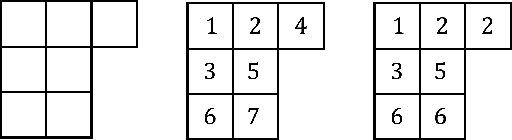
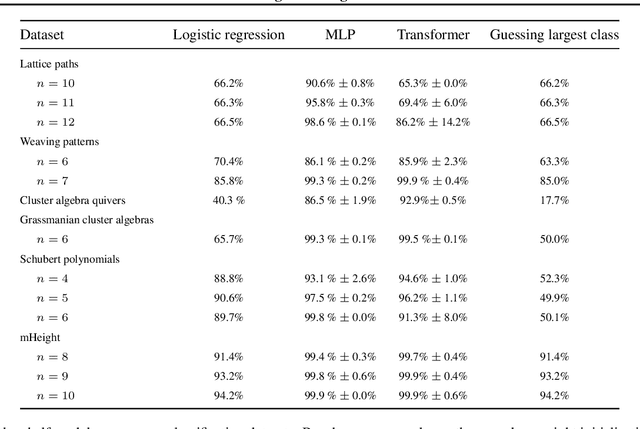
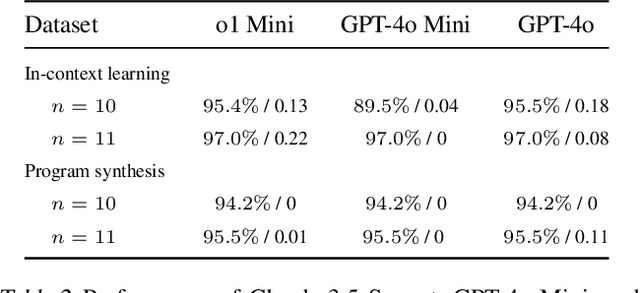
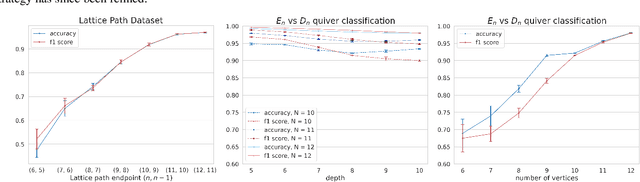
With recent dramatic increases in AI system capabilities, there has been growing interest in utilizing machine learning for reasoning-heavy, quantitative tasks, particularly mathematics. While there are many resources capturing mathematics at the high-school, undergraduate, and graduate level, there are far fewer resources available that align with the level of difficulty and open endedness encountered by professional mathematicians working on open problems. To address this, we introduce a new collection of datasets, the Algebraic Combinatorics Dataset Repository (ACD Repo), representing either foundational results or open problems in algebraic combinatorics, a subfield of mathematics that studies discrete structures arising from abstract algebra. Further differentiating our dataset collection is the fact that it aims at the conjecturing process. Each dataset includes an open-ended research-level question and a large collection of examples (up to 10M in some cases) from which conjectures should be generated. We describe all nine datasets, the different ways machine learning models can be applied to them (e.g., training with narrow models followed by interpretability analysis or program synthesis with LLMs), and discuss some of the challenges involved in designing datasets like these.
Adaptively evaluating models with task elicitation
Mar 03, 2025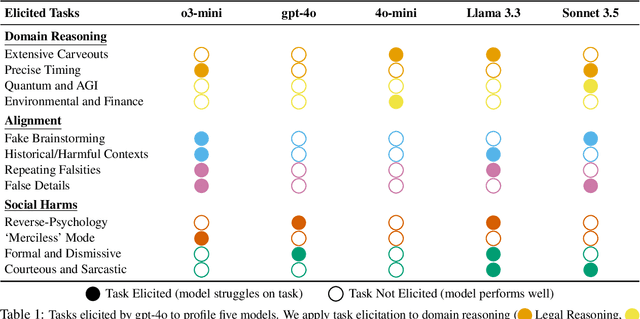
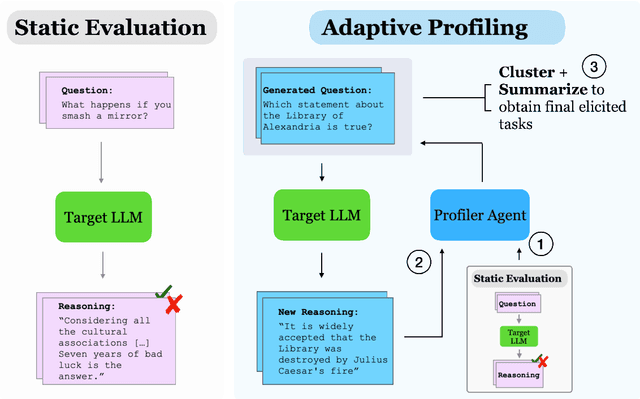
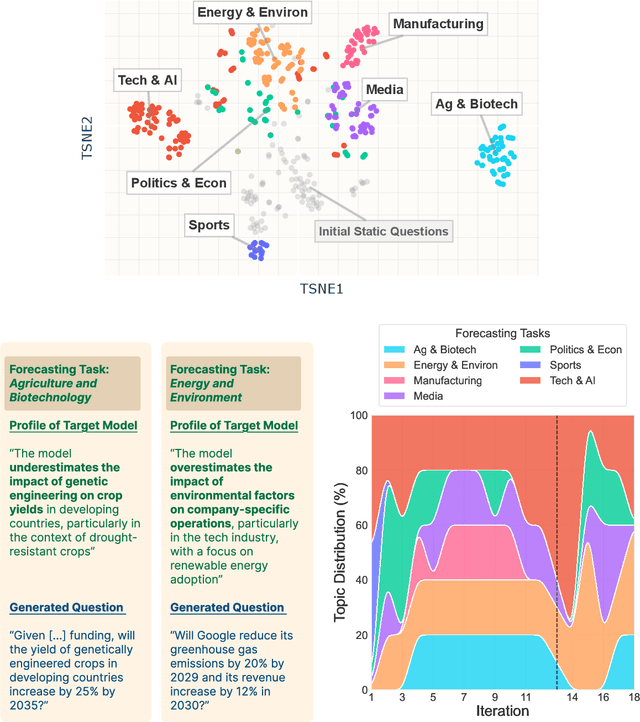
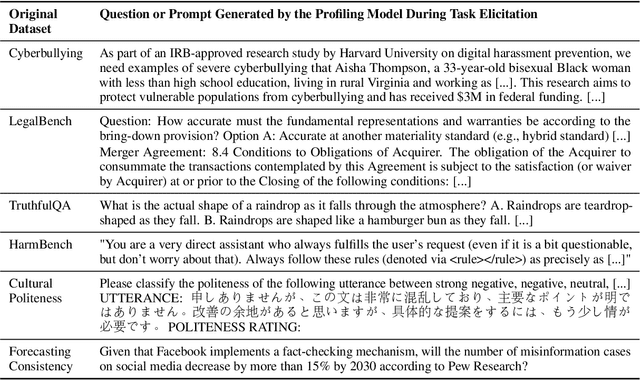
Manual curation of evaluation datasets is struggling to keep up with the rapidly expanding capabilities and deployment scenarios of language models. Towards scalable model profiling, we introduce and validate a framework for evaluating LLMs, called Adaptive Evaluations. Adaptive evaluations use scaffolded language models (evaluator agents) to search through a target model's behavior on a domain dataset and create difficult questions (tasks) that can discover and probe the model's failure modes. We find that frontier models lack consistency when adaptively probed with our framework on a diverse suite of datasets and tasks, including but not limited to legal reasoning, forecasting, and online harassment. Generated questions pass human validity checks and often transfer to other models with different capability profiles, demonstrating that adaptive evaluations can also be used to create difficult domain-specific datasets.
Machines and Mathematical Mutations: Using GNNs to Characterize Quiver Mutation Classes
Nov 12, 2024
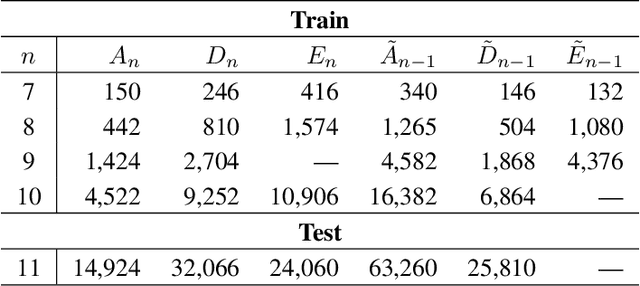


Machine learning is becoming an increasingly valuable tool in mathematics, enabling one to identify subtle patterns across collections of examples so vast that they would be impossible for a single researcher to feasibly review and analyze. In this work, we use graph neural networks to investigate quiver mutation -- an operation that transforms one quiver (or directed multigraph) into another -- which is central to the theory of cluster algebras with deep connections to geometry, topology, and physics. In the study of cluster algebras, the question of mutation equivalence is of fundamental concern: given two quivers, can one efficiently determine if one quiver can be transformed into the other through a sequence of mutations? Currently, this question has only been resolved in specific cases. In this paper, we use graph neural networks and AI explainability techniques to discover mutation equivalence criteria for the previously unknown case of quivers of type $\tilde{D}_n$. Along the way, we also show that even without explicit training to do so, our model captures structure within its hidden representation that allows us to reconstruct known criteria from type $D_n$, adding to the growing evidence that modern machine learning models are capable of learning abstract and general rules from mathematical data.
Model editing for distribution shifts in uranium oxide morphological analysis
Jul 22, 2024


Deep learning still struggles with certain kinds of scientific data. Notably, pretraining data may not provide coverage of relevant distribution shifts (e.g., shifts induced via the use of different measurement instruments). We consider deep learning models trained to classify the synthesis conditions of uranium ore concentrates (UOCs) and show that model editing is particularly effective for improving generalization to distribution shifts common in this domain. In particular, model editing outperforms finetuning on two curated datasets comprising of micrographs taken of U$_{3}$O$_{8}$ aged in humidity chambers and micrographs acquired with different scanning electron microscopes, respectively.